How to Create a Children’s Book: Step-by-Step Guide
So, you have a brilliant idea for a children's book. That's fantastic. But turning that spark into a book that kids will beg to read again and again takes more than just a great story. It's a journey through four distinct phases: understanding who you're writing for, actually writing the story, bringing it to life with art, and finally, getting it into the hands of young readers.
Let's walk through it together.
Getting to Know the Children's Book World
Before you even think about your main character's name, you need to do a little reconnaissance. The children's book market isn't a single, monolithic thing. It’s a collection of unique neighborhoods, each designed for a specific age group with its own rules, language, and expectations. Knowing which neighborhood your story belongs in is the first, most crucial step.
And it's a bustling market to enter. The global children's picture book space was valued at around $6.07 billion and is expected to climb past $10.2 billion by 2035. What's driving this? Parents are more invested than ever in the power of early literacy, creating a huge appetite for books that both teach and delight. You can find more market data and trend analysis on what's behind this growth.
Who Is This Book For?
I've seen so many aspiring authors make the same mistake: they try to write a book for "all children." It’s a noble thought, but it just doesn't work. A book that captivates a 3-year-old will be completely different from one that an 8-year-old can't put down.
Deciding on your target age group is your compass. It will guide everything—the words you choose, the complexity of your plot, and even the style of the illustrations. A board book for a toddler might only have one or two words per page with bold, simple images. A picture book for a 5-year-old, on the other hand, needs a beginning, a middle, and a satisfying end. These details matter. A lot.
If you are still deciding which age you are writing for, our guide to choosing children's books by age is a useful sanity check on what actually lands with each group.
This infographic gives you a quick visual of the market share breakdown by age.
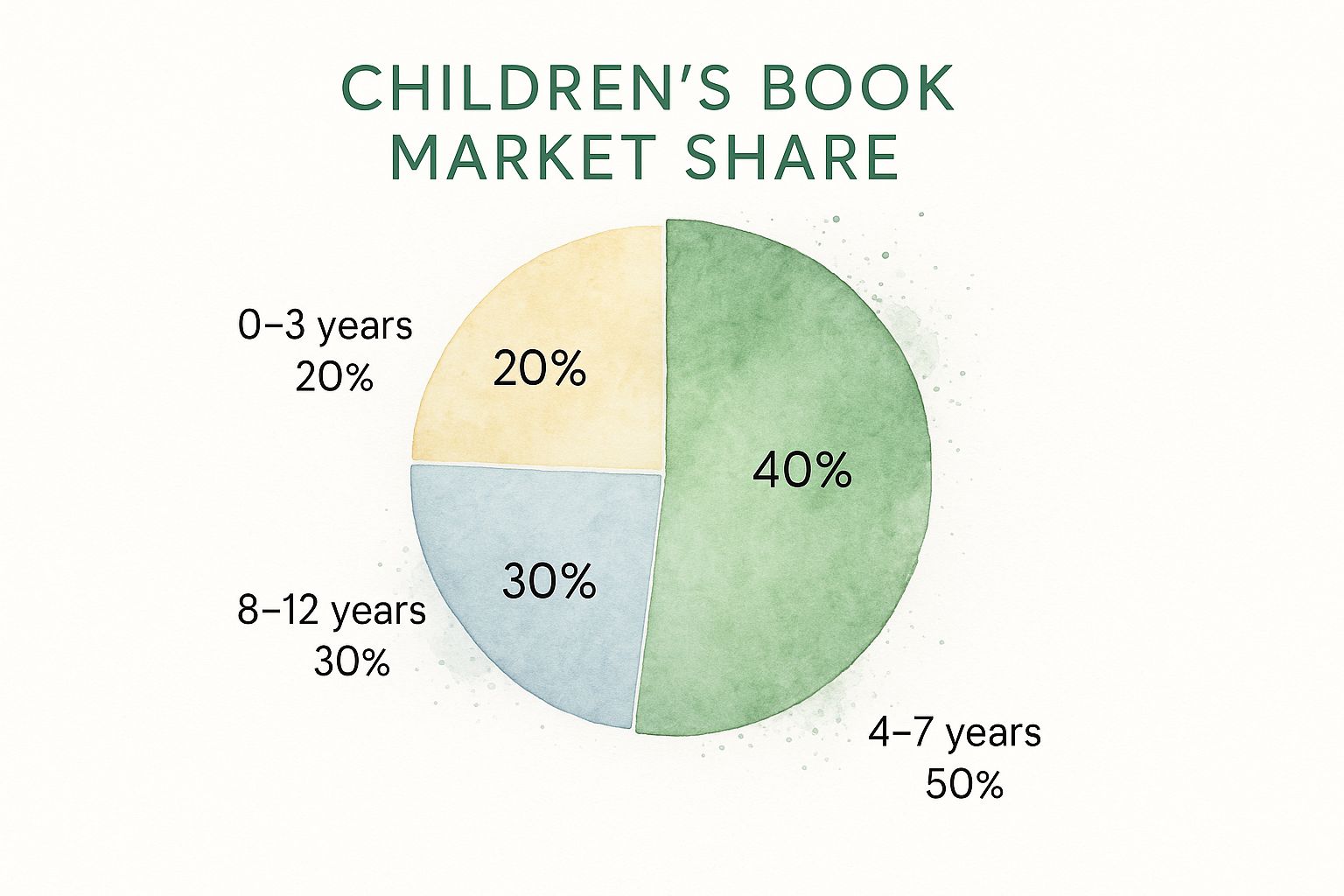
As you can see, that 4–7 age range is the biggest piece of the pie. It's a crowded field, for sure, but also one with a massive, hungry audience if you can get it right.
To help you pinpoint where your idea fits, here's a quick cheat sheet I put together that breaks down the common age categories.
Children's Book Age Categories at a Glance
This table is a great starting point for understanding the range. It lays out the typical expectations for word count, themes, and formats for each major group, helping you align your story with the right readers from the very beginning.
| Category | Target Age | Typical Word Count | Key Features |
|---|---|---|---|
| Board Books | 0-3 years | 0-300 words | Durable pages, simple concepts (colors, shapes, animals), high-contrast images, rhythmic text. |
| Picture Books | 3-8 years | 300-1,000 words | Story told through text and illustrations working together. Strong narrative arc, relatable characters, and clear themes. |
| Early Readers | 5-9 years | 1,000-2,500 words | Designed for kids learning to read independently. Simple sentences, repetitive vocabulary, often chapter-based. |
| Chapter Books | 7-10 years | 5,000-15,000 words | Text is the primary storyteller. More complex plots, character development, broken into short chapters. Illustrations are sparse. |
| Middle Grade | 8-12 years | 25,000-55,000 words | Deeper themes of friendship, identity, and adventure. Complex characters and subplots. No illustrations typically. |
Seeing it laid out like this really highlights how different each category is. A story meant for a 10-year-old just won't work in a 500-word picture book format, and vice versa. Use this as your guide to make sure your story's structure matches its audience.
What Readers and Publishers Want Right Now
Beyond just hitting the right age and word count, you have to know what's resonating with today's readers. The books flying off the shelves—and catching the eyes of agents and editors—often have a few things in common.
- Diverse and Inclusive Representation: Kids need to see themselves and their peers in the books they read. Stories featuring characters from all backgrounds, abilities, and family structures are not just wanted; they're essential.
- Emotional Intelligence and Big Themes: Don't be afraid to tackle big feelings. Books that gently explore topics like empathy, anxiety, kindness, or loss give parents and educators a tool to start important conversations.
- A Strong, Unique Voice: Is your story hilariously funny? Is it quiet and poetic? Whatever it is, own it. A memorable voice is what makes a book stand out in a crowded bookstore.
- Interactive and Engaging Elements: Think rhyme, rhythm, and repetition. Anything that invites a child to chant along, predict what's next, or answer a question makes the reading experience more active and fun.
A great children's book doesn't just entertain; it connects. It serves as a mirror in which a child can see themselves and a window into worlds they have yet to imagine.
Look, this research isn't about chasing trends. It's about developing an instinct for what works. The best thing you can do is go to your local library or bookstore. Spend an afternoon in the children's section. Read the new releases for the age group you're targeting. Ask yourself what makes them work. This hands-on homework is invaluable for creating a book that truly finds its home.
Developing Your Unforgettable Story Idea
Every great children's book starts with a spark. It's rarely a fully-formed, earth-shattering concept. More often, it’s a feeling, a question, or a simple moment of wonder that you just can't shake. This is the true beginning of your journey. Forget about perfection for now; the goal is to find a little seed of an idea and give it room to grow into a real narrative.
Think of this phase as pure creative play. Don't edit yourself. Don't worry about the final product. Just let your mind wander, try to see the world through a child's eyes, and start collecting the raw materials that will eventually become your story.
Finding Your Core Concept
Inspiration is everywhere if you're open to it. The most powerful story ideas often come from the simplest, most universal human experiences. Start by looking at your own life and the world right outside your door.
- Dig into your own memories. Was there a funny moment from your childhood you'll never forget? A specific fear you had to overcome? A beloved family tradition? These personal experiences are story gold because the emotions are already baked in.
- Be an observer. Go to a park and just watch kids play. Listen to their wonderfully unfiltered conversations. What makes them erupt in giggles? What problems are they trying to solve in their games? A single, overheard interaction can easily spark a character or an entire plot.
- Tap into universal themes. Think about the big moments in a small person's life: making a new friend, the first day of school, learning to share, being brave in the dark. Taking one of these timeless themes and giving it your own fresh spin is a tried-and-true recipe for a story that connects.
Take author DeMario Pressley, for example. His family’s love for birds sparked the idea for his main character. He saw birds as tiny symbols of freedom and resilience, which became the emotional heart of his story about a small but brave song sparrow named Ace.
Crafting a Character Kids Will Love
Once you have that flicker of an idea, you need a character to bring it to life. A memorable character is the soul of any good children's book. They're the one the child will root for, laugh with, and remember long after the book is closed. The secret is to make them relatable, even if they happen to be a talking teacup or a grumpy badger.
A truly magnetic character needs a few key ingredients:
- A clear desire: What does your character want more than anything else in the world? This single desire is the engine that drives your plot. Maybe a little dragon wants to breathe fire but can only manage to sneeze bubbles.
- A relatable flaw or fear: Let's be honest, perfect characters are boring. A flaw—like being hopelessly clumsy, terribly impatient, or scared of the water—makes them feel real. It also gives them a hurdle to overcome.
- A distinct personality: Is your main character a total goofball, a quiet observer, a brave adventurer? Giving them a defining personality trait shapes how they react to every challenge and makes them feel like a unique individual.
The real magic isn't just about what a character looks like, but what they feel. You have to show their joy, their worry, their pride, and their fear, often with just a few carefully chosen words and expressive illustrations.
Struggling to bring your character to life? Modern tools can be a fantastic help here. At LoveToRead.ai, you can get personalized stories within seconds. You can convert your real-life photos into characters, making your child the hero of their own story. What truly sets it apart is the ability to create a library of these characters to reuse across a variety of different stories, ensuring perfect character persistence across a wide range of art styles. Plus, you can easily order any book as a beautiful hardback copy.
The illustration side deserves its own decision. We compared the options in our roundup of tools for children's book illustrations.
Structuring Your Simple, Satisfying Plot
With a compelling character and a core idea, it's time to build the plot. For picture books, you don't need anything complicated. The classic three-act structure is your best friend: a beginning, a middle, and an end.
- The Beginning: This is where you introduce your character and their world. We need to see what they want and understand the central problem or conflict they're facing right away.
- The Middle: Here's where the action ramps up. Your character tries to solve their problem, but things don't go as planned. They might try and fail a couple of times, learning a little something with each attempt. This is the heart of the journey.
- The End: Your character finally has a breakthrough! They figure out how to solve their problem, leading to a satisfying resolution. They've achieved their goal and, in the process, have grown or changed in some small but meaningful way.
Getting the Words on the Page
You’ve got a fantastic idea and a character you can’t wait for the world to meet. Now, it's time to actually write the thing. This is the part where you pull that brilliant world out of your head and shape it into words, creating an experience that will make a child want to hear it again and again.
Writing for kids is a special kind of magic. It’s about finding that sweet spot between simplicity and meaning, where every single word matters. Remember, you're not just writing a story; you're often writing a script that a parent or teacher will perform for a young audience.
Finding the Right Voice for Little Ears
The number one rule? Write for the age group you’re targeting. The words and sentence patterns that work for a 3-year-old are worlds away from what a 7-year-old can grasp. This means keeping your sentences tight, using language that’s easy to picture, and steering clear of abstract ideas that might go right over their heads.
Think of your manuscript as half of the final product. The illustrations will do the other half of the heavy lifting. You don't need to describe every last detail in a character's bedroom; focus on the feelings and actions that push the story forward. Trust that your illustrator will bring the visual world to life.
A great way to make your story sing is by using literary tools that kids naturally love.
- Rhythm and Rhyme: A story with a nice, bouncy cadence is just plain fun to read aloud. It also helps kids remember their favorite parts.
- Repetition: Kids adore knowing what's coming next. Repeating a key phrase or a silly sound gives them a chance to join in, making storytime interactive. Think of the classic "I'll huff, and I'll puff…"
- Onomatopoeia: Sound words like thump, buzz, and giggle add a layer of sensory fun that pulls a child deeper into the story.
The revision process is where a good story becomes a great one. It’s not about fixing mistakes; it’s about discovering what the story truly wants to be.
Nailing that first draft feels great, but it’s only the first step. The real work—and where the story truly comes alive—happens when you start to revise and polish.
The Art of Polishing: Revision and Feedback
Once that first draft is done, put it away. Seriously. Don't look at it for a few days, maybe even a whole week. This little bit of distance is crucial. When you come back to it, you'll have fresh eyes to catch clunky sentences, confusing moments, or pacing that feels a bit off.
Your most powerful editing tool is your own voice. Read your entire manuscript out loud. I can’t stress this enough. You will instantly hear where the rhythm falters or where a line of dialogue just doesn't sound right. If a sentence makes you stumble, you can bet it will trip up a parent at bedtime.
After you've done a few passes on your own, it’s time to be brave and get some outside perspective.
- Critique Groups: Find a group of fellow writers, preferably others who also write for children. They speak the language of the craft and can give you specific, helpful feedback on everything from plot to word choice.
- Beta Readers: These are your test audience. Share your story with parents, librarians, and teachers. Most importantly, read it to kids in your target age group. Pay close attention to their reactions. Do they lean in? Do their eyes light up? Do they start wiggling halfway through? Their honest, unfiltered responses are pure gold.
This feedback is what will elevate your manuscript. It helps you step outside your own head and see the story through your reader’s eyes, showing you what connects and what needs a little more work. It’s a collaborative dance, even when you're the only one writing.
Bringing Your Story to Life with Illustrations
If the manuscript is the heart of your children's book, the illustrations are its soul. They don't just decorate the page; they tell half the story. Great art is what pulls a child into the world you've created, conveying all the emotion, action, and wonder that words sometimes can't capture. This is the magical step where your words on a page begin to breathe.
There are a few ways to tackle this, and the path you choose will define the look and feel of your book. You can illustrate it yourself, hire a professional to bring your vision to life, or even use some of the powerful new tools available to generate your own art. There's no single "right" answer—it's all about what works for your skills, budget, and the story you want to tell.
Choosing Your Illustration Path
How you get your book illustrated is a huge decision, one that will shape your timeline, your budget, and the final book that ends up in a child's hands. Let's break down the main options.
- Illustrating It Yourself: Got some artistic chops? Doing the art yourself gives you ultimate control. Every brush stroke and color choice will be yours, ensuring the visuals are a perfect match for the story in your head. The trade-off? It's a massive time commitment and requires a real knack for visual storytelling, from character design to pacing the art across the pages.
- Hiring a Professional Illustrator: Bringing an experienced artist on board can elevate your project to a whole new level. They're professionals for a reason—they know how to make a page-turn exciting and create characters that leap off the page. The challenge is finding the right collaborator whose style fits your story and learning how to communicate your vision clearly.
- Using AI Illustration Tools: This is a real opening for writers who aren't artists. Modern technology now makes it possible for anyone to generate beautiful, consistent illustrations without needing to draw a single line or spend a fortune hiring someone.
This decision is happening within a healthy and growing children's book market, where much of the growth is fueled by digital and interactive formats that get kids hooked on reading from an early age. If you want to dig deeper, you can learn more about the trends in the children's books market to see where the industry is heading.
Working with a Professional Illustrator
If you go the traditional route and hire an artist, your first job is to play matchmaker. Platforms like Upwork, Fiverr, and even a quick search on Instagram can uncover a deep pool of illustration talent.
The key is to find someone whose style sings in harmony with your story. A goofy, laugh-out-loud book needs a quirky, energetic art style. A quiet, gentle bedtime story, on the other hand, calls for soft, dreamy visuals.
Once you’ve found your artist, you need to create a solid creative brief. This isn't just a suggestion; it's the blueprint for your entire collaboration.
Your creative brief should have everything the artist needs to see inside your head. Include the full manuscript, detailed character descriptions (their quirks, their favorite outfits), notes on key scenes, and even a mood board with examples of illustration styles you love.
A thorough brief prevents so much back-and-forth later. It gets you and your illustrator on the same page from the very beginning, empowering them to create the world you've been imagining.
The Power of AI in Creating Illustrations
For so many aspiring authors, this is the part where the dream stalls. What if you can't draw? And what if you don't have thousands to spend on a professional illustrator? This is exactly where AI tools are completely changing the picture.
Platforms like LoveToRead.ai were built for this very problem. You can generate personalized stories within seconds and convert your real-life photos into characters. Create a library of characters to reuse across a variety of different stories, leveraging a broad library of art styles and steady character consistency. It’s the creative freedom of doing it yourself mixed with the quality of a pro, but without the steep learning curve or high cost. Best of all, when you're done, you can easily order any hardback copy, transforming your digital creation into a beautiful physical book to be cherished for years.
Navigating Your Path to Publication
So, your manuscript is polished, the illustrations are sparkling, and your children's book is finally done. Take a moment to celebrate that—it’s a huge accomplishment to bring an idea all the way to a finished story. Now, you’re standing at the threshold of the most exciting part: getting your book into the hands of young readers.

This is where you decide how your creation will meet the world. Broadly speaking, you have two roads ahead: traditional publishing and self-publishing. Each one has its own unique mix of opportunities and challenges. There’s no single "best" way—only the way that fits your goals, your resources, and your timeline.
Exploring the Traditional Publishing Route
This is the path many writers dream of: partnering with an established publishing house like Penguin Random House or Simon & Schuster. It comes with the prestige of professional validation, an expert team to guide you, and access to widespread distribution networks. Getting your foot in that door, however, is a game of patience and persistence.
For children's book authors, the journey almost always begins with finding a literary agent. Why? Because most major publishers won't even look at manuscripts that come directly from an author. An agent becomes your champion and business partner, using their industry know-how to pitch your book to the right editors at the right publishing houses.
Here’s a bird’s-eye view of what that looks like:
- Querying Agents: You'll spend time researching agents who represent books like yours. Then you'll craft a query letter—a professional pitch that summarizes your story and introduces you as an author—and send it out.
- The Publishing Deal: If an agent loves your work and successfully sells it to a publisher, you’ll be offered a contract. This usually comes with an advance (a payment against future royalties) and a set royalty percentage for every copy sold.
- The Trade-Off: In return for their financial investment, the publisher takes the reins on things like cover design, marketing strategy, and final editorial changes. You gain a professional team but give up a significant amount of creative control.
The traditional publishing process is a marathon, not a sprint. Timelines can easily stretch over two years from signing a contract to seeing your book on a shelf. It’s a world built on professional partnerships and industry expertise.
Taking Control with Self-Publishing
If you choose to self-publish, you’re the one in the driver's seat. You are the publisher. This means you manage every single step of the process, from formatting the interior files and designing the cover to marketing and distribution. The payoff? Complete creative freedom and a much, much faster timeline to get your book out into the world.
Of course, with this freedom comes great responsibility. You’ll be funding the entire project yourself, and it’s on you to make sure the final book is up to professional standards. This often means hiring your own team of freelancers—editors, illustrators, designers, and formatters—if those skills aren't in your wheelhouse.
The self-publishing world is evolving fast. The children's publishing market is projected to hit USD 13.18 billion by 2033, but the picture is complex. While overall print sales have seen a slight dip, digital and interactive formats are exploding. E-books and audiobooks have seen staggering growth, with some segments jumping by over 52.8% in a single year. You can dive deeper into these evolving market dynamics to see where readers are headed. This digital shift is a massive opportunity for indie authors to connect directly with a global audience.
Bridging the Gap from Digital to Physical
Let’s be honest—for many of us, the real dream is to hold a physical copy of our book. There's just nothing like turning the pages of a story you brought to life. This is where modern tools can make all the difference, especially for creators who want the control of self-publishing without the logistical headaches.
Platforms like LoveToRead.ai are built to close this gap. You can generate personalized stories in seconds, convert your real-life photos into characters, create a library of reusable characters, and access a wide catalog of art styles with strong character consistency. The platform makes the final step simple: you can easily order a high-quality hardback copy of any book you create, right from the site. This process removes the complexity of printing and lets you focus on creating, giving you a direct path to a beautiful, professionally printed copy you can share.
Your Top Questions About Making a Children's Book, Answered
Jumping into creating a children's book is a thrilling adventure, but it’s totally normal to have a million questions buzzing around your head. It's one part creative magic, one part practical logistics. Let's clear the air and tackle some of the most common questions I hear from aspiring authors.
How Long Should a Picture Book Be?
You'll hear one number over and over again in the children's book world: 32 pages. This isn't just an arbitrary suggestion; it's a practical standard based on how books are printed. Printers work with large sheets of paper that get folded and cut, so working in multiples of eight (like 16, 24, or 32) is the most economical way to do it.
But the page count is only half the story. The real challenge is the word count. Most picture books fall somewhere between 400 and 800 words. Your job is to tell a captivating story concisely, leaving plenty of room for the illustrations to do the heavy lifting. Every single word has to earn its spot on the page.
Do I Really Need an Agent to Get Published?
If your goal is to see your book on a shelf with a logo from one of the big publishing houses, then yes, you almost certainly need an agent. Think of a literary agent as your champion in an industry that's notoriously difficult to break into. They have the relationships to get your manuscript past the gatekeepers and onto the right editor's desk.
That said, an agent isn't the only way to get published. Plenty of smaller, independent presses are happy to look at submissions directly from authors. And if you decide to self-publish, you're the boss—no agent required.
Is It Okay to Use AI for My Book's Illustrations?
Absolutely. In fact, using AI for illustrations has opened the door for so many authors, especially those who can't draw a stick figure to save their lives. It really levels the playing field, giving you access to professional-grade artwork without needing to be an artist yourself.
This is a huge shift in how children's books get made. Instead of spending a small fortune and months collaborating with a traditional illustrator, AI tools can help you generate stunning visuals in a consistent style. It puts you, the writer, in complete creative control of your book's look and feel from start to finish.
Using AI isn't about replacing human creativity. It's about giving you a new tool to bring your vision to life, no matter your artistic skill level.
What's the Real Cost to Self-Publish a Children's Book?
This is the classic "it depends" question. The cost can swing wildly, from just a few hundred dollars to well over $10,000. It all comes down to what you're willing to do yourself versus what you hire out to professionals.
Here’s a realistic look at where the money goes:
- Illustrations: This is typically the biggest chunk of the budget. A professional illustrator can easily charge $3,000 to $12,000+ for a standard 32-page book. An AI tool, on the other hand, can slash this cost dramatically.
- Editing: Don't skip this. A good editor is worth their weight in gold and will save you from embarrassing mistakes. Budget at least a few hundred dollars for a solid professional edit.
- Design and Formatting: You'll need someone to design a great cover and lay out the book's interior so it's ready for printing. This can also run you several hundred dollars.
- Printing: The good news is you can use print-on-demand services. This avoids the massive upfront investment of buying thousands of copies. You only pay for books as customers order them.
By being smart about your choices—handling some tasks yourself and using cost-effective tools for others—you can create a polished, high-quality book without breaking the bank. That's the beauty of the indie route.
Ready to bring your own story to life without the high costs and complexities? LoveToRead.ai makes it simple. You can generate personalized stories in seconds, convert your real-life photos into unique characters, and maintain perfect character persistence across every page. With our platform, you get access to a full range of art styles and can easily order a beautiful hardback copy of your creation. Start creating your personalized children's book today at https://lovetoread.ai/.
Article created using Outrank