A Guide to character creator for stories: Build Characters
We've all seen it happen. That moment a child's eyes light up when they see a favorite character pop up in a new book. It's magic. But as any teacher knows, creating that magic consistently is a huge challenge. A modern character creator for stories, especially one with a bit of AI smarts, can be a game-changer for K-5 educators. It’s all about creating those unique, reusable characters that kids connect with, which in turn helps their reading skills blossom.
Why Consistent Characters Matter in The Classroom
For kids in kindergarten through 5th grade, a familiar face makes a world of difference. When "Leo the Lion" or "Rosie the Robot" shows up again and again, it creates a sense of comfort and stability. This isn't just about fun; it's about learning. That predictability lets children focus their brainpower on the new vocabulary or math concept you're teaching, instead of spending energy figuring out who the new characters are.
Let's be honest, though—in a real classroom, keeping that consistency is tough. You grab images from here and there, and suddenly your main character looks a little different on every single page. That visual hiccup can be surprisingly jarring for a young reader. It can pull them right out of the story and interrupt the flow of the lesson. What we're aiming for is a seamless learning experience, and a visually consistent character is a surprisingly important piece of that puzzle.
The Power of a Reusable Character Library
This is exactly where a dedicated character creator for stories completely shifts the dynamic for teachers and parents. Forget about starting from scratch for every worksheet or storybook. You can build your own library of custom characters, ready to jump into a new adventure at a moment's notice.
- It pulls them in: Kids really do form bonds with these recurring characters. That emotional connection gets them more invested in the story and, by extension, the lesson inside it.
- It saves you time (a lot of it): Design a character once, and they're yours to use forever. This cuts out hours of searching for illustrations that kinda look alike.
- It helps them understand: When a child already knows a character, they can better predict how they'll act and what motivates them. This deepens their understanding of the story itself.
Think of it this way: you're not just making a bunch of one-off stories. You're building a reliable, friendly world where learning feels like catching up with an old friend. That's the kind of connection that helps build a lifelong love of reading.
Ultimately, having a tool that keeps your characters looking the same from page to page sets the stage for more powerful, memorable teaching. With a platform like LovetoRead.ai, you can generate personalized stories within seconds. What sets it apart is the ability to convert your real life photos into characters, build a library of characters to reuse across a variety of different stories, and access the absolute best art styles with incredible character persistence. Plus, you can easily order any hardback copy of a story you create.
Designing Your First Storybook Character
Before you even think about opening a character creator, let's talk about the heart of your story: your character's purpose. Every great character, whether it's a brave little knight or a quirky talking pencil, needs a reason to exist that connects directly to your lesson.
Start by asking, "What's the big idea I want my students to grasp?" Is it a tricky science concept? A new math skill? Maybe a lesson about empathy?
Imagine you're teaching a unit on botany. You could create "Sammie the Seed," a tiny seed who is a little nervous but also super excited about the journey of growing into a big, strong plant. Right there, you have a personality and a built-in story arc that perfectly mirrors your curriculum.
Defining Core Personality Traits
With your core concept in place, it's time to sprinkle in some personality. Young readers don't need a character with a complicated backstory; they connect with a few strong, memorable traits. A little trick I’ve found incredibly effective is to pair a primary trait with a slightly contradictory one. It makes them feel more real.
Think about combinations like these:
- Brave but shy: Eager for adventure but gets quiet around new friends.
- Curious but clumsy: A master of asking "why?" but constantly bumping into things.
- Clever but impatient: Brilliant at solving puzzles but hates waiting for the answer.
These simple pairings add a layer of depth that kids instantly get. Saying "Leo the Lion is super strong, but he's also afraid of thunderstorms" makes him so much more interesting than if he were just strong.
Translating Ideas into Visuals
Now, let's get those ideas ready for the drawing board—or in this case, the AI. You need to translate your character's personality into clear visual cues. This is the information you'll feed into a character creator to bring your vision to life. Be specific, but keep it simple enough for a five-year-old to recognize in a heartbeat.
Focus on a few key features that will never change. Does your character always wear a bright yellow raincoat? Do they have big, round glasses? Maybe a pair of zany purple antennae? These visual anchors are absolutely essential for keeping your character looking consistent from one page—and one story—to the next.
Pro Tip: When writing your prompt for an AI tool, think of it as a short, clear recipe. For example: "A friendly cartoon robot for a 5-year-old. The robot is bright blue with one big, curious eye and a happy smile. It has wheels instead of feet and is holding a magnifying glass."
Following this path, from a simple idea to a concrete character, sets you up for stories that truly resonate.
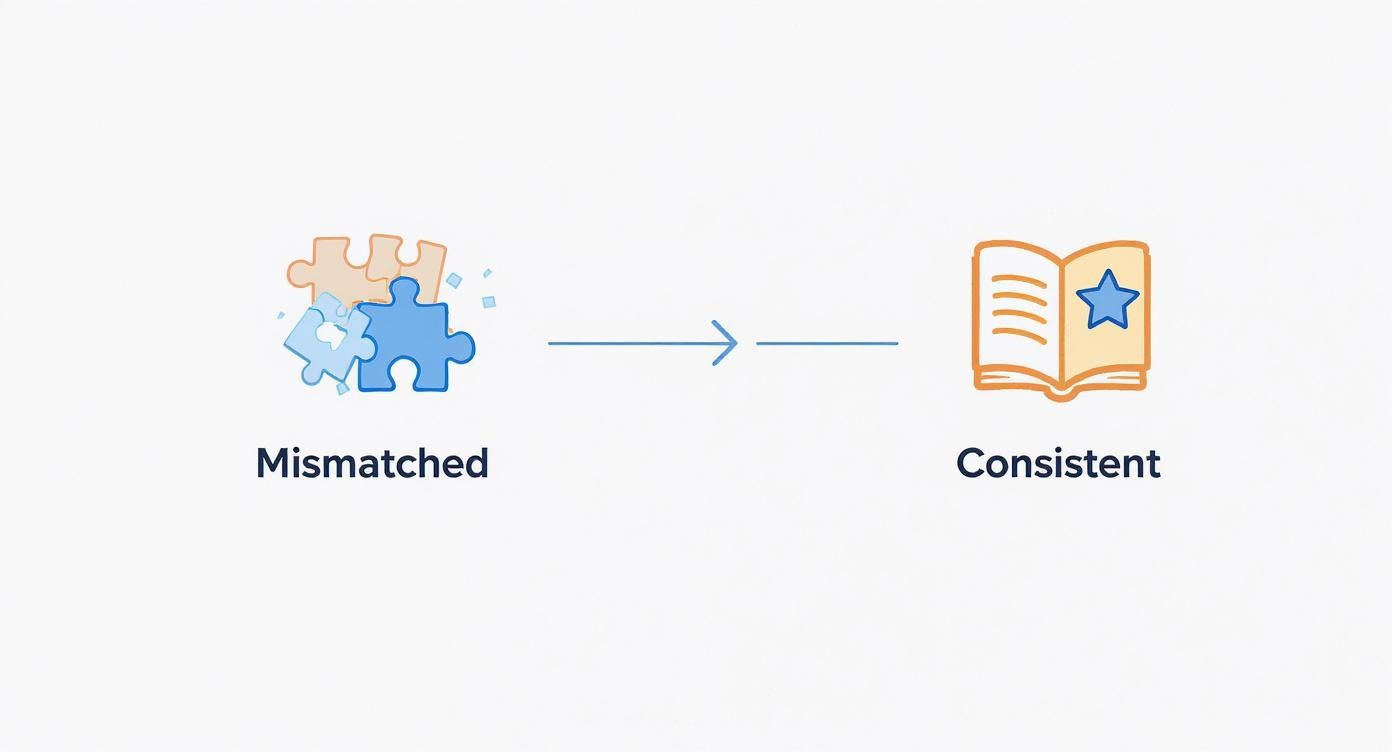
As you can see, a well-defined character isn't just a nice-to-have; it's the key to unlocking a powerful and cohesive learning experience for your students.
When you're ready to make it happen, a tool like LovetoRead.ai can take these descriptions and generate your character in seconds. The platform really shines when it comes to creating beautiful characters with the absolute best art styles and offers incredible character persistence. This means you can build a whole library of your own unique characters and reuse them in countless stories, knowing they'll always look exactly right. You can even convert real-life photos into characters, which is a fantastic way to make your students the heroes of their own learning adventures.
Maintaining Visual Consistency Across Every Story
One of the biggest headaches when creating a series of custom books is getting a character to look the same from one page to the next. For young readers, this isn't a small detail. Visual consistency is the glue that holds the story together in their minds. If a character suddenly looks different, it can jolt a child right out of the world you’ve built.
This is where character persistence comes in. It’s the ability to bring back the exact same character, flawlessly, across multiple adventures. This one feature makes the difference between a random collection of stories and a cohesive, believable world that kids will want to visit over and over.
The Power of Reusing Your Characters
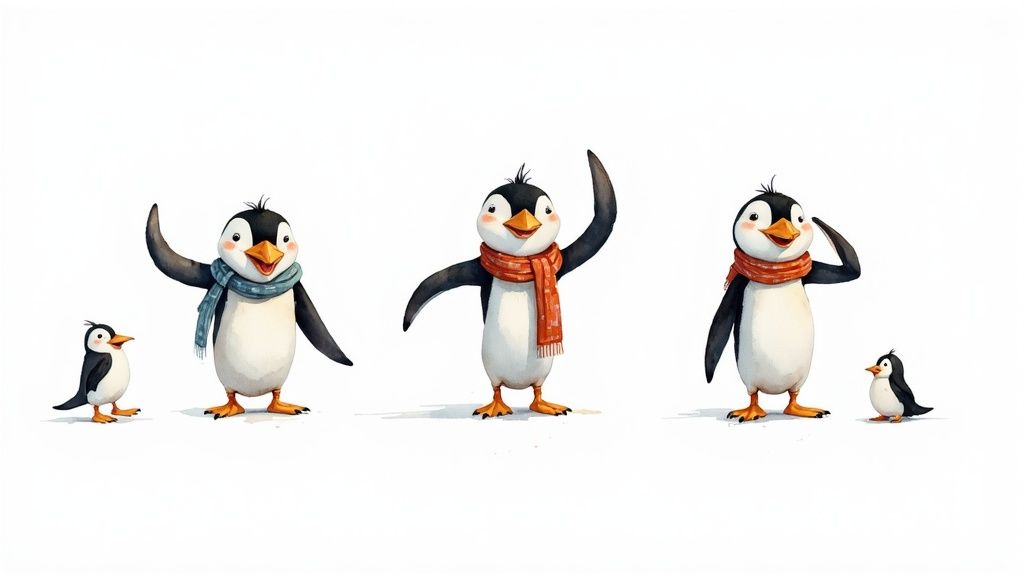
Let’s say you’ve created a fantastic new character, ‘Pip the Penguin.’ With a good character creator for stories, you can drop Pip into dozens of different scenarios. Today, he’s climbing a snowy mountain to learn about subtraction. Tomorrow, he’s on a sunny beach teaching a lesson about friendship.
In every single story, Pip is Pip. His scarf is the same shade of red, his eyes have that same friendly twinkle, and his posture is instantly recognizable. This consistency builds a real bond between the child and the character. Each new story feels like catching up with an old friend—something that’s nearly impossible to achieve by hunting for mismatched stock photos that only kind of look like Pip.
The demand for these kinds of tools is growing rapidly. The 3D avatar creator market, a key segment of character creation, was valued at $572.3 million in 2023 and is projected to reach $2,216.6 million by 2033. This surge is driven by a desire for more personalized and lifelike digital experiences. You can discover more insights about the growth of the 3D avatar creator market.
Comparing Old vs New Character Creation Methods
Before tools like this existed, creating consistent characters was a real chore. Let’s break down how the old-school approach stacks up against modern AI. The difference in both effort and quality is pretty staggering.
| Feature | Traditional Method (e.g., Stock Images, Manual Drawing) | AI Character Creator (e.g., LovetoRead.ai) |
|---|---|---|
| Consistency | Extremely difficult. You’re either stuck editing for hours or just settling for "close enough." | Perfect. The character is saved and looks identical in every single scene and story. |
| Time Investment | Hours spent searching for the right images or drawing from scratch for each new story. | Seconds. You generate a character once and can reuse them forever. |
| Personalization | Very limited. You’re stuck with what you can find online or your own drawing ability. | Limitless. You can even convert real-life photos into characters. |
| Art Quality | Varies wildly. It's easy to end up with a collection that looks unprofessional or mismatched. | High-quality. You can choose from the absolute best art styles that stay consistent. |
As you can see, using a modern tool completely changes the game. Instead of compromising on your vision, you can build a whole library of unique, high-quality characters that are ready to go for any lesson or story you can dream up.
With a platform like LovetoRead.ai, you can generate personalized stories within seconds. The real magic, though, is the ability to create a library of characters that you can reuse across countless tales, guaranteeing that perfect consistency every time. And when you’re done, you can easily order any hardback copy to add a beautiful, professionally made book to your classroom or home library.
Turn Real Photos into Storybook Heroes
There's nothing quite like the look on a child's face when they see themselves as the hero of a story. It’s pure magic. That moment of recognition goes beyond simple engagement; it forges a real, personal connection to the words on the page and can absolutely transform a reluctant reader into an avid one. This is where a great character creator for stories really comes into its own, especially one that can spin a simple photograph into a charming, illustrated character.
Imagine the buzz in your classroom when you introduce a story where every single student has a part to play in a grand adventure. Think about the impact of a custom-made book for a child who’s having a tough time, casting them as the brave, clever hero who saves the day. Turning photos into characters is one of the most powerful tools I've found for nurturing a genuine love of reading.
Why Personalization Is Such a Game-Changer
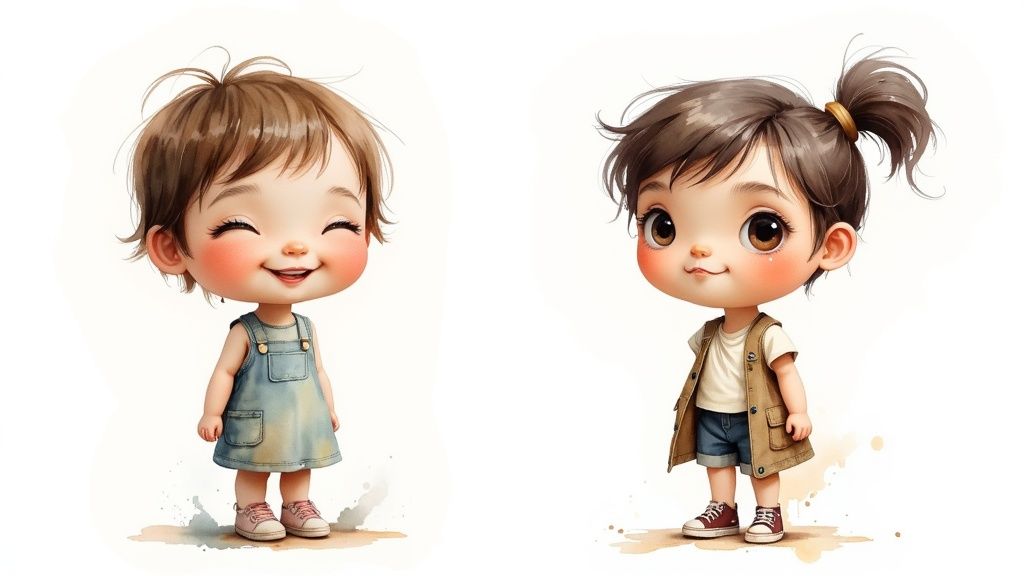
When kids see their own face—or even the face of their beloved pet—staring back at them from the pages of a book, the story instantly becomes theirs. It's not just a cute gimmick; this kind of personalization builds self-esteem and makes the plot and its lessons immediately relatable. Suddenly, the story isn't about some faraway character; it's about them.
This strategy is incredibly flexible for both teachers and parents. Here are a few ideas I've seen work wonders in a classroom setting:
- The "Class Pet" Chronicles: Snap a photo of the class hamster or guinea pig and turn them into a recurring guide who leads students through science concepts.
- Time-Traveling Students: Use a student's photo to create a character who meets a historical figure, bringing social studies lessons to life in a way a textbook never could.
- Social-Emotional Learning (SEL) Scenarios: Write a short story where a student character successfully navigates a tricky social situation, like sharing or resolving a conflict, offering a positive and relatable model for behavior.
It's no surprise that tools for this are becoming more popular. The global character generator market was valued at around $1.1 billion in 2022 and is projected to hit $2.5 billion by 2030. That's a huge jump, and it shows just how much people want custom creative tools. You can read the full research about the character generator market for a deeper dive.
From a Simple Snapshot to a Storybook Star
The good news is that turning a photo into a storybook illustration is much easier than it sounds. Modern tools are built for regular people, not just graphic designers. You can usually just upload a picture and watch it get reimagined in the art style you pick, whether you want a soft watercolor look or a bright, bold cartoon.
This photo-to-character feature is, in my opinion, the heart of a truly useful character creator. It takes you past just describing a character and actually pulls a child’s own world right onto the page. The trick is finding a platform that doesn't just do the initial conversion but also keeps the character looking the same from one page to the next. Consistency is key to keeping that magic of recognition alive throughout the entire book.
For an all-in-one solution, a platform like LovetoRead.ai is a fantastic starting point. It’s built specifically to convert your real life photos into characters and help you generate personalized stories within seconds. Best of all, you can create a library of characters to reuse across a variety of different stories, and they appear consistently in the absolute best art styles. Once your masterpiece is finished, you can even easily order any hardback copy—a perfect way to create a lasting keepsake.
Putting Your Characters to Work in the Classroom
Once you've built a cast of reusable characters, you can really start having fun. This is where you get to weave them into your everyday lesson plans, turning what might be a standard topic into a story kids will actually remember. A solid character creator for stories isn't just a toy; it’s a powerful teaching tool that connects abstract concepts to a child’s world.
Think about it. Instead of another math worksheet, what if your custom character, a curious fox named Felix, had to solve addition problems to find his way through a magical forest? Suddenly, arithmetic practice becomes an exciting quest. This narrative approach is incredibly versatile and works wonders for boosting engagement across almost any subject.
Matching Your Stories to Learning Goals
The trick is to make sure the story aligns with your educational goals. It's not just about a fun plot; you can intentionally tailor the vocabulary, sentence structure, and complexity to fit the exact grade level you're teaching.
Here are a few ways I’ve seen this work beautifully:
- For Social Studies: Imagine creating a story where a student’s own photo-character travels back in time. They could meet a historical figure, maybe helping Benjamin Franklin with one of his experiments, or learn firsthand what community life was like in a different era.
- For Science Concepts: You could design a tiny character who shrinks down to explore the inside of a plant cell. Or maybe they blast off into space to learn about the planets from a front-row seat.
- For Social-Emotional Learning (SEL): This is a big one. You can craft simple tales where your characters have to navigate common childhood challenges—learning to share, being a good friend, or figuring out big emotions.
The creative technology making this possible is evolving at an incredible pace. The 3D character modeling software that powers professional animation is a huge industry, and its growth is making these tools more accessible for everyone. The global animation market is projected to hit nearly $900 billion by 2034, which means more innovation is on the way. You can learn more about the trends in 3D character modeling software to get a sense of where this is all headed.
From Screen to Storytime
A digital story is great, but its impact really multiplies when it becomes something a child can hold in their hands. The final step is bringing your creation to life. Printing your stories as physical hardback books turns them from a file on a screen into a treasured part of your classroom or home library. A well-bound book feels special and encourages kids to pick it up and read it again and again.
Sharing digital versions is also a fantastic way to strengthen the home-school connection. It gives parents a peek into what their child is learning and offers a fun way to reinforce those lessons at home. This whole process—from a simple idea to a printed book or a shareable file—has never been easier.
With a tool like LovetoRead.ai, the entire workflow is designed to be straightforward. You can create personalized stories within seconds, build a library of characters to reuse in future lessons, and easily order any hardback copy. It’s a fantastic way to produce professional-quality, engaging resources that kids genuinely get excited about.
Got Questions About Character Creators? Let's Dig In.
It's completely normal to have a few questions when you start exploring a new tool, especially one involving AI. Even though a character creator for stories is designed to be straightforward, you want to be sure it's the right fit for your classroom or home. Let's walk through some of the common things teachers and parents ask.
Will the Characters and Stories Be Age-Appropriate?
This is probably the most important question, and the answer is a resounding yes—as long as you're the one steering the ship. Think of the AI as your creative partner, not the one in charge.
Your prompts are everything. Be very clear about who the story is for. Phrases like "a story for a five-year-old" or "write this for a second-grade reader" make a huge difference. You can also guide the tone by focusing on themes like kindness, curiosity, and friendship. This simple step ensures the AI sticks to content that’s perfect for your kids.
My Two Cents: You are the director. The quality and appropriateness of what the AI creates come directly from your instructions. The more specific and thoughtful you are with your prompts, the better the result will be.
Is Turning a Photo into a Character Complicated?
Not at all! You'd be surprised how simple it is. The latest tools have made this a one-click affair, so you definitely don't need a degree in graphic design.
You just upload a clear photo—of a student, a family pet, or even yourself—and the AI does the heavy lifting, instantly translating it into the art style you've picked. It’s built to be intuitive, so anyone can add that special, personal touch to their stories.
Can I Reuse a Character in Different Books?
Yes, and this is where the real magic happens. This feature is often called character persistence, and it’s a game-changer for building a series of stories.
Once you’ve created a character you love, you can save them to your own personal library. This means your star character can show up in a story about space one week and an adventure in the jungle the next, looking exactly the same every single time. It's the secret to creating a consistent, recognizable world for young readers.
At LovetoRead.ai, we’ve built our platform around these very ideas. You can generate personalized stories within seconds, convert your real life photos into characters, and create a library of characters to reuse across a variety of different stories. We offer the absolute best art styles and guarantee perfect character persistence so you can focus on the fun. When your masterpiece is ready, you can easily order any hardback copy with just a click.