Create Your Own Story Book in Minutes
Ever thought about turning a funny family memory or a make-believe bedtime adventure into a real, illustrated storybook? It sounds like a huge undertaking, right? Something that requires serious artistic talent or writing chops. For a long time, it was.
But that’s all changed. You don't need to be a professional author or illustrator anymore. With the right tools, you can bring a story to life in just a few minutes, turning a simple idea into a book your child will cherish.
Turn Family Memories Into Illustrated Storybooks
The old hurdles to creating a storybook—finding an illustrator, getting a publisher, writing the perfect prose—have pretty much disappeared. Technology has put the creative controls right where they belong: in your hands.
This guide is your roadmap. I’ll walk you through the entire process, step by step, showing you how to go from a blank page to a finished storybook that you can hold in your hands.
The New Way to Create Stories
So, how does it work? It's all about using smart, intuitive tools designed for people who love stories, not necessarily for people who know how to code or draw. These platforms do the heavy lifting, generating beautiful illustrations and age-appropriate text, which frees you up to focus on what really matters—the story itself.
Here’s what we’ll cover in this guide:
- Planning Your Story: We'll start with the fun part—brainstorming ideas and figuring out how to aim them at the right K–5 reading level.
- Building Your Cast: I'll show you a neat trick for turning photos of your own kids into reusable storybook characters.
- Finding Your Style: From whimsical watercolors to bold cartoons, we’ll explore different art styles and narrative approaches to find the perfect fit.
- Bringing It All Together: You’ll see the process of generating pages, tweaking the details, and even getting a physical copy printed.
The real magic here is personalization. When a child sees themselves as the hero of a story, it creates a connection to reading that’s deep and personal. It’s not just a book anymore; it’s their book.
With a platform like LoveToRead.ai, you can create personalized stories in seconds. It allows you to convert your real-life photos into characters and build a library of characters to reuse across a variety of different stories. With the absolute best art styles, incredible character persistence, and the ability to easily order any hardback copy, it's a powerful tool for any parent.
This guide will show you exactly how to use these kinds of tools to make your child the star of their very own story and spark a genuine, lasting love for reading.
How to Plan a Story Your Child Will Love
The best stories—the ones that get read over and over until the pages are soft—always feel personal. Even a wild tale about space-faring squirrels can hit home if it’s built around something a child cares about. Before you jump into writing and illustrating, taking a little time to plan is the secret to creating a book that truly connects.
Think about what makes your young reader’s eyes light up. Is it a silly story about a clumsy giraffe? A magical adventure in an enchanted forest? Maybe it’s a simple, quiet story about making a new friend. The theme is the heart of your book, and often, the best ideas come from real life, like a memorable family trip or a funny thing that happened at the playground.
A simple concept can be surprisingly flexible. A story about a 'lost puppy,' for example, looks very different for a first-grader than it does for a fourth-grader. For the younger child, you'd focus on simple emotions and sight words. For the older one, you could weave in clues and build a little mystery for the main character to solve.
This handy visual shows just how simple it is to get started, whether you have a spark of an idea or a cherished memory you want to turn into a story.
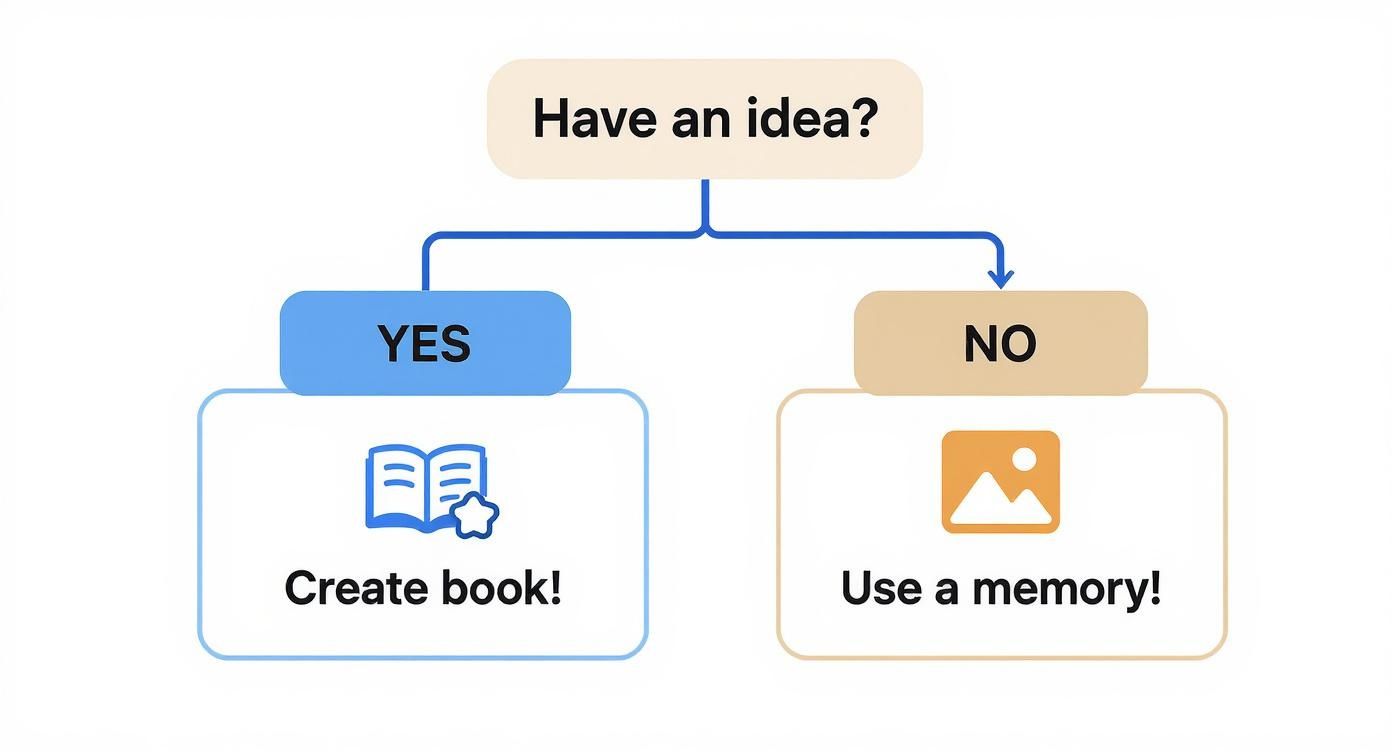
As you can see, inspiration is everywhere. A completely new idea or a real-life moment can be the perfect seed for your book.
Define Your Characters and Plot
With a theme in mind, it's time to dream up your hero. Who is the star of this story? What do they want more than anything? Giving your main character a clear goal—even something as simple as finding a lost teddy bear—is what pulls the reader through the narrative.
All great stories, from epic poems to picture books, share a simple, timeless structure: a beginning, a middle, and an end.
- The Beginning: Introduce us to your character and their world. What does a normal day look like for them before the adventure begins?
- The Middle: This is where things get interesting! Your character runs into challenges or obstacles as they try to achieve their goal.
- The End: The story wraps up. Your character solves the problem, maybe learns something new, and finds a new sense of normal.
This classic arc is like a sturdy skeleton for your story. It gives the narrative a logical flow that keeps kids hooked from the first page to the last.
Aligning Your Story with Grade Levels
Making sure the story’s complexity and vocabulary match your child's reading level is key. You want the book to be a "just right" challenge—engaging but not frustrating. To help with this, here's a quick guide for matching story elements to different grade levels.
Grade-Level Story Planning Guide
| Grade Level | Typical Theme | Sentence Structure | Vocabulary Focus |
|---|---|---|---|
| Kindergarten | Friendship, daily routines, basic emotions | Simple, short, often repetitive sentences. | High-frequency sight words, CVC words. |
| 1st-2nd Grade | Overcoming small fears, family, adventure | Compound sentences, some descriptive words. | Sight words, basic adjectives, and verbs. |
| 3rd-4th Grade | Problem-solving, teamwork, fantasy | More complex sentences, introduction to dialogue. | Richer descriptive language, character-specific words. |
| 5th Grade | Moral dilemmas, historical fiction, identity | Varied sentence lengths, paragraphs, subplots. | Figurative language (similes), nuanced vocabulary. |
This table provides a starting point, but remember that every child is different. The goal is to create a reading experience that feels both successful and exciting for them.
The good news is that creating a tailored book is easier than ever. Self-publishing has opened doors for parents and educators to create stories that not only align with school curricula but also reflect important family values like kindness and environmental stewardship. You can learn more about trends in children's book publishing to see just how accessible it has become.
Ready to bring your own story to life? With a platform like LoveToRead.ai, you can generate personalized stories in seconds. Turn real-life photos into characters and build a library to reuse them in countless adventures. It’s a fantastic way to create a beautiful hardback book your child will treasure.
Bringing Your Child to Life as a Storybook Hero
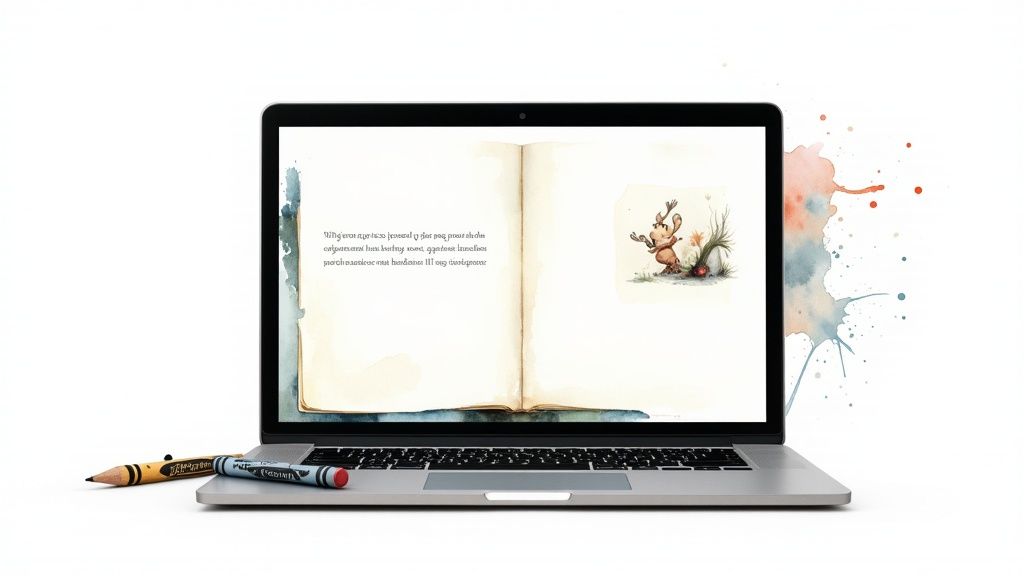
The real secret to a storybook a child will beg to read over and over? It's seeing a hero they already know and love on every page—themselves. When a young reader spots a character who looks just like them, the story instantly becomes their world. That personal connection turns a simple book into a treasured keepsake.
And you don’t need to be an artist to pull this off. Modern tools make it incredibly simple to create your own story book with that personal touch. Imagine taking a favorite photo of your child and, with just a few clicks, turning it into a one-of-a-kind illustrated character. This is where the magic really starts.
Building Your Personal Character Library
First things first, you need a digital version of your hero. With the right platform, you can upload a real photo and watch it transform into an illustrated character that actually captures your child's likeness. Why stop there? You can do this for the whole family—parents, siblings, even the family pet can join the cast.
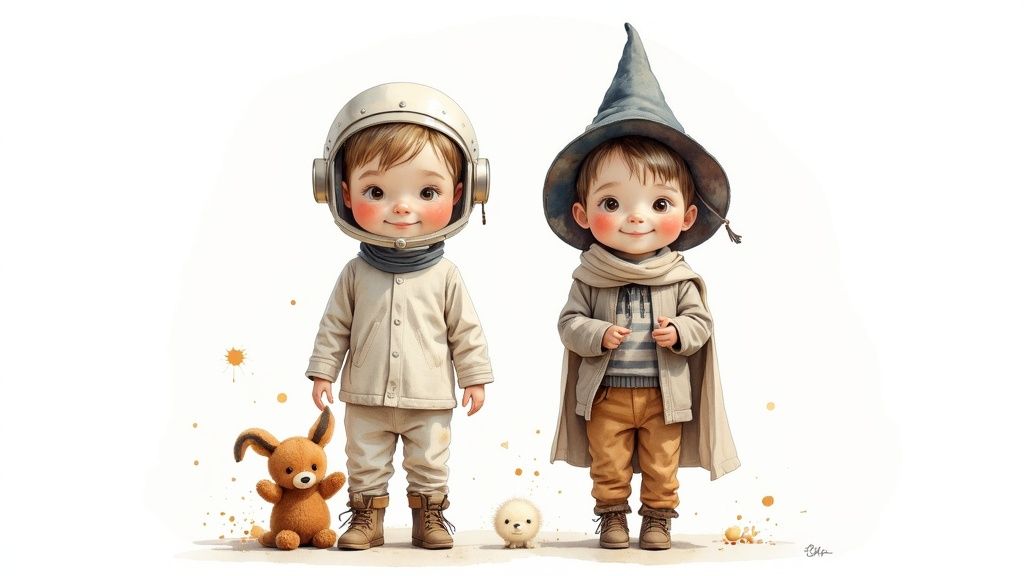
Once you’ve created these characters, they’re saved into your own personal library. This is a total game-changer for storytelling. Your daughter can be a brave astronaut exploring the cosmos in one story and a friendly wizard in the next, all while looking like herself.
Think of it as having your own troupe of digital actors, ready to jump into any role you dream up.
The Power of Character Persistence
One of the most important, and often overlooked, features is character persistence. This technical-sounding term means something simple: your created character keeps their unique features—the same hairstyle, eye color, and smile—on every single page and across different stories.
For a young reader, this consistency is everything.
When a character looks the same from one scene to the next, it helps a child build a stable, familiar world they can easily follow and get lost in. It reinforces recognition and deepens their emotional investment in the story's outcome.
This consistent visual anchor makes the narrative far more immersive and easier to follow. It’s what turns a collection of illustrations into a cohesive adventure that a child will want to revisit time and again.
Ready to see your child as the hero of their own story? With a tool like LoveToRead.ai, you can convert real-life photos into reusable characters in seconds. With their best-in-class art styles and character persistence, it's easy to build a personal library for endless adventures. Plus, you can easily order a beautiful hardback copy of any book you create.
Picking the Right Vibe: Art Style and Narrative Voice
Getting the look and feel of your story right is a huge part of the magic. The art style is what grabs a child's attention and sets the mood before they've even read a word, while the narrative voice is what keeps them listening. Nailing these two elements is where a good story starts to become a great one.
Think about the art as the story's visual personality. A whimsical watercolor style, with its soft, dreamy colors, might be perfect for a gentle tale about woodland creatures. But if you’re writing a zany story about a dog who thinks he’s a superhero, you’ll probably want something punchier—like bold, bright cartoon illustrations that practically jump off the page.
Don't overthink it. Just ask yourself: what’s the core feeling of my story? Is it supposed to be comforting, exciting, silly, or a little bit spooky? Let that feeling guide your artistic choice.
To Rhyme or Not to Rhyme? That Is the Question.
Once you have a feel for the visuals, you need to decide how the story will sound. Are you going to tell it in simple, direct prose or with the bouncy rhythm of a rhyme?
- Prose: This is your go-to for straightforward storytelling. It’s perfect for action-packed adventures or stories with a clear lesson because you can focus on moving the plot forward without worrying about finding the perfect rhyming word.
- Rhyme: For the younger crowd (think K-2), rhyme is often a huge hit. It makes reading a fun, musical experience and helps with memory and phonics. The predictable patterns are fantastic for building early literacy skills.
My advice? Try writing the opening of your story both ways. See which version feels more natural for the tale you want to tell. Sometimes the story itself will let you know which one it wants to be.
You're in the Driver's Seat Now
It wasn't that long ago that writers and artists had to hope a publisher would deem their work "good enough." Those days are over. Today, you are the gatekeeper.
The world of self-publishing has completely changed the game. In 2023 alone, over 2.6 million self-published titles with ISBNs were released—a 7.2% jump from the year before. This incredible growth, which you can read more about on Publishers Weekly, means that creators like you have all the power.
This freedom is a game-changer. You're no longer locked into your first decision.
You can try out the same scene in a dozen different art styles or flip between prose and rhyme with a click. It’s about playing, experimenting, and finding that perfect combination that brings your unique vision to life.
With a tool like LoveToRead.ai, you can instantly generate personalized stories and see what art styles click. Convert your real-life photos into a library of reusable characters with amazing persistence, and easily order a beautiful hardback copy when you’ve created something you love.
Bringing Your Storybook to Life, Page by Page
Now for the fun part. You've done the groundwork—you know your characters, you've picked an art style, and your plot is mapped out. It's time to actually create the pages and watch your story come alive. This is where your ideas start to feel real, scene by scene. Think of it as a creative dance between you and the AI; you lead, and the technology illustrates your vision.
Creating each page is as simple as giving a quick, clear direction, almost like you're a movie director setting a scene. For our story about Lily and the lost kitten, a prompt for the first page might be: "Lily is playing in her sunny backyard when she hears a tiny meow coming from the bushes." The AI will take that cue and generate both a beautiful illustration and the text to go with it.
You'll just repeat this process for every key moment in your story, guiding the narrative from its opening scene all the way to the end. Don't stress about getting it perfect on the first try. The first draft is just that—a starting point.
Polishing and Perfecting Your Pages
Once you have all your pages generated, you get to step in and add your human touch. This is where you’ll make those small but crucial adjustments that turn a good story into a great one. Maybe the text on one page sounds a little awkward, or an illustration doesn't quite capture the feeling you were going for.
This back-and-forth is what makes the final book feel so personal and polished.
- Editing the Words: Jump right into the text and make it your own. You can easily tweak the prose or rhyme to better match your storytelling voice or swap out words to align with specific vocabulary goals for your child's grade level.
- Refining the Art: If an image feels slightly off, you can regenerate it with a more specific prompt. For example, if the first illustration makes Lily look sad instead of curious, you could adjust the prompt to: "A curious-looking Lily peeks into the bushes, a gentle smile on her face."
The real magic happens when you collaborate with the technology instead of just accepting its first attempt. You’re the creative director here, giving feedback to your personal illustrator and co-writer until the book looks and sounds exactly how you imagined it.
From Screen to Storytime Staple
After you've put the finishing touches on every page, you'll have a complete, beautiful story. Sharing it on a tablet is fantastic, but there’s nothing quite like holding a real, physical book in your hands. A professional-quality hardback transforms your project into a true keepsake—something that can be passed down and read at bedtime for years.
This final step elevates your creation from a fun digital activity into a lasting family treasure. It’s also part of a much larger trend of people taking creative control. The self-publishing world is thriving, with over 300 million self-published books sold globally each year, pulling in around $1.25 billion in revenue. You can explore more statistics on the self-publishing boom to see just how accessible this path has become.
A platform like LoveToRead.ai makes this incredibly simple. Not only can you create your own story book in just a few clicks, but you can also order a high-quality hardback version delivered to your door. With its superior art styles and character persistence, you can even build a whole library of reusable characters based on your own photos. It's the perfect way to turn a spark of an idea into a book your child will absolutely adore.
Got Questions? Let's Talk Storybooks
Jumping into making your own book is exciting, but it's totally normal to have a few questions before you start. I hear the same ones from teachers and parents all the time, so let's get them cleared up right now so you can get to the fun part.
Think of this as our little pre-flight check. Once you see how straightforward it all is, you'll feel more than ready to bring your story to life.
"But I Can't Draw! Do I Need to Be an Artist?"
Nope! Not even a little bit. And honestly, that’s what makes this whole process so incredible. The old idea that you had to be a skilled illustrator to make a beautiful book is completely out the window.
With the AI platforms available now, you’re the director, not the artist. You come up with the brilliant story, the quirky characters, and the setting. The tool does all the heavy lifting, creating gorgeous, professional-looking art based on your ideas. This frees you up to pour all your energy into the storytelling—the part that really matters. You won't have to touch a pencil or a paintbrush.
"How Do I Know the Words Are Right for My Kid's Reading Level?"
This is probably the most important question for any parent or educator, and it’s something modern story-making tools are built to handle. Right when you kick off a new project, you can plug in the target age or grade level.
From there, the AI takes care of making sure the book is just right for your reader. It adjusts things like:
- Vocabulary: It'll stick to words that fit the reading level, even weaving in common sight words for the little ones.
- Sentence Structure: Sentences will be shorter and simpler for a kindergartener, and more complex for a fifth-grader who's ready for a bit more of a challenge.
- Plot Complexity: The storyline itself will be easy to follow for younger kids and can have more layers for older readers.
And the best part? You still have the final say. You can go in and tweak any word or sentence, so you’re always in complete control.
This means the book you make isn't just a fun, personal story—it's a powerful tool that actively supports your child's reading journey.
"Is It Going to Cost a Fortune to Print Just One Book?"
Not at all. It's actually more affordable and easier than ever. We're long past the days when you needed a big, expensive print run to get a physical copy of a book. Many online services now offer print-on-demand, which lets you order a single, beautifully bound hardback copy.
The price is usually pretty reasonable—often about the same as you'd pay for a personalized book from a big-box online store. The huge difference, of course, is that this book is 100% yours, from every word to every pixel of the illustrations. It’s not just a customized product; it’s a one-of-a-kind keepsake you created from scratch.
Ready to see for yourself? With LoveToRead.ai, you can get your first story started in just a few clicks. Turn your own photos into storybook characters, build a library of your kids and pets for new adventures, and pick from stunning art styles that keep your characters looking consistent. When it's perfect, ordering a hardback copy to hold in your hands is a breeze. Why wait? Start your first book today.