Using Images for Story Telling in Education
Using pictures to tell a story does more than just decorate a page—it turns reading into a real adventure, especially for young kids. The right image can be the bridge between a word a child doesn't know and the "aha!" moment of understanding. It's what makes a story stick.
A great picture can spark a dozen questions, provide clues about what's happening, and ultimately, build a genuine love for reading that lasts.
It's More Than Just Pretty Pictures
Think about it from a K-5 student's perspective. A page filled with nothing but words can feel like trying to climb a wall. That's where visual storytelling shifts from being just a nice-to-have to a core teaching tool. We know from loads of research that when kids see what they're reading about, they get it faster and remember it longer.
This is a lifeline for our emerging readers or any student who finds reading a bit of a struggle. Visuals are like a helpful guide, offering context clues that help them figure out tricky sentences and stay on track with the plot. A single illustration of a character's slumped shoulders can communicate sadness or disappointment far more powerfully than a paragraph of text, which helps build their confidence and keeps frustration at bay.
Going Beyond Decoration to Build Real Skills
It's easy to dismiss illustrations as fluff, but they're actually working hard to build critical literacy skills. A thoughtfully chosen image in a story can:
- Boost Vocabulary: Seeing a picture of a "galleon" right next to the word? That connection is instant and it's going to stick.
- Teach Inference: An image might show a character peering out a rainy window with a frown. The text doesn't have to say "she was sad." The child can figure that out on their own, which is a huge step in reading comprehension.
- Keep Kids Hooked: Let's be honest, vibrant and exciting images grab a child's attention and make them want to know what happens next.
Visuals don't just support the story; they make it bigger. They give young readers a mental anchor, a way to organize what they're learning and start making smart guesses about the plot. That's what being an active reader is all about.
Making Custom Stories a Reality
Not too long ago, creating a beautiful, custom storybook was a job for a professional illustrator with a lot of time on their hands. That's just not the case anymore. New tools have opened this door for all of us. Imagine taking a photo of a student and turning them into the main character of a story you created just for them.
That kind of personal connection is an absolute game-changer for engagement. When a child sees themselves as the hero, their investment in the story goes through the roof.
Curious to see just how simple this can be? With a tool like LoveToRead.AI, you can create personalized stories in seconds. Convert your real-life photos into characters and build a library of heroes to reuse across different adventures. With the absolute best art styles and character persistence, you can bring any story to life and easily order a beautiful hardback copy of your creation.
How to Plan Your Visual Narrative
A great visual story never happens by accident. It's built on a plan. We've all seen stories where the pictures feel like an afterthought, and it just confuses kids. But when you're thoughtful about it, every single image has a job to do—guiding young readers through the story and making sure they get it. So before you even think about creating a picture, let's map out the visual journey.
It all starts with the heart of your story. Ask yourself: What's the one big idea or feeling I want a child to walk away with? Is it about friendship? Trying something scary? The magic of a rainy day? Once you nail down that central theme, every visual choice you make should circle back to support it.
This is the stage where fuzzy ideas start to become real, tangible things for a child to grasp.
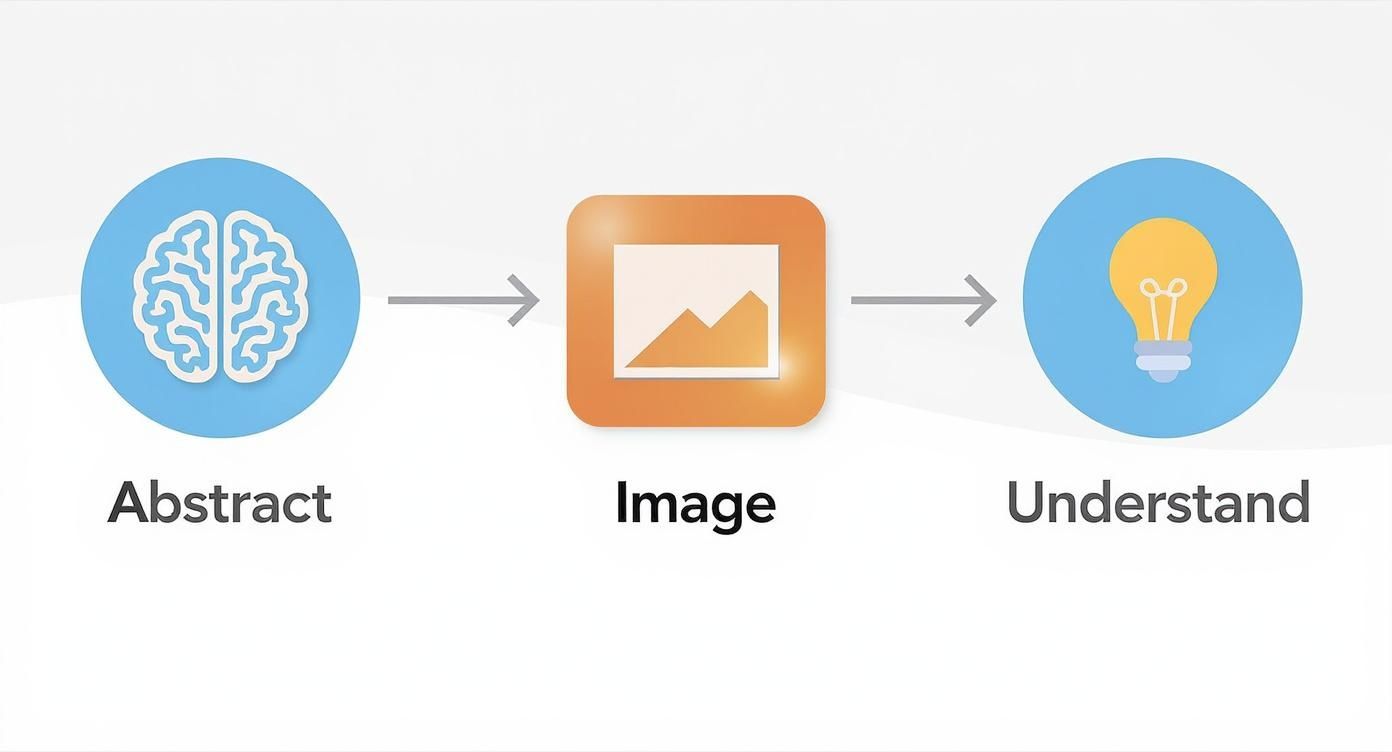
Think of it this way: what starts as an abstract thought in our head becomes a concrete image, and that image is what sparks real understanding and even more ideas for our students.
Choosing Which Story Moments to Illustrate
With your core message locked in, the next question is what to actually illustrate. You definitely don’t need a picture for every sentence. That would be overwhelming! Instead, think like you're making a movie trailer—you want to pick the scenes that pack the most punch.
Deciding which scenes get an illustration is a strategic choice. You want to focus on moments that move the story forward, build emotion, or clarify something important. This table can help you prioritize.
| Moment Type | Purpose of Illustration | Example |
|---|---|---|
| Introductions | Ground the reader right away by showing who the story is about and where it's happening. | A picture of Leo the Lion in his cozy jungle den. |
| Emotional Turning Points | Show, don't just tell, a character's feelings. This builds empathy and connection. | A close-up of a character's face showing surprise when they find a hidden key. |
| Key Action Sequences | Visualize the most exciting parts to build suspense and keep kids hooked. | An image of the main character bravely crossing a rickety rope bridge. |
| The Resolution | Provide a satisfying conclusion that visually captures the story's outcome or lesson. | A final illustration of the whole family happily eating pizza together. |
Focusing on these pivotal scenes ensures your images for storytelling do the heavy lifting, reinforcing the plot and keeping kids glued to the page.
Simple Storyboarding for a Clear Flow
Once you know which scenes you're illustrating, it's time for a storyboard. And no, it doesn't have to be a work of art! A few quick stick-figure sketches on a whiteboard or even just descriptions on sticky notes will do the trick.
The goal is to lay everything out and see the story's visual flow. It’s the best way to catch weird gaps in the narrative or awkward transitions before you've spent time creating the final images.
For a story about a lost puppy, a quick storyboard might look like this:
- Scene 1: Happy puppy playing in a sunny backyard.
- Scene 2: Puppy looking sad and alone in a dark, unfamiliar forest.
- Scene 3: A kind child finding the puppy and offering it a snack.
- Scene 4: Puppy joyfully reuniting with its owner at the front door.
See? This simple outline confirms you have a complete visual arc—a clear beginning, middle, and end. Taking just a few minutes for this step saves a ton of headaches later and makes sure your final images come together as a cohesive, powerful story for your students.
Creating Consistent Characters with AI
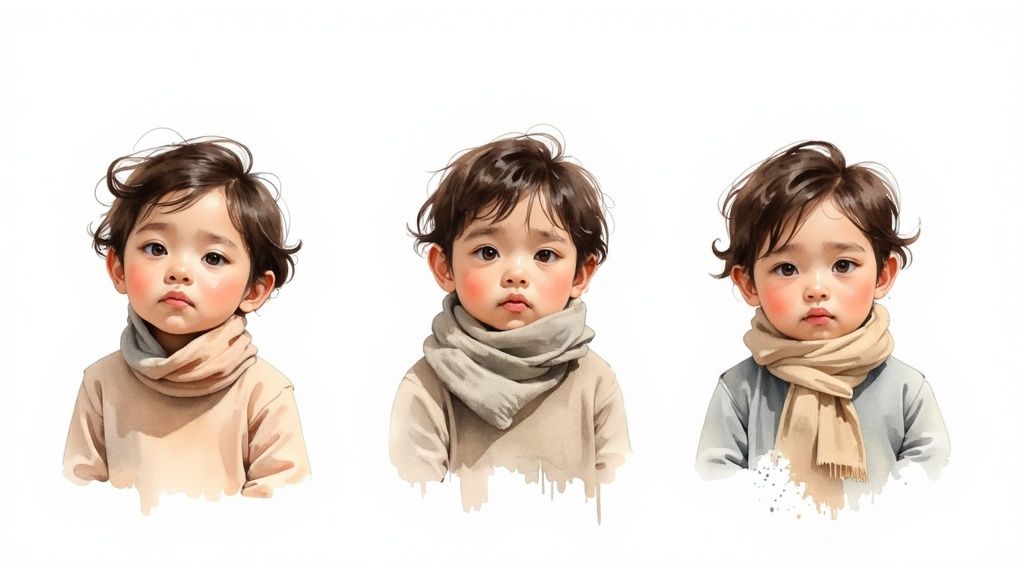
Nothing pulls a child out of a story faster than an inconsistent character. Imagine their favorite hero, a boy with a bright red superhero cape, suddenly appearing in the next illustration with a blue one. That little detail can be jarring for a young reader, breaking the narrative spell and making the story harder to follow.
For years, keeping a character looking the same from page to page was a skill reserved for professional illustrators. They had the training and memory to meticulously redraw a character in any pose or situation. Thankfully, that’s no longer the case. The latest AI tools have cracked this code, putting the power of consistent character creation into our hands.
Building Your Personal Character Library
The secret to effortless consistency is to think like a casting director. You're not just creating a single image; you're building a reusable model of your character. This becomes your personal library, a cast of familiar faces ready to star in any story you dream up.
This is where things get really exciting. You can design a character from scratch or even upload a photo of a student or child and transform them into an illustrated hero. The potential for personalization is incredible—a child who sees themselves as the main character is instantly captivated.
Being able to keep a character looking the same across different scenes, emotions, and even entirely different stories is a game-changer. It means anyone, regardless of artistic ability, can produce a visually cohesive and professional-looking narrative.
How Character Persistence Works in Practice
So, how does it all come together? Specialized AI platforms are trained to "remember" a character's defining features—their hairstyle, eye color, a specific freckle pattern, or a favorite t-shirt. Once you've created and saved a character, you can drop them into any new scene with a simple text prompt.
Let’s say you’ve created a character named "Leo the Adventurer." You could then ask the AI to generate images like:
- "Show Leo the Adventurer looking happy while riding a friendly dinosaur."
- "Show Leo the Adventurer feeling curious as he discovers a hidden treasure map."
- "Show Leo the Adventurer looking brave as he crosses a wobbly bridge."
In every single image, Leo will look like Leo. This seamless continuity helps kids form a stronger bond with the character and fully immerse themselves in the story's world. This is especially true for visual content, as our brains are wired to process it so effectively. In fact, research shows that charts can improve comprehension by 80% compared to text alone. You can learn more about the power of visual communication from recent studies on the topic.
Making Cohesive Storytelling Accessible
This technology truly opens the door for anyone to create high-quality, illustrated stories. You don’t need to be an artist to bring your vision to life. You can finally put all your creative energy into what matters most—the story—while the AI handles the complex task of making sure every picture looks just right.
Tools like LoveToRead.AI make this process incredibly simple. You can generate personalized stories in seconds by turning real photos into unique characters and building a library to reuse them in new adventures. The platform is built around the best character persistence and offers beautiful art styles, so your heroes always look consistent. Best of all, you can easily order a beautifully printed hardback copy of your story.
Choosing an Art Style to Match Your Story's Mood
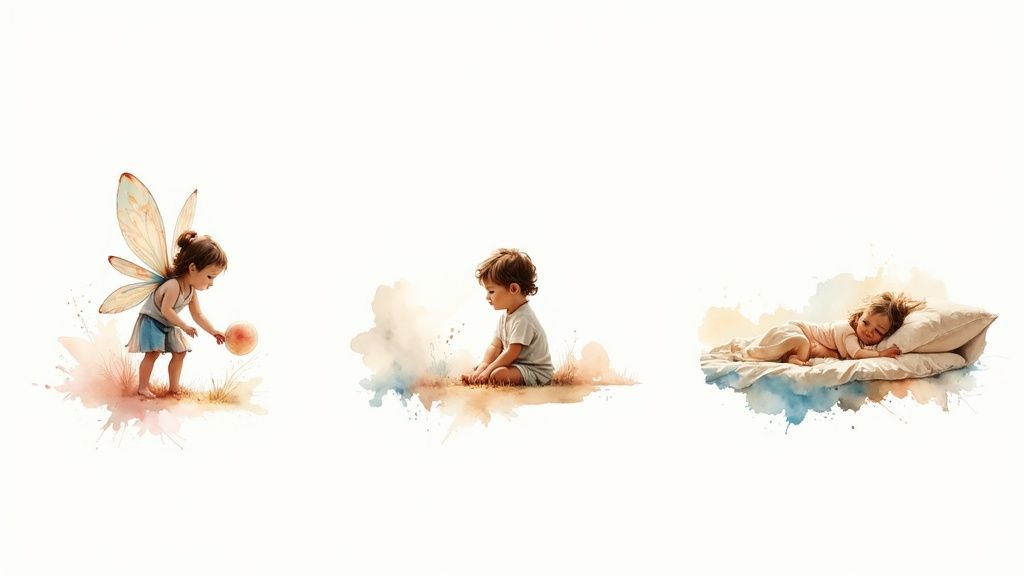
Think of the art style as the soundtrack for your story. It’s a powerful tool that sets the emotional tone and tells the reader what to expect before they even read the first word. A soft, gentle watercolor illustration whispers that this is a calm, dreamy tale. In contrast, a bold, high-contrast comic book style practically shouts that it's time for action and excitement.
Getting this right ensures your visuals and narrative are singing from the same hymn sheet, creating a cohesive and immersive experience for your young readers. It’s all about matching the visual feeling to the story's heart.
A Gallery of Styles and Their Emotional Impact
Not sure where to begin? Let’s walk through a few common art styles and the feelings they usually bring to mind. Considering these options can help you lock in the perfect look for your narrative.
- Whimsical Watercolor: This one is a natural fit for fairy tales, gentle bedtime stories, or any plot with a little magic. The soft edges and blended colors create an immediate sense of wonder and calm.
- Vibrant Cartoon: With its bright, solid colors and clean lines, this style is pure energy and fun. It's an excellent choice for upbeat stories about friendship, school adventures, or silly situations designed to make kids giggle.
- Bold Comic Book: Featuring dynamic action lines and high-contrast shading, this style is made for superhero sagas or fast-paced adventures. It communicates excitement, bravery, and a sense of "what happens next?!"
- Cozy Storybook: This is that classic, familiar style that feels like a warm hug. It uses warm color palettes and soft, friendly character designs, making it perfect for stories about family, kindness, and the little joys of everyday life.
The real secret is to first identify the main emotion of your story. Is it excitement? Comfort? Curiosity? Let that feeling be your guide, and the art style will become a natural extension of your plot.
Practical AI Prompts to Get You Started
Thankfully, with modern AI tools, you don't have to be a professional artist to experiment. You can generate the same scene in multiple styles to see which one truly clicks. Here are a few examples to show how a simple phrase can produce dramatically different results.
Our core concept will be: "A friendly dragon."
| Art Style | Sample AI Prompt |
|---|---|
| Whimsical Watercolor | "A friendly dragon sleeping on a cloud, in a soft and dreamy watercolor style." |
| Vibrant Cartoon | "A friendly dragon juggling colorful fruit, in a bright and cheerful cartoon style." |
| Bold Comic Book | "A friendly dragon flying over a city, in a dynamic comic book style with action lines." |
| Cozy Storybook | "A friendly dragon sharing a cup of tea with a rabbit, in a warm, classic storybook illustration style." |
See how that little descriptor at the end completely changes the scene's mood?
This level of creative control really opens up storytelling for everyone. I’ve seen amazing results from platforms like LoveToRead.AI, which has refined this process. You can generate personalized stories in seconds, turn real photos into characters, maintain perfect consistency, and select from the absolute best art styles. They even let you easily order a hardback copy, bringing your unique creation right into your hands.
Putting It All Together: Fun Activities for School and Home
Alright, now for the fun part. Let's take all these ideas and turn them into real, hands-on activities that you can use with your kids, whether you're in a classroom of 25 or sitting on the couch at home. The idea is to get kids making, not just consuming.
When kids get to be the author and the illustrator, something clicks. They're not just reading a story anymore—they're invested. It’s a game-changer for building their confidence and sparking a genuine excitement for reading.
Quick and Creative Classroom Warm-Ups
You don't need a whole lesson block to get the creative juices flowing. Here are a few 15-minute warm-ups that pack a big punch with minimal prep.
- Story Starters: Toss a single, fascinating image up on the screen. Think something like, "a tiny mouse wearing a backpack and standing at the base of a giant tree." Ask students to write—or just say aloud—one sentence about what happens next. It's that simple.
- The Feeling Game: Generate a few pictures of the same character showing different emotions—happy, sad, surprised, worried. Kids can take turns identifying the feeling and maybe even sharing a time they felt that way. It's a great way to build emotional vocabulary.
- Pass the Story: Start with one image and have a student begin a story. After a minute or so, introduce a completely new image and have the next student pick up the narrative, weaving in the new visual. It gets wild, and they love it.
These little exercises are fantastic for practicing inference and just letting their imaginations run wild.
Story Time Adventures at Home
For parents, story time can be so much more than just reading a book off the shelf. It’s a chance to create something magical together, especially before bed.
Think about it: a personalized bedtime story where your child is the hero is more than just fun. It reinforces a positive self-image and makes reading feel like a special event you share. Try turning a real family photo into a character and make up a short tale about their day.
This simple routine doesn't just build a stronger bond; it shows them how stories are all around us. There's a reason the global visual content market is projected to reach $19.17 billion by 2032—visuals are simply a powerful way to connect. You can dig into the numbers in this visual content statistics report.
If you want to take this to the next level, tools like LoveToRead.AI make it incredibly easy to create these personalized stories in just a few clicks. You can convert your real-life photos into characters, build a library of heroes to reuse across a variety of different stories, and choose from the best art styles available. It transforms a quick digital creation into a real, tangible keepsake you can hold in your hands and be proud of, especially since you can easily order any hardback copy.
Your Top Questions About Visual Storytelling Answered
Jumping into any new creative tool, especially when it’s for our kids, naturally brings up a few questions. Let's walk through some of the most common ones I hear from educators and parents about using images for storytelling.
Is It Safe to Use AI for My Child’s Story Images?
Yes, as long as you stick with the right platforms. The best tools designed for kids and classrooms have very strong safety filters built right in. They're programmed to make sure every single image is completely age-appropriate.
The trick is to choose a tool that was made from the ground up for education or family fun. These services are all about creating a safe sandbox for imagination, so you don’t have to worry about what might pop up on the screen.
Do I Need to Be an Artist to Make Good Illustrations?
Absolutely not, and that’s the real magic here. You don't need an ounce of traditional artistic skill. Modern image generators are made for storytellers, not necessarily artists.
If you can describe a scene in a sentence—"a brave little knight with red hair standing in a spooky forest"—you have all the skill you need.
The focus isn't on your drawing ability anymore; it's purely on your imagination. The tool does all the heavy lifting, artistically speaking. You just get to focus on bringing your story to life.
How Can These Images Actually Help a Struggling Reader?
Custom images are a game-changer for kids who find reading a challenge. Imagine a child who struggles with words suddenly seeing a main character who looks exactly like them or their own dog. Their interest in that story skyrockets.
This personal connection is huge. The pictures also provide powerful context clues that help them figure out new words and understand what's happening in the plot. You can even create a series of images without any text at all. This "wordless book" approach is a fantastic way to build comprehension and confidence before you even add the words. It makes reading feel less like a chore and more like a fun puzzle to solve.
Can We Turn Our Digital Story Into a Real, Physical Book?
You bet! This is often the most exciting part for kids. Many platforms know how special it is to hold a book you created. They have built-in options to order a professionally printed, hardback copy of the story you made together.
There's nothing quite like seeing a child's face light up when they hold a real book with their name on it. It transforms a fun screen-time activity into a tangible keepsake they can put on their shelf and share with family for years to come.
Ready to create a story that truly belongs to your child? At LoveToRead.AI, you can generate personalized stories within seconds. Convert your real-life photos into characters, create a library of characters to reuse across a variety of different stories, and choose from the absolute best art styles with incredible character persistence. When you’re done, you can easily order any hardback copy. Start your storytelling adventure today.