Writing Your Own Stories A Guide for Creators
It’s easy to get stuck in the "I want to write a story" phase. The real trick is shifting your mindset to actually writing. It’s not about waiting for the perfect lightning bolt of inspiration or getting some kind of permission slip. It's about taking that first small, concrete step to get your idea out of your head and onto the page.
Your Story Starts Now, Not Later

So many of us fall into the trap of waiting for the "right moment" to start writing. We think we need a stroke of genius or a nod of approval from an industry pro before we can even begin. Honestly, that’s the single biggest hurdle to getting started. The truth is, the road to writing your own stories has never been more wide open.
The days of needing a traditional publisher or an agent to get your work out there are fading. You are your own gatekeeper now. With so many digital tools, self-publishing platforms, and creative aids at our fingertips, the power is truly in our hands. This means you can get down to what really matters: telling a great story.
The New Creative Freedom
The self-publishing boom has completely redrawn the map for authors. Just look at the numbers from 2023—the amount of self-published titles hit over 2.6 million globally. That number dwarfs the 563,019 titles from traditional publishers. This isn't just a small shift; it's a massive trend showing that more and more writers are taking the reins and connecting directly with their audience. You can find more data on this publishing shift and see for yourself how writers are thriving.
This new freedom isn't just about publishing, either. It’s baked into the creative process itself. Today’s tools let you visualize your ideas in ways that were once out of reach for a solo creator. You don't have to just imagine your characters anymore—you can actually see them.
The most important step any writer can take is the one that moves them from dreaming to doing. Your first page doesn't have to be perfect; it just has to exist.
Making Your Story Real from Day One
Seeing your ideas come to life is an incredible motivator. It’s one thing to have a character sketched out in your mind, but it’s a whole different feeling to see them illustrated on a page. This is where you can really use technology to get that creative spark going. For example, imagine taking a photo of a loved one and instantly turning it into a storybook character.
This approach makes the writing process feel more tangible and rewarding right from the start. You can:
- Turn your real-life photos into characters for a story that feels deeply personal.
- Build a library of reusable characters to keep your stories consistent.
- Experiment with professional art styles to find the perfect look for your narrative.
Platforms like LoveToRead.ai are built for this, helping you create personalized stories in just a few seconds. You can even order a beautifully printed hardback copy, turning that digital file into a real book you can hold in your hands. This whole process reinforces that crucial mindset shift: you’re not just planning to write someday. You're creating your story right now.
Building a World Readers Won’t Forget
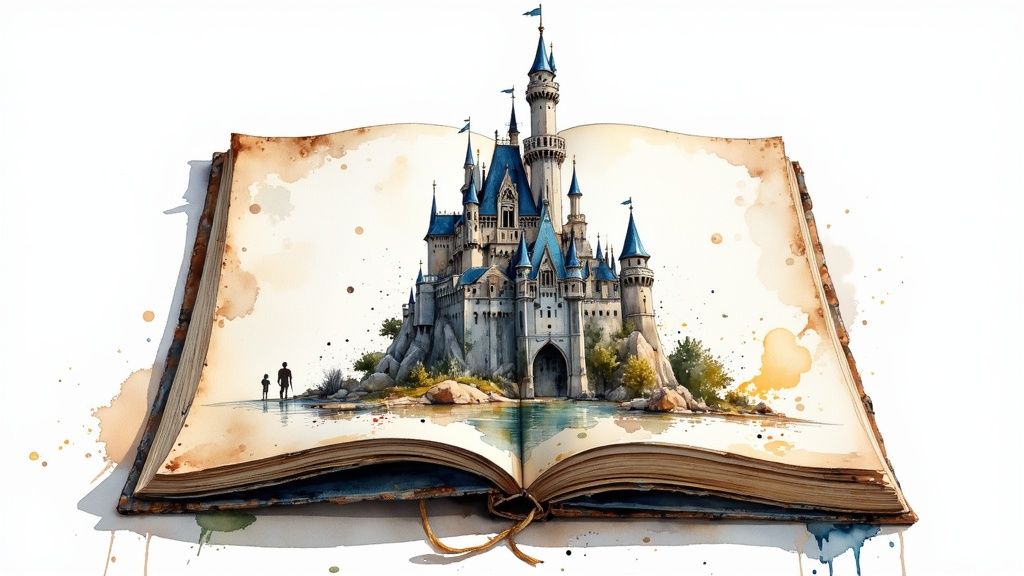
Every story that sticks with you, from a sprawling fantasy epic to a quiet, heartfelt tale, starts with a solid blueprint. Before you even think about writing that first sentence, you need to map out the foundational elements that turn a spark of an idea into a structured narrative.
This is where you focus on the big three: plot, theme, and character. They’re interconnected, each one strengthening the others. The plot gives you the "what happens," the theme provides the "why it matters," and the characters are the living, breathing heart of it all. If one of these is weak, the whole story can feel a bit wobbly.
Crafting Believable Characters
Let's be honest: plots are just a series of events until you add people. It's the characters who give a story its emotional weight. Readers don't just follow events; they connect with the people experiencing them. A character's unique motivations, their flaws, and their backstory are what make them feel real.
Think about someone you know well—their little habits, their history, what makes them tick. Real people are wonderfully complex, and your characters deserve that same depth. A great first step is simply to visualize them. What do they look like? How do they walk and talk? Making them concrete in your own mind is the key to making them feel real on the page.
One of the coolest things about modern tools is how they can help with this. The LoveToRead.AI platform, for example, lets you bring characters to life from the get-go. You can generate illustrations that match your vision, ensuring your main character looks consistent from the first page to the last—a small detail that makes a huge difference for reader immersion.
Structuring Your Narrative
Once your characters start feeling like old friends, it's time to give them a journey. This is where a narrative framework comes in handy. You don’t need a rigid formula, but time-tested structures like the three-act structure or the hero’s journey are like proven maps for storytelling.
- The Three-Act Structure: This is the classic. It breaks your story into a beginning, middle, and end: the setup (Act I), the rising action and conflict (Act II), and the climax and resolution (Act III). It’s a straightforward way to build momentum and deliver a satisfying conclusion.
- The Hero’s Journey: This model is perfect for stories about personal growth. It follows a protagonist who leaves their ordinary world, faces a major crisis, and returns home transformed. It’s a powerful arc for any character-driven tale.
The best stories don't just happen; they are carefully constructed. Using a proven framework helps ensure your plot has purpose, your characters have a meaningful arc, and your ending resonates with readers long after they've finished the last page.
Before you start drafting, running through a quick checklist of your core story elements can save you a lot of headaches later. It forces you to solidify your ideas and make sure you have all the essential building blocks in place.
Core Story Elements Checklist
| Story Element | Key Questions to Answer | Example |
|---|---|---|
| Protagonist | Who is the main character? What do they want? | A shy librarian named Arthur who secretly wants to be an adventurer. |
| Inciting Incident | What event kicks off the story and changes everything? | Arthur discovers an ancient, magical map hidden in a donated book. |
| Core Conflict | What is the central struggle or obstacle? | Arthur must decipher the map and find a lost city before a rival collector does. |
| Setting | Where and when does the story take place? | A cozy, modern-day town with a mysterious, unexplored forest nearby. |
| Theme | What is the underlying message or idea? | True courage comes from facing your fears, not from the absence of them. |
| Stakes | What is at risk? What happens if the protagonist fails? | If he fails, the magical city's secrets will be exploited by the villain. |
With these elements defined, you have a solid foundation to build upon.
Now, imagine taking that blueprint and seeing it come to life instantly. That's where a tool like LoveToRead.AI can be a game-changer. You can plug in your ideas and generate a personalized story, complete with beautiful illustrations. It’s a fantastic way to test your plot and see your characters in action. You can even create characters from your own photos, building a reusable library that makes the whole process feel incredibly personal. And when you're done? You can easily order a hardback copy, turning your creative vision into a real book you can hold in your hands.
Bringing Your Story to Life Through Words and Visuals

You've got your world built and your characters are starting to feel real. Now for the fun part: getting the story down on the page. The first draft has just one job—to exist. Forget about perfection. Seriously. Trying to polish every sentence as you go is the fastest way to kill your creative momentum.
This stage is all about forward motion. I've found that building a small, consistent writing habit is far more powerful than waiting for a huge chunk of free time that never seems to show up. Even 15-20 minutes a day keeps the story fresh in your mind and helps you push past that nagging voice of self-doubt.
Make Your World Feel Real
One of my favorite tricks for staying motivated during a long project is to make the world tangible. When I can see it, I can write it. Try picturing your main character in a pivotal scene, or even just sketch a rough map of the kingdom they’re about to explore. The more concrete these details feel to you, the more inspiration you'll have to draw from.
This is where modern creative tools can be a game-changer. It's one thing to imagine your hero, but it’s another thing entirely to see them staring back at you from the screen. This visual connection makes their personality click into place and pulls you deeper into the narrative.
The first draft is you telling yourself the story. It’s about discovery, not perfection. Embrace the mess, follow your characters, and let the narrative unfold naturally. The polish comes much later.
From Imagination to Illustration
What if you could generate custom artwork that captures the exact mood of your story as you write it? This kind of immediate visual feedback is incredibly powerful. It keeps your creative energy high and helps you maintain a consistent tone, closing the gap between the story in your head and the one taking shape on the page.
Here’s how seeing your story can sharpen your writing:
- Stronger Character Voice: When you see a character’s expression, it's so much easier to write dialogue that sounds authentically them.
- Richer Scene Setting: An illustration of a key location can spark new ideas for descriptive language you might not have thought of otherwise.
- Flawless Consistency: Having visual references ensures your characters and settings don't accidentally change from one chapter to the next.
A platform like LoveToRead.AI integrates this process beautifully. You can create personalized stories in just a few seconds, complete with art that brings your unique vision to life. A really cool feature is the ability to convert your real-life photos into characters, adding a deeply personal touch to your creation.
By building a library of reusable characters with consistent, high-quality art styles, you make sure your world feels cohesive from start to finish. And when you're done, you can easily order a hardback copy, turning your digital project into a professional-looking book. It makes the entire process more immersive and, ultimately, helps you create a much better story.
Polishing Your Draft: The Real Work Begins
Finishing a first draft is a huge milestone. Seriously, take a moment to celebrate. You've wrestled an entire story out of your imagination and onto the page, and that's no small feat. But as any seasoned writer will tell you, the first draft is just the beginning. Now, the real craft of storytelling kicks in: revision.
The thought of editing can feel daunting, but the trick is to not try and fix everything at once. The pros tackle it in layers, and you can too. Let's break it down into two manageable passes.
First Pass: The Big-Picture Edit
Before you start agonizing over comma splices or word choice, take a step back and look at the whole story. This is what's called a developmental edit. You’re not polishing sentences yet; you're checking the architectural integrity of your narrative.
Think of it like checking the blueprints of a house you just built. Is the foundation solid?
- Plot: Are there any glaring plot holes? Do all the events logically connect, or are there moments where a reader might ask, "Wait, how did that happen?"
- Characters: Do your characters feel real? Does the main character have a clear arc—do they learn something or change in a meaningful way by the end?
- Pacing: Is the story exciting? Or does it get sluggish in the middle? Maybe the ending feels too rushed.
This is where you make the big, messy changes. You might need to move a few scenes around, add a new one to flesh out a character's motivation, or even scrap the ending and write a new one. It's tough work, but it’s essential.
A developmental edit is all about making the story work. Polished writing can't save a broken plot, so you have to make sure the core narrative is strong before moving on.
Second Pass: Zooming in on the Details
Once you're happy with the structure, it’s time to get out your microscope for the line edit. Now your focus shifts to the sentence level—the prose, the rhythm, and the clarity of your writing.
One of the best tricks in the book is to read your story out loud. It feels a little silly at first, but your ears will catch clunky phrasing, awkward dialogue, and repetitive sentence structures that your eyes might miss.
You're hunting for sentences that could be sharper, descriptions that could be more vivid, and moments where your unique voice can really shine through. Every word should earn its place on the page. The goal here is to create a smooth, invisible reading experience that pulls your reader in and doesn't let go.
Finally, don't underestimate the power of a second opinion. A beta reader—a friend, family member, or writing buddy you trust—can be your greatest asset. They come to your story with fresh eyes and can point out confusing parts or inconsistencies you've become blind to. Learning how to take their feedback gracefully is a skill in itself, one that will ultimately make your story not just good, but truly memorable.
Choosing Your Path to Publication
Your manuscript is polished and ready to go. So, what’s next? Getting that story into the hands of readers, of course! This is where the real fun begins, and for writers today, you've got two main roads you can take. Each one has its own unique set of twists, turns, and rewards. The right path for you really comes down to your personal goals, what resources you have, and just how much creative control you want to keep.
One route is traditional publishing. This is the classic approach where you find a literary agent who then shops your book around to publishing houses. The other option is self-publishing, where you essentially become the publisher yourself, handling everything from marketing to distribution. It’s a path that gives you total creative freedom but also means you're footing the bill and managing the project.
Understanding the Self-Publishing Investment
Going the self-publishing route means you're in the driver's seat for every decision, from the cover art to the final comma. That's incredibly empowering, but it’s crucial to go in with eyes wide open about the costs. A professional-looking book isn't free, and that polish is what can make your story stand out.
For a standard 80,000-word book, you can expect to invest anywhere from $2,940 to $5,660. This budget covers the absolute essentials: editing, cover design, and formatting. While that might sound like a lot, the potential return is huge. Indie authors often keep 70-80% of their ebook revenue, a much larger slice than what traditional publishers offer. For a deeper dive into these numbers, you can discover more insights about ebook statistics on Whop.com.
So, where does that money go?
- Professional Editing: This is the one corner you absolutely cannot cut. It includes developmental editing (big picture story stuff), line editing (prose and flow), and copy editing (grammar and typos).
- Cover Design: Your cover is your number one marketing tool. It has to grab a reader's attention in a split second.
- Interior Formatting: A clean, professional layout for both print and digital versions is a must for a good reading experience.
- Marketing and Promotion: This could be anything from running social media ads to hiring a PR specialist.
This infographic breaks down two of the most critical editing stages you'll invest in.
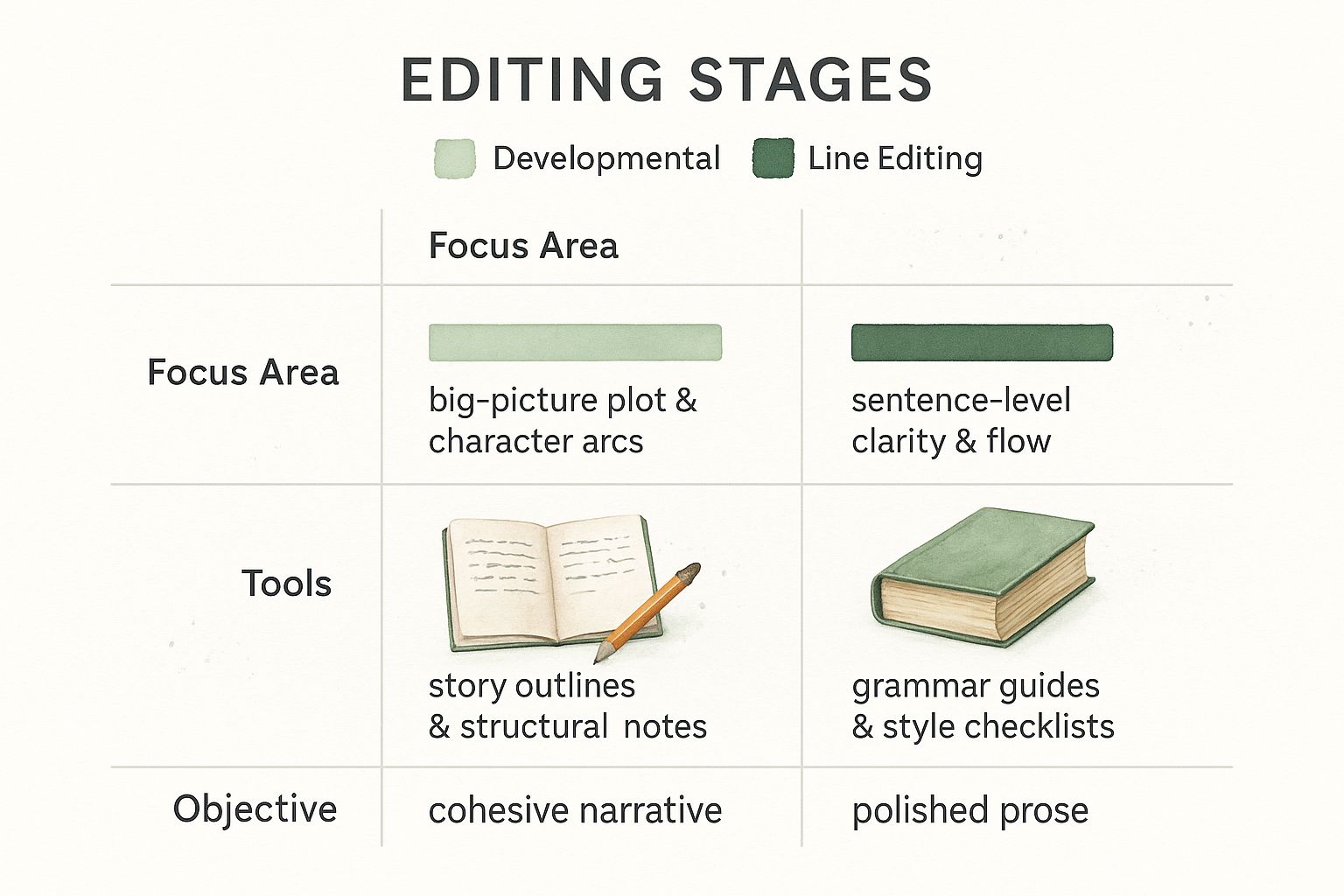
As you can see, developmental editing focuses on making sure the story itself works, while line editing makes the writing sing. Both are vital.
Deciding between these two publishing worlds can feel daunting. To make it a bit clearer, here’s a quick comparison of what you can expect from each.
Publishing Paths at a Glance
| Feature | Traditional Publishing | Self-Publishing |
|---|---|---|
| Upfront Costs | None. The publisher invests in you. | You cover all expenses for editing, design, marketing, etc. |
| Creative Control | Limited. The publisher has the final say on the cover, title, and often the content. | Full control. Every decision is yours to make. |
| Royalties | Lower (typically 10-15% of net receipts). | Higher (up to 70% on platforms like Amazon KDP). |
| Speed to Market | Slow. Can take 1-2 years or more from signing the contract to launch. | Fast. You can publish as soon as the book is ready. |
| Distribution | Broad, with access to physical bookstores and established channels. | Primarily online, though print-on-demand makes physical copies accessible. |
| Marketing Support | Varies. The publisher handles some marketing, but the author is expected to do a lot. | All marketing responsibility falls on you. |
| Validation/Prestige | The "stamp of approval" from a publisher can carry significant weight. | Success is built on reader reviews and sales, offering a different kind of validation. |
Ultimately, there's no single "best" choice—only the best choice for your book and your ambitions.
A More Personal Path to Publishing
Let's be honest: not every writer dreams of hitting the New York Times bestseller list. For many of us, the real goal is to create something deeply personal and share it with the people who matter most. Think about those charming children's stories, treasured family histories, or creative passion projects. For these kinds of books, the whole song and dance of traditional or mass-market self-publishing can feel like overkill.
The most meaningful publication journey is the one that aligns with your personal vision for your story. Whether that's global distribution or a single, cherished copy for your family, success is defined by you.
This is where a simpler, more direct approach can be perfect. Instead of trying to crack the code of the entire publishing industry, you can just focus on making a beautiful, high-quality book.
Platforms like LoveToRead.AI were built for this very purpose. They bridge the gap between your digital story and a physical, professionally printed book you can hold in your hands.
With just a few clicks, you can take the story you’ve so carefully crafted—with its unique characters based on your own photos and gorgeous, consistent art—and easily order a hardback copy. It’s a wonderfully straightforward way to create a meaningful gift for friends and family or a beautiful keepsake to remember your creative journey. It’s publishing on your own terms, centered on the pure joy of bringing a story to life.
Got Questions? Let's Get Them Answered
It's completely normal to have a head full of questions when you start writing. Every writer, no matter how experienced, has been there. Let's tackle some of the most common ones I hear so you can push forward with more confidence and less doubt.
Think of this as our final chat before you dive back into your world-building. Clearing up these common sticking points now will let you focus on what really matters: telling your story.
How Long Should My Story Be?
This is the big one, isn't it? The honest-to-goodness answer is that your story should be exactly as long as it needs to be. A gripping short story might only need 1,000 to 7,500 words, while a sprawling novel usually kicks off around the 40,000-word mark. If you're writing for a younger audience, a Young Adult novel often finds its sweet spot between 55,000 and 80,000 words.
Here’s a piece of advice I wish someone had given me sooner: Forget the word count on your first draft. Seriously. Just focus on telling a complete, satisfying story from beginning to end. You can always add scenes or trim the fat later on.
Get the heart of the story down first. The length will sort itself out as you let your characters and plot breathe.
What’s the Best Way to Deal With Writer's Block?
Ah, the dreaded block. I find it’s usually just a sign that you’re feeling overwhelmed or disconnected from the story. The trick is to stop fighting it and instead change your approach. Get up, step away from the screen, and do something completely different. Sketch, go for a walk, listen to an album you love—anything to get your creative brain firing in a new way.
Another great trick is "free writing." Just set a timer for 15 minutes and write anything that pops into your head. Don't stop, don't judge, don't edit. The point is just to get your fingers moving again. Or, you could simply jump ahead to a scene you’re actually excited to write. Breaking that inertia is everything.
Do I Really Need Special Software to Write?
Nope. All you truly need to write a story is something to type on. A basic word processor works just fine. That said, the right platform can feel less like a tool and more like a creative partner, especially if you're creating a story with visuals.
A dedicated platform like ours can step in to help with things like:
- Creating incredible art that perfectly captures the mood of your story.
- Keeping your characters looking consistent from the first page to the last.
- Printing a professional-quality hardback book when you're all done.
It lets you stay focused on the storytelling, while the technical and artistic details are handled for you. It can make the whole process feel a lot more seamless and inspiring.
How Can I Tell If My Story Idea Is Any Good?
Here’s the secret: A "good" idea is any idea you're fired up about. If you're passionate about the concept, that excitement will shine through in your writing and pull readers in. The idea itself is just the spark; the execution is the fire.
Want to put your idea to the test? Try explaining the main conflict in just one or two sentences. Does it have a hook? Pitch it to a friend you trust and watch their reaction. Remember, readers are hungry for unique voices. The self-publishing market is expected to rocket past $20 billion by 2025, and the number of self-published books has jumped by 264% in the last five years. There's real data behind this trend—you can read the full research about self-publishing trends and see for yourself. Your passion is what makes an idea great, and there's a huge audience waiting for it.
Ready to bring your own stories to life? With LoveToRead.AI, you can create personalized stories in seconds. Convert your real life photos into characters and build a library of characters to reuse across a variety of different stories. Experience the absolute best art styles and character persistence. When your masterpiece is complete, you can easily order any hardback copy. Start creating today at https://lovetoread.ai/.
Article created using Outrank