How to Improve Reading Comprehension in Kids
When we talk about improving reading comprehension, we're really talking about helping kids connect the dots between the words on the page and the world of ideas they represent. It’s a mix of different skills working together—like decoding words, knowing what they mean (vocabulary), and using what you already know to build a mental picture of the text.
What Is Reading Compreprehension, Really?
True reading comprehension isn't just about sounding out words. It's an active, dynamic process of making meaning. Think of it less like watching a movie and more like being a detective, constantly searching for clues to piece together the whole story.
It all starts with decoding—turning letters on a page into sounds and words. But that’s just the first step. The next layer is vocabulary. A child has to not only recognize a word but also grasp what it means.
The Core Parts of Understanding
Real understanding happens when a reader starts linking those words to what they already know about the world. This web of connections is what turns a simple string of sentences into a living story or a fascinating new idea.
You can spot a strong reader by watching what they do mentally as they read. They are constantly:
- Visualizing: Creating little movies in their head of the characters, places, and action.
- Making Inferences: Reading between the lines to figure out things the author doesn't say directly.
- Asking Questions: Wondering why a character did something or what might happen next.
A child who's struggling might read a page out loud perfectly but then have no idea what it was about. They might not be able to give you a simple summary or explain why a character was happy or sad. Catching these signs early is key to getting them the right support.
Reading is a conversation between the reader and the text. The goal is not just to hear the words, but to understand the message, question the ideas, and make the story a part of your own thinking.
Before we get to the specific strategies, let’s quickly break down the foundational skills. These are the pillars that hold up everything else.
The Building Blocks of Reading Comprehension
Here's a quick look at the essential skills that form the foundation of strong reading comprehension.
| Component | What It Means for Your Child | Why It Matters |
|---|---|---|
| Decoding | The ability to sound out words on the page. | Without this, reading is impossible. It’s the starting line. |
| Fluency | Reading smoothly, with proper speed and expression. | Frees up brainpower to focus on meaning instead of just sounding out words. |
| Vocabulary | Knowing the meaning of a wide range of words. | You can't understand a story if you don't know what the words mean. |
| Background Knowledge | What your child already knows about the world. | Helps them make connections and understand context. It’s the "mental file cabinet." |
| Working Memory | Holding onto information as they read. | Allows readers to remember what happened at the start of a sentence by the time they get to the end. |
Think of these as the ingredients in a recipe. You need all of them working together to create a truly skilled and confident reader.
The Role of Engagement and Environment
The setting where a child reads makes a huge difference. When reading is a fun, supportive activity—not a chore—comprehension skills just naturally get better. Study after study confirms the powerful link between a child's home life and how well they read.
For instance, a huge study of 400,000 students found that kids who genuinely enjoy reading and get encouragement at home consistently score higher on comprehension tests. The Progress in International Reading Literacy Study (PIRLS) pinpointed reading engagement at home as a critical factor for success—a finding that became even more clear after the COVID-19 pandemic affected reading scores worldwide.
This just drives home how important consistent, positive reading habits are. You can take a look at the complete findings in this global education report for a deeper dive.
Practical Strategies to Build Comprehension Skills
Knowing the theory behind reading comprehension is one thing, but putting it into practice with a young reader is where the magic really happens. The goal is to help kids shift from passively sounding out words to actively making sense of the story.
This isn't about complicated drills. It’s about using simple, powerful techniques that turn reading time into a dynamic exploration. When you model these skills, you’re not just reading a book; you’re teaching a child how to think like a reader.
This flow shows how a reader builds meaning—it’s a journey from just seeing words on a page to truly understanding their deeper context.
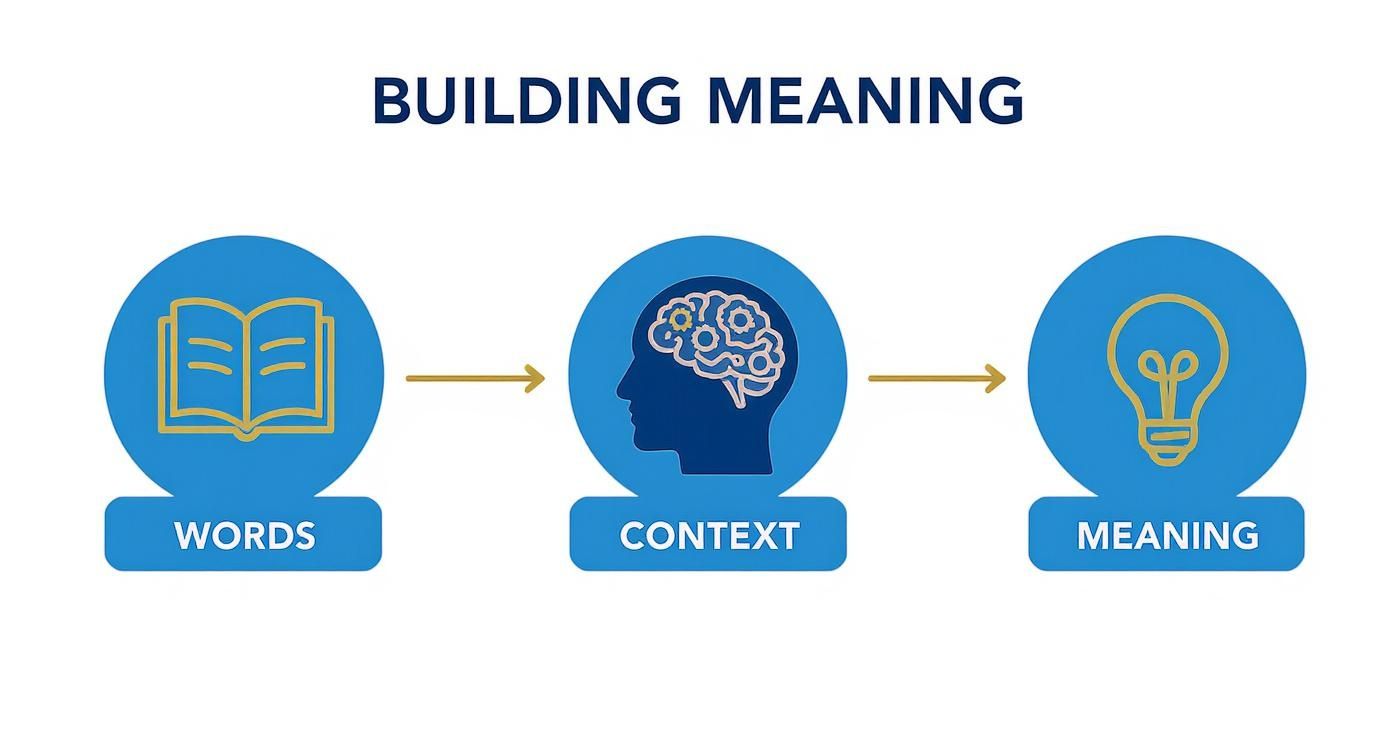
As you can see, the process starts with decoding, moves to connecting words with background knowledge, and culminates in genuine understanding. It's the foundational sequence for any reader looking to build confidence.
Use Think-Alouds to Model Understanding
One of the most powerful things you can do is make your own thinking visible. A think-aloud is exactly what it sounds like: you talk through your thoughts as you read a book together. This pulls back the curtain on the mental processes that strong readers use without even realizing it.
For instance, while reading a picture book, you might pause and say, “Hmm, the author says the little bear stomped his feet and crossed his arms. The picture shows him frowning, too. I’m thinking this tells me he’s feeling really angry right now, even though the words don't actually say ‘angry’.”
This simple act models inference-making in real-time. It shows your child that reading is about being a detective and hunting for clues, not just calling out words.
Ask Powerful Questions: Before, During, and After
Questions are the engine of comprehension. The trick is to ask different kinds of questions at each stage of the reading process. This keeps your child’s mind fired up and actively engaged with the text. If your child is still in picture books rather than chapter books, dialogic reading is this same habit scaled down to a bedtime story.
- Before Reading: Spark curiosity. Just look at the cover and ask, “What do you think this story might be about? What makes you say that?” This primes their brain to start predicting.
- During Reading: Keep tabs on their understanding. Pause at a key moment and ask, “Why do you think the character did that?” or “What’s your guess about what might happen next?”
- After Reading: Check for the big picture. Ask questions that require them to summarize or reflect, like, “What was the most important part of this story?” or “How did the main character change from the beginning to the end?”
A great question is a tool that helps a child build their own understanding. It doesn't just test what they know; it guides them to discover what they can figure out.
Teach Active Reading Strategies
Beyond just asking questions, there are a few core strategies you can explicitly teach that will transform a child from a word-caller into a meaning-maker. Giving kids these specific tools empowers them to tackle any text they encounter.
Research consistently backs this up. A World Bank report, for example, highlights that the most effective reading programs are those that explicitly teach core skills, including specific comprehension strategies. The report found this systematic approach gives reading abilities a significant boost across the board. You can read the full report on evidence-based literacy solutions to learn more.
Here are a few essential strategies to get started with:
1. Visualization
Encourage your child to create a movie in their mind. After reading a descriptive paragraph, stop and ask, “What do you see in your head right now? Can you describe the room the character is in?” This helps them engage their senses and build a much richer mental picture of the story.
2. Making Predictions
This strategy turns reading into an exciting game. Based on the title, cover, or what just happened in a chapter, ask, “So, what’s your prediction for what will happen next?” As you continue reading, you can circle back: “Was your prediction right? What clues helped you figure that out?”
3. Summarizing
Being able to summarize is a true test of comprehension. For younger kids, this can be as simple as retelling the main parts of the story in their own words. You can prompt them by asking, “Can you tell me the story in just a few sentences? Who was the story about, what did they want, and what happened at the very end?”
By teaching these practical skills, you equip young readers with a versatile toolkit. They learn not just how to read, but how to think deeply about what they are reading, setting them on a path to becoming confident, lifelong learners.
Making Reading Fun with Everyday Activities
Let's be honest, improving reading comprehension doesn't have to mean sitting at a desk with a book. In fact, some of the best learning happens when kids don't even know they're "practicing" a skill. By weaving little comprehension-building moments into your daily life, you can nurture these abilities in a way that feels natural and fun.
The trick is to connect the dots between understanding stories and understanding the world around them. It shifts the dynamic from "homework" to "play," taking the pressure off and building a genuinely positive vibe around reading.
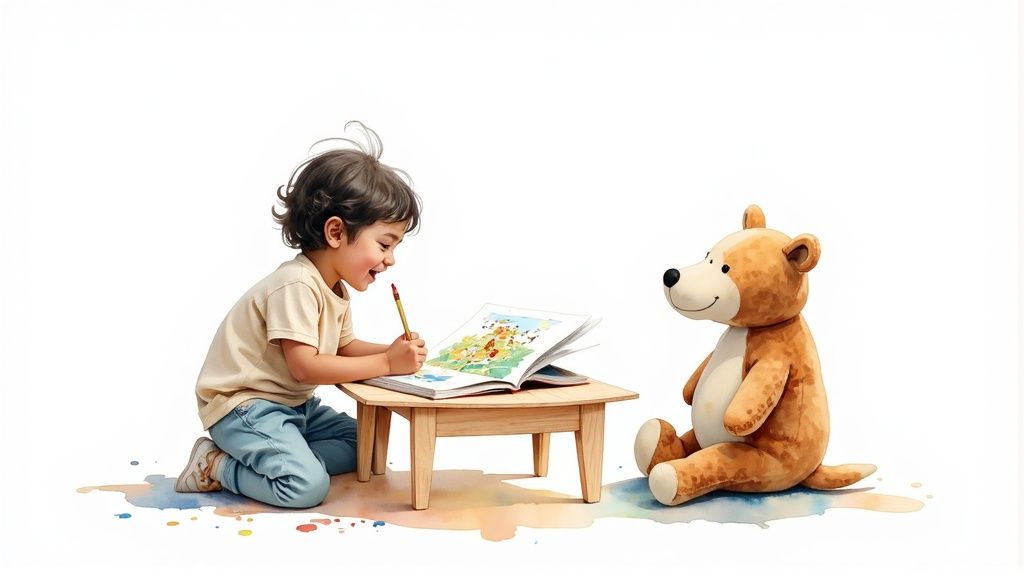
This approach helps kids naturally develop those crucial habits of mind—like predicting, questioning, and summarizing—without the formal structure of a lesson. Suddenly, routine activities become rich learning opportunities.
Turn Daily Routines into Story Time
Your day-to-day life is already packed with chances to flex those comprehension muscles. With just a little intention, you can turn a trip to the store or a family meal into a powerful learning experience.
Think about your next grocery run. Hand your child the list and give them a mission: find the next three items. It seems simple, but this little task forces them to decode words, hold information in their head, and follow a plan. These are the nuts and bolts of comprehension.
Or try baking together. Following a recipe is a goldmine for this stuff. Ask them to read the next step out loud. Then, before you do it, toss out a quick question: “What do you think will happen when we add the eggs to the flour?” You’re teaching them to think ahead and grasp cause and effect, which is exactly what they need to do to follow a plot.
The secret is to embed practice in activities your child already loves. When learning is just part of the fun, it becomes a habit, not a chore.
Even screen time can be a tool. Pause a movie during a big scene and ask, "What do you think that character is feeling right now? What clues make you say that?" This is just a casual way of teaching inference, an absolutely essential skill for reading between the lines.
Get Creative with Hands-On Activities
For a lot of kids, especially the ones who need to move, getting their hands and bodies involved is the key to unlocking a story. Tangible activities help them process information in a completely different way.
One of my favorite low-prep ideas is creating a story map. After finishing a book, just grab a big piece of paper and some markers. Ask your child to draw the main things that happened in the story, in order. We're not looking for a masterpiece; the goal is simply to help them visualize the story’s beginning, middle, and end.
Here are a few other hands-on ideas to get you started:
- Act It Out: Get silly and act out your favorite scene from a book together. To play the part, your child has to think deeply about the character's feelings and motivations.
- Character Journal: Have them write a quick diary entry from the main character’s point of view. "What was I thinking during that big chase scene?" This is a fantastic way to build empathy.
- Build the Setting: Bust out the LEGOs, Play-Doh, or even just an old shoebox to create the world from the story. This tactile process really makes the setting stick in their minds.
These playful methods turn abstract ideas into something kids can touch and feel, making them much easier to remember. It’s a brilliant way to improve reading comprehension for children who learn best by doing.
Ultimately, the more personal and engaging you can make a story, the deeper a child will connect with it. A really cool way to do this is to literally make them the hero. Platforms like LoveToRead.AI give you the power to create stories that actually star your child, using their photos to generate characters. That personal connection is magnetic. You can even create a personalized storybook in seconds and watch their imagination light up.
Using Technology to Spark a Love for Reading
Let's face it, we live in a world full of screens. But instead of fighting it, we can lean into technology to make reading a real adventure for our kids. When used the right way, certain tools can transform reading from a quiet, solo activity into an interactive experience that actually improves reading comprehension. The trick is finding tech that pulls a child deeper into the story, rather than just distracting them.
Think of interactive e-books with pop-up questions or apps that turn vocabulary into a game. These digital tools meet kids on their own turf, making stories more personal, accessible, and just plain fun. When a child sees a tablet as a portal to new worlds, their desire to read and understand what they're reading grows naturally.

Make Reading Deeply Personal
What’s the fastest way to get a young reader hooked? Make them the star of the show. Seriously. When kids see themselves as the hero of the story, their engagement level goes through the roof. This isn't just a fun gimmick; it's a direct path to better comprehension because they are instantly invested in what happens next.
Imagine a book where the main character doesn't just share your child's name but actually looks like them. That immediate recognition makes abstract concepts like plot and setting feel real and important. They aren't just reading about a brave astronaut; they're reading about themselves as a brave astronaut.
This level of personalization helps kids instinctively understand things like point of view. They're far more likely to ask insightful questions ("What would I do in that situation?") and make predictions because they have a real stake in how the story turns out.
The Power of AI-Generated Storybooks
New tools are taking this idea and running with it. One of the most exciting developments is the ability to generate unique, high-quality stories built entirely around your child in a matter of seconds. We've moved way beyond simply plugging a name into a template.
Technology becomes a powerful learning tool when it fosters a deeper connection between the reader and the story. Personalization is the key that unlocks a child's intrinsic motivation to understand.
For example, a platform like LoveToRead.AI lets you upload a photo of your child and turn them into a storybook character. That character can then star in countless different tales, creating a wonderful sense of continuity from one story to the next. For engagement, and by extension comprehension, this makes a real difference.
Key Features That Boost Comprehension
As you look for the right tech, a few features can make a huge difference in how your child builds their understanding.
-
Character Creation and Reuse: The ability to build a library of characters—your child, their best friend, the family dog, even their favorite stuffed animal—is huge. When a child’s personal character shows up in a new story, it’s like visiting an old friend, making each book feel familiar and exciting.
-
High-Quality Art Styles: Visuals are everything for young readers. Stunning, professional illustrations capture their imagination and offer rich context clues that support the words on the page. The art helps them visualize the action, which is a core comprehension skill.
-
On-Demand Story Generation: Kids’ interests change fast. One week it's all dinosaurs, the next it's deep-sea exploration. The ability to create a story about any topic in seconds means you can always match their reading to their latest obsession, instantly grabbing their attention.
This kind of immediate personalization keeps reading from ever feeling stale. A child who is genuinely curious about the topic is far more likely to put in the mental energy to truly understand it.
Bringing the Story to Life
The magic doesn't have to stay on the screen. The final piece of the puzzle is bringing the digital into the physical world. Being able to order a hardback copy of a personalized story creates a treasured keepsake that reinforces the whole experience.
Holding a real book that stars them as the hero makes a child feel like a published author. It's a tangible reward that strengthens their positive feelings about reading and encourages them to revisit their own adventures again and again. Every time they re-read it, they're reinforcing their grasp of the vocabulary, plot, and themes.
Ready to make your child the hero of their own story? Explore how you can create personalized adventures in seconds with LoveToRead.AI. You can turn real photos into storybook characters, build a reusable character library, choose from beautiful art styles, and even order a hardback copy of your unique creation.
Tackling the Tough Spots in Reading Comprehension
Even the most enthusiastic young reader hits a snag now and then. One minute they're devouring books, the next they seem completely checked out. These bumps in the road are usually signs of specific comprehension struggles, but they're far from permanent. Once you pinpoint what's really going on, you can offer the right kind of support to help them get back on track and feel confident again.
These challenges aren't just happening in your home; they're part of a bigger picture. Global literacy data reveals that comprehension issues are common, and recent educational disruptions have led to a dip in fourth-grade reading scores, even in high-income nations. It’s a clear signal that our kids need consistent, early support to improve reading comprehension. You can dive deeper into these trends by exploring the latest literacy statistics and their implications.
Figuring out the specific problem is always the first move toward finding a solution.
What to Do When Their Focus Fades
Does your child start fidgeting just a few pages into a story? A short attention span is a classic hurdle, especially for our younger readers or when a text suddenly gets more complex. It's usually not about a lack of interest—it's about cognitive overload. Their brain is juggling decoding words, tracking characters, and making sense of it all. If the fidgeting shows up at a predictable point every session rather than only on hard texts, it is worth working on reading stamina directly before pushing comprehension further.
The trick is to work with their attention span, not fight it.
- Break it down. Instead of pushing through a whole chapter, read in smaller, more digestible chunks. A focused 10 minutes of successful reading is way better than a frustrating 30-minute battle.
- Guide their eyes. A simple bookmark or even a ruler placed under the line they're reading can work wonders. It helps keep their eyes from jumping all over the page, which can feel overwhelming.
- Take a "brain break." After a short reading session, get them up and moving. A quick stretch or a walk around the room helps reset their focus before they jump back in.
This approach builds reading stamina over time, making longer books feel much less daunting.
When Abstract Concepts Don't Click
Some kids are very literal thinkers. They can give you a perfect play-by-play of what happened in the story, but they get stuck when you ask them why. Abstract ideas—like a character's true motivation, the underlying theme, or inferring what someone is thinking—can feel like a total mystery.
The goal is to make the invisible visible. Help your child become a "story detective," searching for the clues the author leaves behind to understand what’s happening beneath the surface.
To help them connect the dots, bring in some visual tools to make these fuzzy ideas more concrete. A graphic organizer is your best friend here. A simple "Character Map," for instance, can help them chart a character's feelings, actions, and motivations as the story unfolds.
You could also try a T-chart to separate what the book says outright ("What Happened") from what it implies ("What It Means"). These visual aids give their thoughts a place to land, helping them build the connections they might otherwise miss. It’s a skill that goes way beyond one book—it teaches them how to think critically about any story they pick up.
Got Questions About Reading Comprehension? We’ve Got Answers.
As a parent or teacher, you know that helping a child become a strong, confident reader isn’t always a straight shot. It’s a journey with its own twists and turns, and it’s perfectly normal to have questions pop up along the way.
Let’s work through some of the most common ones I hear from parents. The goal here is to give you clear, practical answers you can start using right away.
When Should We Actually Start Focusing on Comprehension?
You might be surprised to learn that comprehension skills begin taking root long before a child can even sound out a word. When you're reading a picture book to your toddler, you're laying the foundation. You’re building their vocabulary, showing them how stories work, and introducing them to the rhythm of language. They’re soaking in the idea that stories have a beginning, a middle, and an end.
A more direct focus on comprehension can start the moment they begin reading words themselves, usually around kindergarten or first grade. Comprehension becomes the main event later on, in the phase researchers call reading to learn — our guide to the stages of reading development explains when that shift usually happens. Keep it simple. Ask questions like, "What do you think will happen next?" or "Why do you think the bear was so grumpy?"
As they grow as readers, the conversations can get deeper. The key is that it's never too early to talk about what a story means; the conversation just evolves as their skills do.
What Can I Do to Help a Child Who Hates Reading?
This is a big one. The first thing to do is put on your detective hat and figure out the why. Is the book just too hard, leading to pure frustration? Or is it simply boring to them? More often than not, a reluctance to read comes from a mismatch between the book and the kid. We go deeper on that mismatch — including how to tell a reluctant reader from a struggling one, which changes what you should do next — in our guide to books for reluctant readers.
The best fix is to connect reading to their passions. If they’re obsessed with dinosaurs, hunt down the most exciting books on paleontology you can find. If they love video games, graphic novels or books about how games are made might be the perfect hook.
Don't get stuck on a narrow definition of "reading." Audiobooks, magazines, interactive story apps, and even just following a recipe together are all fantastic ways to practice comprehension.
Your main goal is to create positive, low-pressure reading experiences that feel like fun, not a chore. Nothing motivates a child to read more than seeing their own world and interests reflected on the page.
What's the Difference Between Fluency and Comprehension?
This is such a crucial distinction to understand. Fluency is the mechanics of reading—being able to read words accurately, at a good pace, and with natural-sounding expression. Comprehension is all about the meaning—actually understanding what you just read.
If it's the fluency side where your child is stuck — the words come out right, but the reading sounds flat or choppy — our guide to reading fluency and how to build it at home covers what to listen for and the practice that moves it.
The two are deeply connected, but they aren't the same. I've seen many kids who can read a passage out loud beautifully—every word perfect—but have zero idea what it was about. They're fluent, but they aren't comprehending.
Think of fluency as the bridge that gets you to comprehension. When a child doesn't have to struggle with sounding out every single word, their brain is freed up to focus on the bigger picture: the characters, the plot, and the meaning behind it all. It’s vital to work on both skills at the same time.
How Much Reading Does My Child Need to Do Every Day?
When it comes to building any skill, consistency beats duration every time. You’ll see much better progress with short, daily reading sessions than with one long, cram session on a Sunday afternoon.
So, what’s a good target?
- For younger readers in K-2, aim for a solid 15–20 minutes a day.
- For older elementary students in grades 3-5, bumping that up to 20–30 minutes is a great goal.
Remember, this isn't just about silent, independent reading. This time can be a mix of them reading to you, you reading to them, or just talking about a book you both enjoyed. The quality of that time—the questions, the predictions, the laughs—matters far more than the number on the clock.
The most powerful way to foster a love for reading is to make it personal. At LoveToRead.AI, we help you do just that. You can create personalized stories for your child in seconds, converting their real-life photos into characters and building a reusable library for endless adventures. With the absolute best art styles and character persistence, you can bring their unique stories to life and even order a beautiful hardback copy. Discover how to make your child the hero of their own story at https://lovetoread.ai/.