Creating Your Own Story Book with AI
Bringing a personal story idea to life as a beautifully illustrated, published book used to feel like an impossible dream for most people. The traditional path was long, complicated, and often expensive.
This guide is all about a new way forward. We'll walk through how you can sidestep that entire complex process and go from a simple concept to a finished, hold-in-your-hands book in a single afternoon. Seriously.
A Whole New Way to Make Your Own Story Book
Think about a cherished family memory or a funny inside joke you share with your child. Now, imagine turning that little spark of an idea into a professional-quality storybook in just a few minutes. For generations, that was unheard of. Creating a book meant tackling separate, time-consuming stages: writing the manuscript, finding an illustrator you could afford, designing the layout, and then trying to figure out the publishing world.
That old way of doing things was a huge barrier for most families and educators. It kept book creation in the hands of a few. Thankfully, that's not our reality anymore.
From Months of Work to Minutes of Fun
AI-powered platforms have completely changed the game, putting the power of an author, illustrator, and publisher right at your fingertips. What once took months of coordination and effort can now be a fun, creative activity you do in one sitting.
This isn't just a small change; it's part of a huge shift. Self-publishing has grown sharply over the last decade, and it's easy to see why. Creators want more control and a faster path to a finished product. If you're curious, you can find more insights on this trend and see how it's empowering independent authors everywhere. This new approach isn't just about speed—it's about making storytelling accessible to everyone.
This simplified process lets you focus on what truly matters: the heart of your story. You get to be the creative genius without getting bogged down by all the technical stuff.
It boils down to a simple, three-step journey: from a creative spark to a finished book.
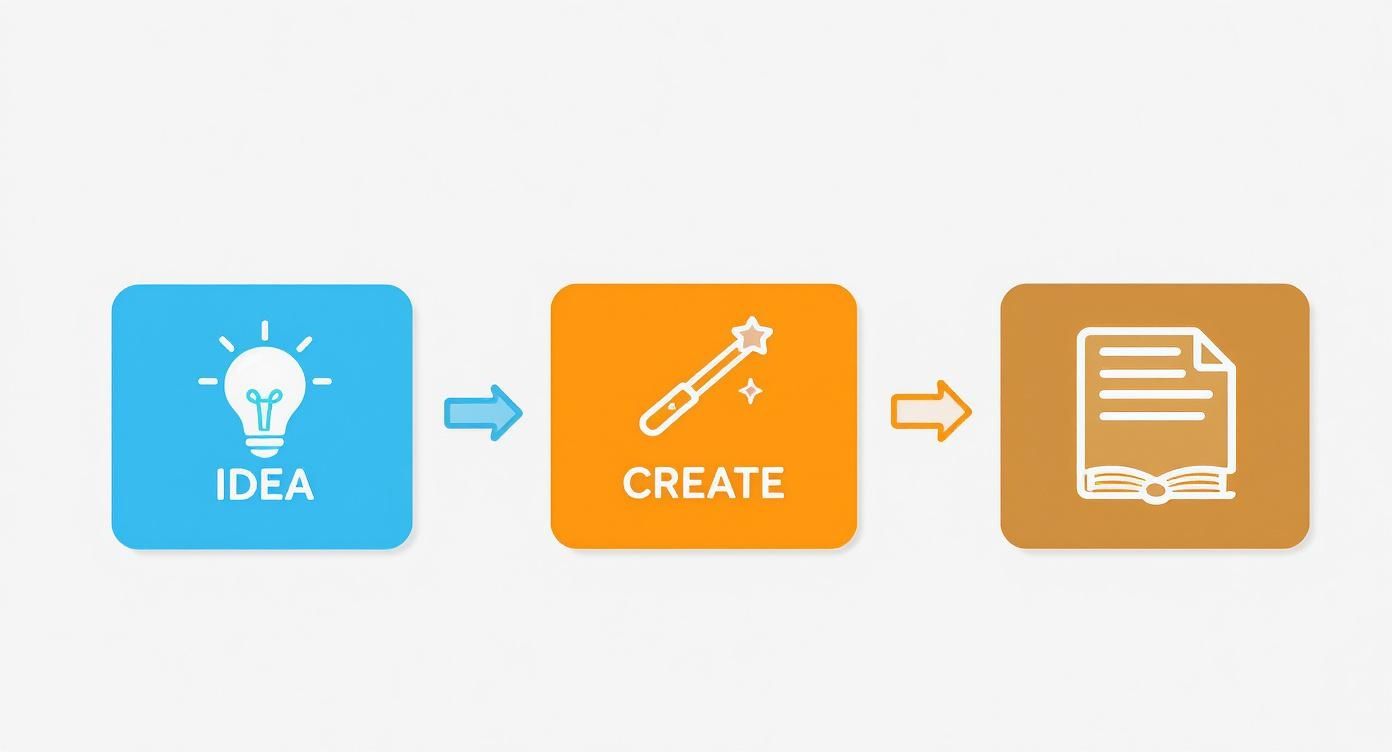
This flowchart really shows how today's tools have merged the creative, production, and printing steps into one seamless workflow.
To really appreciate the difference, let's compare the old way with the new.
Traditional vs AI-Powered Storybook Creation
| Process Step | Traditional Method | AI-Powered Method (e.g., LoveToRead.ai) |
|---|---|---|
| Writing | Weeks or months of drafting and editing. | Minutes. AI helps draft a story based on your ideas. |
| Illustration | Hiring an artist, which can take months and cost hundreds or thousands. | Seconds. AI generates custom illustrations instantly. |
| Revisions | A slow back-and-forth process with the illustrator and editor. | Instantaneous. Change text or regenerate images on the fly. |
| Layout/Formatting | Requires design software and expertise; can be costly and complex. | Automated. The platform handles all formatting for you. |
| Publishing | Finding an agent or publisher, or navigating complex self-publishing platforms. | One-click. Order a printed copy directly from the platform. |
| Cost | Can easily run from $500 to $5,000+ for a single book. | A small fraction of the cost, often a low one-time fee per book. |
As you can see, the AI-powered approach removes nearly all the friction, time, and prohibitive costs, opening up a world of creative possibility.
Creating a Deeper Connection Through Personalization
What really makes this new method special is the depth of personalization. You're not just writing a generic story; you're weaving your child's own world directly into the pages.
With today's technology, you’re not just making a book—you're crafting a unique experience where your child sees themselves as the hero of their own adventure. This connection is the magic ingredient for fostering a lifelong love of reading.
Platforms like LoveToRead.ai have taken this a step further by letting you convert real-life photos into storybook characters. You can build a whole library of characters based on your kids, grandparents, and even the family dog, and use them again and again with perfect consistency.
When a child opens a book and sees a hero that looks exactly like them, the story becomes theirs. It’s a powerful way to make reading a deeply personal and unforgettable experience. This is the future of making your own story book.
Finding Your Perfect Story Idea
Every great book starts with that first flicker of an idea. When you're making a storybook for a child you love, the best inspiration usually comes from the world you already share. You don't need a massive, epic fantasy—you just need a concept that feels real and connects with them on a personal level. Honestly, the most powerful stories are often the simplest ones, built on genuine feelings and experiences.
Forget the pressure to invent something totally new. The most brilliant ideas are hiding in plain sight, just waiting for you to spot them. Your child’s own life is a goldmine of story-worthy material.
Think about it: that hilarious thing they said over breakfast, that unforgettable family vacation, or the time they showed surprising kindness to a friend. These aren't just memories; they're the raw ingredients for a story that will feel both exciting and comfortably familiar to them.
Draw Inspiration from Everyday Life
The trick is learning to see the "story" inside the memory. A simple real-life event can easily become a fantastic narrative once you give it a little shape. For instance, remember that time your child was terrified to try a new food but ended up loving it? That’s a perfect plot right there.
Here are a few places I always tell people to look for their next great idea:
- A Funny Quote: Did your kid once seriously declare that spaghetti noodles are just "wiggly worms"? That's your opening line for a silly adventure about a boy who's convinced his dinner is alive.
- A Memorable Trip: A trip to the local zoo can morph into a tale about a mischievous monkey that sneaks into your backpack and follows you home. A day at the beach? That could easily become a story about finding a seashell that whispers secrets.
- A Lesson Learned: Think about a time your child had to be brave, was reluctant to share a favorite toy, or went out of their way to help a friend. These moments are natural, built-in stories about courage, friendship, and empathy.
Shaping Your Idea into a Story
Once you’ve caught that initial spark, the next step is to mold it into a basic plot. All good children’s stories have a clear beginning, middle, and end. This structure doesn’t need to be complicated; it’s just a simple path that guides the reader logically from start to finish.
A great story idea for a child takes a familiar feeling—like being scared of the dark or buzzing with excitement for a birthday—and explores it through a simple, relatable adventure. The magic happens when the child feels truly seen and understood.
Take a moment to think about the core theme you want to explore. Is this a story about the thrill of trying something new? The importance of being a good friend? Or maybe the sheer power of imagination? Pinning down this central message will be your north star, keeping the narrative focused and meaningful as you start bringing your book to life.
Bringing Your Story and Characters to Life with AI
So, you've got your story idea mapped out. Fantastic! Now comes the fun part: turning those concepts, characters, and plot points into a real, illustrated narrative. This is where modern AI tools really shine, stepping in as a dedicated creative partner. They handle the heavy lifting of writing and illustrating, but you’re always in the director's chair, guiding the final product.
The best part of making your own book is seeing that vision become a reality. Platforms like LoveToRead.ai are designed to make this whole process feel intuitive and a little bit magical, especially when it comes to personalization. You're not just creating a story with generic characters; you're building a world around a hero that is genuinely meaningful to your child.
Turn Real Photos into Storybook Heroes
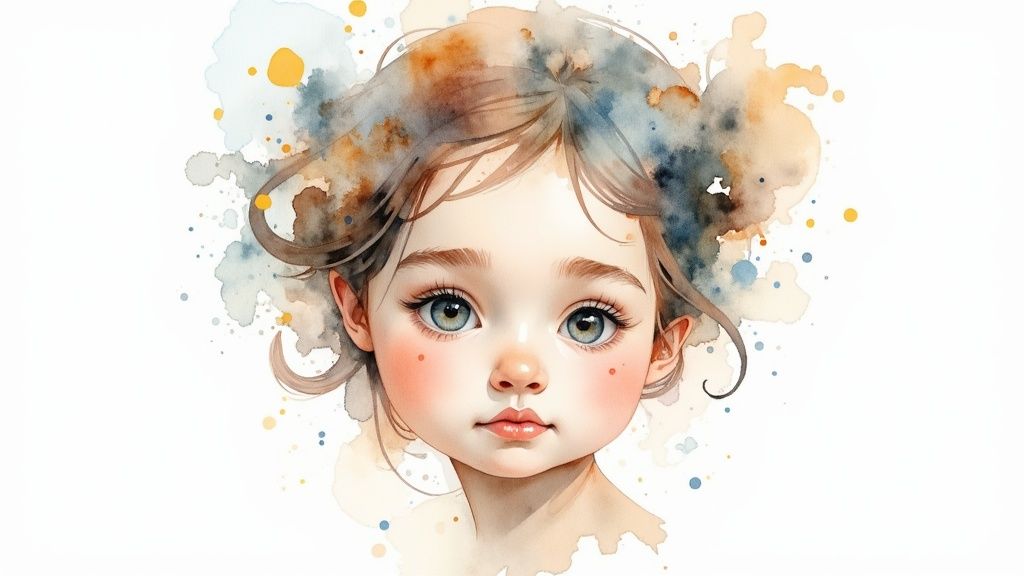
One of the most useful features now available is the ability to transform a real photograph of your child, a beloved pet, or even a grandparent into a storybook character. Just imagine the look on your child's face when they open a book and see a beautifully illustrated version of themselves as the star. It creates an instant, powerful connection that makes storytime unforgettable.
The process is surprisingly straightforward. You upload a clear photo, and the AI gets to work, analyzing key features to generate a unique character. What’s even better is that some platforms, including LoveToRead.ai, let you save these characters in a library. This means your child can star in a whole series of adventures, and their character will look perfectly consistent every single time.
Crafting the Perfect Narrative with AI
With your hero ready to go, it's time to build the story. Think of this as a collaboration where you guide the AI with specific instructions, or prompts. A great prompt gives the AI clear direction and details.
For example, instead of a vague request like "write a story about a brave knight," try something much more descriptive:
"Write a funny, rhyming story for a five-year-old about a nervous but brave little knight named Alex who is afraid of fluffy kittens. The story should have a happy ending where Alex learns that the kittens just want to play."
This level of detail is gold. It tells the AI about the tone (funny, rhyming), the target age, the plot, and the character arc you have in mind. You can steer everything from the vocabulary level to the core moral of the story.
The rise of these tools has completely changed how stories are created and shared. We're seeing a huge shift in how families interact with books, largely driven by the convenience of tablets and smartphones. In fact, children's digital audio sales recently jumped 28.2% and e-books grew 9.6% in just one month. This trend toward digital creation and reading is undeniable. You can read the full statistics on recent book sales to get a better sense of how the market is evolving.
Choosing Your Visual Style
The final piece of the puzzle is deciding on the look and feel of your book. For a child, the illustrations are just as important as the words. Most AI tools offer a variety of art styles, allowing you to find the perfect match for your story's mood.
Here are a few popular options you'll likely come across:
- Watercolor: Soft, dreamy, and absolutely perfect for whimsical or gentle tales.
- Cartoon: Bold, bright, and a fantastic choice for funny or action-packed adventures.
- Anime: Expressive and dynamic, great for stories that feature big emotions.
- Pixel Art: A fun, retro style that works especially well for video game-themed narratives.
Once you’ve picked a style, the AI takes care of character persistence, which is a fancy way of saying your custom hero will look the same on every single page. This visual consistency is crucial for creating a professional, polished book that feels like a believable world your young reader can get lost in.
Giving It That Final Polish
You’ve done it. You have a complete first draft of your storybook, with text and illustrations generated in a fraction of the time it would normally take. Now comes the most important part: adding your personal touch. This is where you, the creator, step in to transform a clever AI creation into something truly special and heartfelt.
Think of yourself as the story's first and most important reader. This final polish isn’t about heavy-duty editing; it's about making small, thoughtful tweaks that align everything perfectly with your original vision.
A Quick Checklist for Refining the Story
The best way to start is by reading the entire story out loud. Seriously, don't skip this step. It’s the fastest way to find sentences that sound clunky, spot awkward phrasing, or notice where the pacing just feels a little off. You'll immediately hear if the language is too grown-up or too simple for your little reader.
Once you've done a read-through, take a closer look at the details.
- Is the tone consistent? If you're writing a zany, laugh-out-loud adventure, you don't want a suddenly formal or serious sentence popping up out of nowhere. Keep the vibe consistent from start to finish.
- Does the story flow logically? Make sure each page connects smoothly to the next. The journey from the first page to the last should feel natural and easy for a child to follow.
- Is the language right for the age? A book for a 4-year-old will use very different words and sentence structures than one for an 8-year-old. Swap out any words that might be too tricky.
Making Sure the Pictures Tell the Same Story
Now, let's look at the art. AI image generators have gotten very good at keeping characters consistent, but it's always worth a final check. Does your main character look the same from one scene to the next?
More importantly, do the illustrations match the text? If your story describes the brave knight feeling nervous, his picture shouldn't show him with a huge, confident grin.
This final review is all about making sure the words and the art are a perfect team. When they work together seamlessly, that’s when the story really comes alive and feels magical.
Spotting a mismatch isn't a disaster. For instance, if the text says, "Leo felt a tear roll down his cheek," but the illustration shows him happy, that's an easy fix. Just go back to that specific page in your AI tool and regenerate the image with a slightly adjusted prompt. A little tweak is usually all it takes to get it just right.
This final quality check is what turns your project into a polished, professional-looking book you’ll be proud to read and share.
Printing and Sharing Your Custom Story Book
You’ve done all the creative work—dreaming up characters, weaving a story, and bringing it all to life with illustrations. Now for the best part. Seeing your creation go from a file on your screen to a real, physical book you can hold is a genuinely good feeling. That moment you finally have the glossy cover and vibrant pages in your hands is when the project truly feels complete.
This is where your story makes the leap from screen to shelf, becoming a durable, professional-looking book that’s ready for countless story times. And thankfully, it's easier than ever.
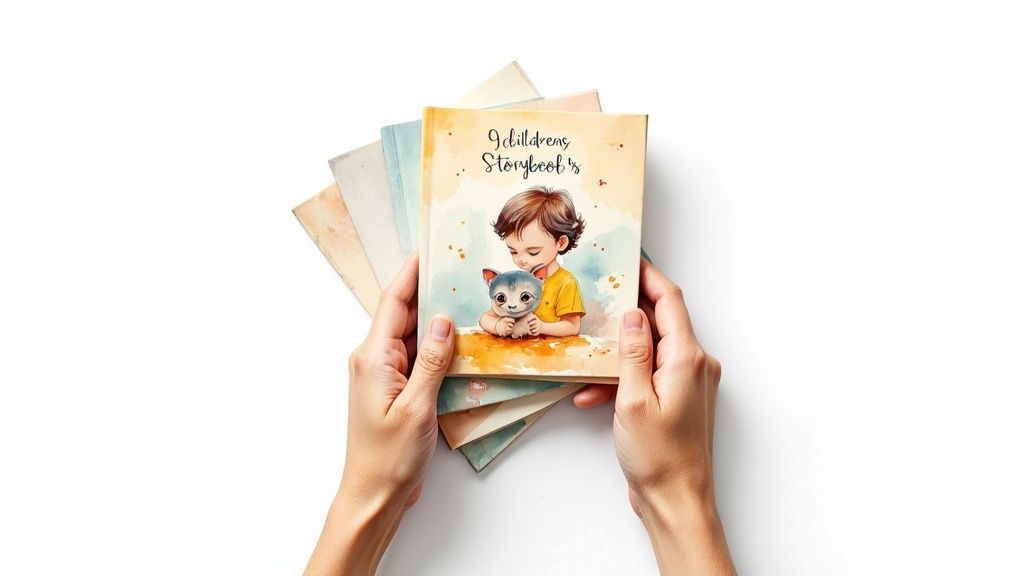
From Digital File to Hardback Heirloom
Modern AI platforms have made the printing process surprisingly straightforward. A service like LoveToRead.ai, for example, builds the ordering process right into their system, which cuts out all the usual publishing headaches. With just a few clicks, you can order a high-quality, durable hardback copy of the very book you just finished designing.
Forget about wrestling with file formats, color profiles, or finding a reliable third-party printer. The platform takes care of all the technical heavy lifting behind the scenes. All you have to do is give it a final look-over and wait for that special package to show up at your doorstep.
What arrives isn't just a printout; it's a bookstore-quality product. You can expect a professionally bound book with a sturdy cover designed to survive the love of enthusiastic little readers. The pages are printed on high-quality paper that makes the colors of your AI-generated illustrations truly shine.
Sharing Your Creation with Family and Friends
While one special copy for your child is the main goal, you’ll probably find yourself wanting to share the magic. These personalized books make fantastic, heartfelt gifts for grandparents, cousins, and close family friends. Ordering a few extra copies is just as simple as ordering the first one.
You aren’t limited to physical copies, either. Most platforms let you download a PDF version of your book. This is perfect for emailing to relatives who live far away or loading onto a tablet for a modern, on-the-go storytime.
Even with all our screens, the power of a physical book is undeniable. The U.S. children's storybook market is valued at a massive $3.3 billion in 2025, and print sales have held remarkably steady. It just goes to show that families still treasure the experience of cuddling up with a real book. You can discover more insights about children's book publishing to see just how much print continues to matter.
Creating a physical book does more than just finish a project. It solidifies a memory, captures a moment in your child's life, and creates a cherished heirloom that can be passed down and enjoyed for years to come.
This final step is the ultimate reward. It’s the moment you get to see your child's eyes light up as they hold a book that stars them, ready to start an adventure you created together. It’s a truly magical end to your book-making journey.
Common Questions About Making AI Storybooks
As you get ready to jump in and create your own storybook, a few questions are bound to come up. This is a pretty new and exciting way to make stories, so it’s totally normal to be curious about how it all works. I've pulled together some of the most common questions I hear to give you clear, straightforward answers.
Do I Really Need to Be an Artist or a Writer for This?
Nope, not at all. And honestly, that's the whole point. You bring the heart of the story—the initial spark, the character's personality, all those little personal details—and the AI steps in as your dedicated writer and illustrator.
Think of yourself as the creative director. You're the one calling the shots on the plot, the feel of the story, and the visual style. This process lets anyone create a genuinely professional-quality book without ever having picked up a paintbrush or taken a writing class. The tech handles the heavy lifting, freeing you up to focus on the fun part: the vision.
How Does the AI Actually Make the Characters Look Like My Kid?
This is where the magic really happens. The platforms built for personalized stories use some pretty smart technology. You just need to upload a few clear photos of your child. From there, the AI gets to work, carefully analyzing the images to pick up on their key facial features.
It then generates a consistent, beautifully illustrated character that looks just like your child on every single page. The key here is something called character persistence. This advanced tech is what makes sure the hero of the story looks right from the first page to the last.
Can I Use My Custom Characters Again in Other Stories?
Absolutely, and this is a fantastic feature for parents and educators. Once you’ve created a character from a photo, the best platforms let you save that character right into your personal library. This is a game-changer if you want to create a whole series of adventures.
Building a library of your own characters—your child, their friends, even the family pet—lets you create a familiar world that grows with your reader. Every new book feels like coming home.
This means you can easily bring back your child as the star, cast a sibling as a trusty sidekick, or even feature the family dog as a goofy companion in brand-new tales. You can build an entire universe around your custom cast without ever having to start from scratch.
What’s the Quality of the Physical Hardback Books Like?
The final printed books are designed to be lasting, professional keepsakes. When you decide to order a hardback copy, you should expect a book with a sturdy cover, high-quality paper, and vibrant, crisp printing that really makes the illustrations come alive.
The goal isn't just to make something that looks good on a shelf. It’s to deliver a real, bookstore-quality product that can stand up to the love and enthusiasm of a young reader. It becomes a cherished family item you can enjoy together for years to come.
Ready to bring your own story idea to life? At LoveToRead.AI, you can create personalized stories within seconds. Convert your real-life photos into characters, create a library of heroes to reuse across different stories, and choose from a wide range of art styles with perfect character persistence. Start creating your own story book today and easily order a beautiful hardback copy to treasure forever.