Hanukkah Traditions: A Family Guide to All Eight Nights
A practical guide for parents of young children: the menorah, gelt, dreidel and latkes, plus a simple theme for each of the eight nights. Hanukkah 2026 begins at sundown on Friday, December 4.
The Story Behind the Light: Why Hanukkah Matters
Hanukkah, also called the Festival of Lights, is one of the most beloved celebrations in the Jewish calendar — and one of the most accessible for young children. At its heart, it is a story about courage, hope, and a small flame that refused to go out. Understanding that story transforms every tradition, from the sizzle of latkes to the spin of a dreidel, from a fun activity into a living connection to thousands of years of Jewish history.
The holiday commemorates events that took place more than 2,000 years ago in Jerusalem. A small group of Jewish fighters called the Maccabees reclaimed the Holy Temple from the Seleucid Greek army, which had seized and desecrated it. When the Maccabees went to rededicate the Temple — the word "Hanukkah" itself means "dedication" in Hebrew — they found only enough ritually pure olive oil to keep the Temple's menorah burning for a single day. Yet the oil burned for eight full days, which is why we celebrate for eight nights.
For young children, the most powerful way to tell this story is to frame it as a tale of bravery and a tiny bit of oil that simply refused to give up. You don't need to go into the full military history with a three-year-old — the emotional core of the story is enough. "A small group of people were very brave. They found just a little bit of oil. And do you know what? That oil kept burning and burning, all the way for eight whole nights. That's why we light candles — to remember that miracle." That's Hanukkah in a nutshell.
Hanukkah 2026 begins at sundown on Friday, December 4, the eighth candle is lit on Friday, December 11, and the holiday ends at nightfall on Saturday, December 12. Because both the first and the last night fall on a Friday, families who keep Shabbat light the hanukkiah before the Shabbat candles, a little before sunset. Either way, a Friday start gives you a weekend evening to open the celebration without the pressure of a school night.
Understanding the "why" behind the holiday gives every tradition deeper meaning. The candles are not just pretty — they are a public declaration of the miracle. The fried foods are not just delicious — they honor the oil. The dreidel is not just a toy — it carries a hidden message of hope. When children know the story, the whole holiday comes alive.
The Classic Hanukkah Traditions Every Family Should Know
Before you can build your own family's Hanukkah traditions, it helps to understand the classic ones that have been passed down through generations. These are the five pillars of the holiday — the ones that appear in virtually every Jewish home, from New York to Los Angeles to Tel Aviv.
The Hanukkiah: Lighting the Menorah
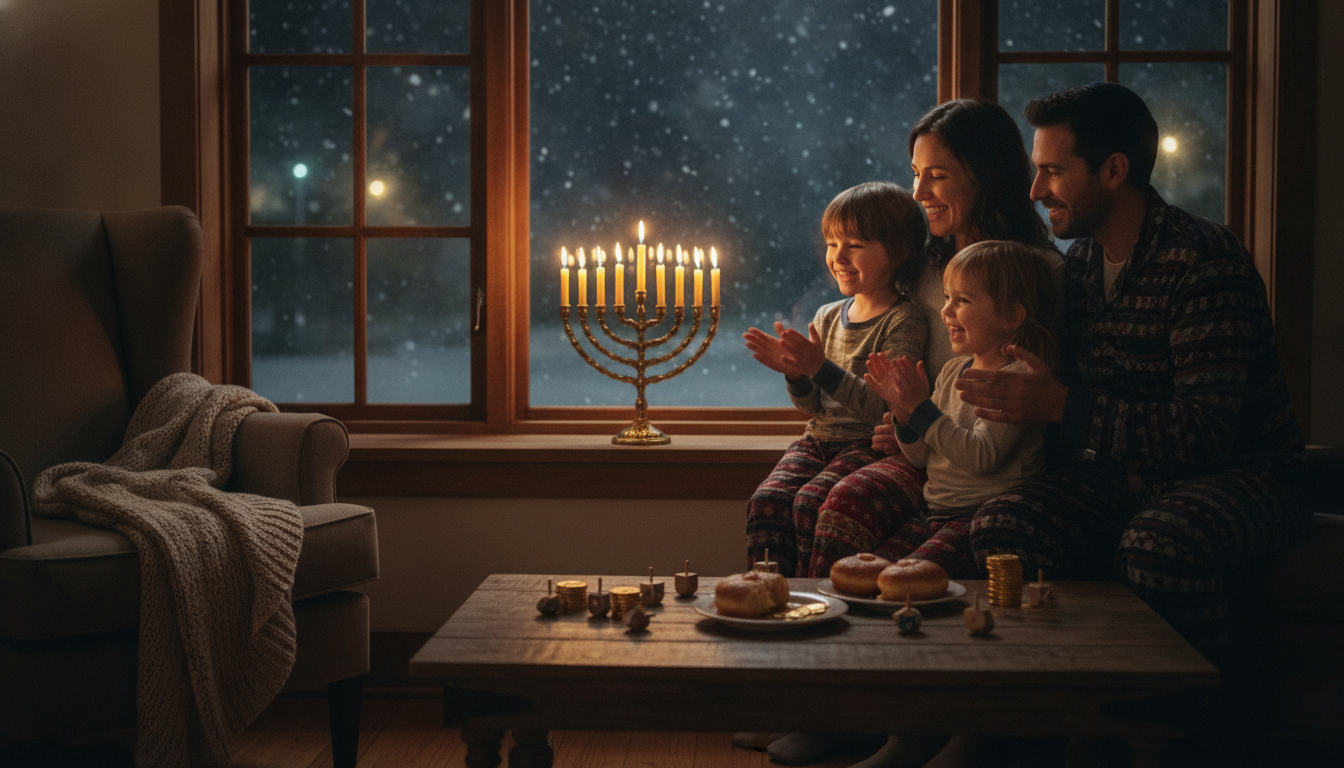
The hanukkiah — the nine-branched Hanukkah menorah — is the heart of the holiday. One candle or oil lamp is lit on the first night, two on the second, and so on, with a special candle called the shamash (the "helper" candle) used to do the lighting each time. The shamash sits slightly apart from or above the other candles, so it's always clear which light is which. Placing the lit hanukkiah in a window is a beloved tradition rooted in the commandment to "publicize the miracle" — to let the world see the light. For young children, the nightly ritual of counting candles and watching the hanukkiah grow brighter each night is a beautiful, concrete way to experience the passage of time.
Gelt: The Gift of Gold
Gelt — the Yiddish word for money — has been given to children during Hanukkah since at least the 18th century in Eastern Europe, and it doubles as a first lesson in generosity and charity. Today, gelt takes two wonderful forms: real coins given by grandparents and relatives as a symbol of blessing, and the iconic gold foil-wrapped chocolate coins that appear in grocery stores from late November onward. Both have their place. The chocolate gelt is pure joy for young children; the real coins open the door to conversations about saving, spending, and giving to others.
The Dreidel: A Game with a Hidden Message
The dreidel is a four-sided spinning top inscribed with the Hebrew letters Nun, Gimel, Hey, and Shin, which stand for the phrase Nes Gadol Hayah Sham — "A great miracle happened there." (In Israel, the last letter is Pey, for "here.") Players spin the dreidel and win or lose pieces of gelt, chocolate chips, or raisins depending on which letter lands face up: Nun means nothing happens, Gimel means you take the whole pot, Hey means you take half, and Shin means you put one in. It is a perfect game for young children because it involves luck rather than skill, moves quickly, and ends with everyone eating chocolate.
Fried Foods: Honoring the Oil
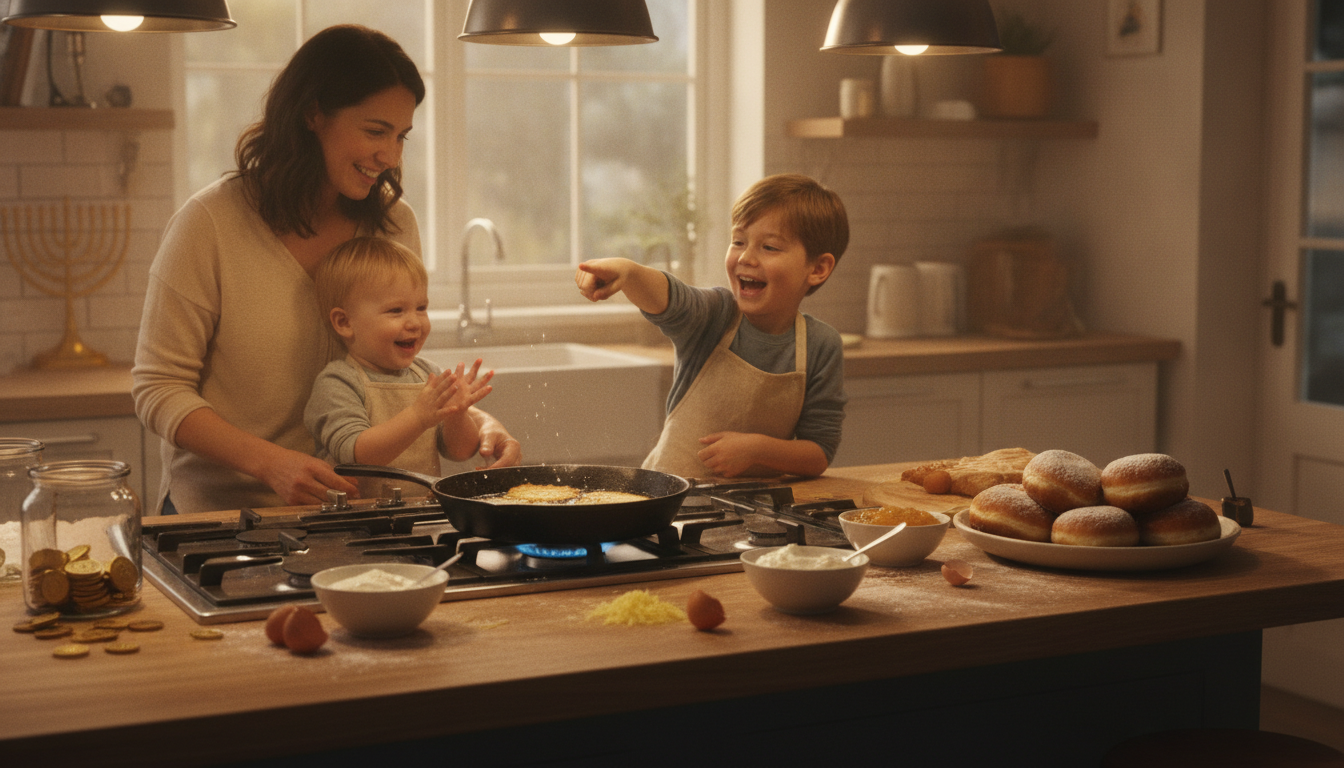
Fried foods are central to Hanukkah because oil is the symbol of the miracle. Latkes — crispy potato pancakes served with sour cream or applesauce — are the most beloved Hanukkah food in American Jewish homes. Sufganiyot, jelly-filled doughnuts dusted with powdered sugar, are equally popular and have become a wonderful baking project to tackle with kids. Both dishes fill the kitchen with warmth and the kind of smell that becomes permanently associated with the holiday in a child's memory.
Songs: Building Musical Memory
Singing Hanukkah songs while the candles burn down is one of the simplest and most powerful traditions a family can build. Maoz Tzur (Rock of Ages) is the traditional liturgical song sung after lighting; I Have a Little Dreidel is the playful classic that even toddlers can hum along to. Music builds memory in a way that nothing else does — children who grow up singing these songs will find them rising up, unbidden, decades later.
The Modern Eight-Nights Idea: One Theme Per Night
In recent years, many Jewish families have embraced a structured approach to Hanukkah where each of the eight nights has a small theme. Rather than treating Hanukkah as a single gift-giving event — or worse, trying to compete with the scale of Christmas — the themed-nights approach turns the holiday into a week-long celebration of experiences, values, and togetherness. It works especially well for young children, who thrive on anticipation and routine.
The beauty of this framework is that it naturally shifts the focus away from presents and toward moments. Some nights have a small, inexpensive gift that reinforces the theme — a book on Book Night, a new pair of pajamas on Pajama Night, a coin to donate on Giving Night. Other nights are purely about an activity or experience. The goal is always joy and connection, not a pile of boxes.
Why the Themed-Nights Approach Works for Young Children
- Young children thrive on predictability — knowing "tonight is Game Night" builds delicious anticipation all day long.
- It spreads the celebration across the full eight nights rather than front-loading everything on Night 1.
- Extended family members can "sponsor" a night, making them feel included even if they can't be there in person.
- Smaller, more meaningful moments beat large gifts every time when it comes to lasting memories.
- The framework is flexible — adapt any night to suit your child's interests or your family's values.
This approach also pairs beautifully with other holiday reading traditions. If you enjoy building a book advent calendar in December, the themed-nights structure gives you a natural home for a new book on Night 2 — and you can extend the reading magic all month long.
Your Eight-Night Hanukkah Theme Table for 2026
Here is a complete guide to all eight nights of Hanukkah 2026, with a theme and small gift idea for each. Think of this as a starting point — swap any night for something that fits your family better, and don't feel pressure to do every element every year. The best traditions are the ones that feel natural to you.
| Night & Date | Theme | Activity | Small Gift Idea |
|---|---|---|---|
| Night 1 Fri, Dec 4 |
Candle Night | Set up the hanukkiah together, learn the blessings, and let kids place their own candles | A child-safe flameless LED menorah or a Hanukkah candle kit |
| Night 2 Sat, Dec 5 |
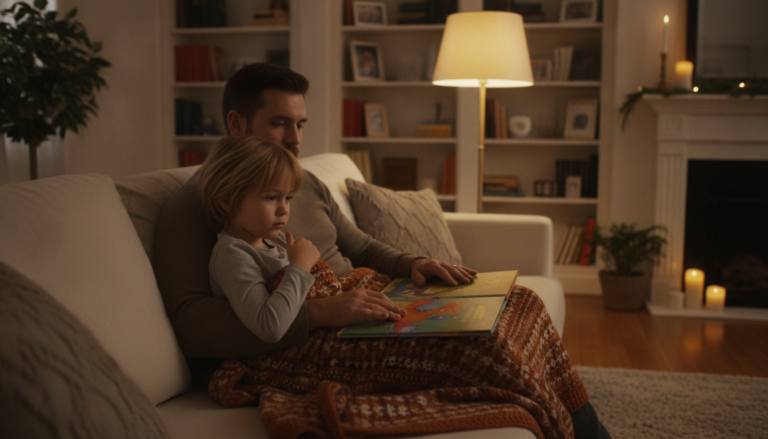
Book Night | Read Hanukkah stories together by candlelight; visit the library for a stack of holiday picture books | A personalized illustrated storybook from LoveToRead, where your child stars in their very own story — a keepsake they'll treasure for years |
| Night 3 Sun, Dec 6 |
Game Night | Play dreidel with chocolate gelt, then break out a family board game or card game | A new dreidel set, a family card game, or a Hanukkah-themed puzzle |
| Night 4 Mon, Dec 7 |
Giving Night | Talk about tzedakah (charity and justice) and let children choose a cause to donate to together | A decorated tzedakah box or piggy bank, plus a coin to start their giving fund |
| Night 5 Tue, Dec 8 |
Cooking Night | Make latkes or sufganiyot together; assign kids age-appropriate tasks like mixing, topping, or decorating | A child-sized apron, a fun cookie cutter set, or a kids' cookbook |
| Night 6 Wed, Dec 9 |
Movie Night | Snuggle up for a family-friendly film with Hanukkah or Jewish themes; make popcorn together | A cozy new blanket, a bag of popcorn, or a stuffed animal to cuddle during the film |
| Night 7 Thu, Dec 10 |
Art Night | Make paper dreidels, paint a menorah, or create handmade Hanukkah cards for grandparents | A new art supply set, stickers, or a watercolor kit |
| Night 8 Fri, Dec 11 |
Pajama Night | End the festival with the coziest night of all — hot cocoa, final candle-lighting, and a family snuggle | Festive holiday pajamas, a warm robe, or cozy slippers |
A note on Book Night: if you want one gift from this entire list to be a true keepsake, this is it. LoveToRead creates personalized illustrated storybooks where your child is the star of the story — their name, a character drawn to look like them, their own adventure. It's the kind of book that gets read again and again, long after the candles have burned down. For families who want to explore a wider selection of Hanukkah reading material, our guide to Hanukkah books for kids covers the best read-alouds for every night of the holiday.
Hanukkah Traditions by Age: Toddlers to Early Readers
One of the most common questions parents ask is: "How do I make Hanukkah meaningful for a two-year-old and a seven-year-old at the same time?" The answer is that Hanukkah is remarkably age-flexible — the same traditions can be experienced at completely different depths depending on where a child is developmentally. Here's how to tailor each stage.
Toddlers (Ages 1–2): Sensory and Simple
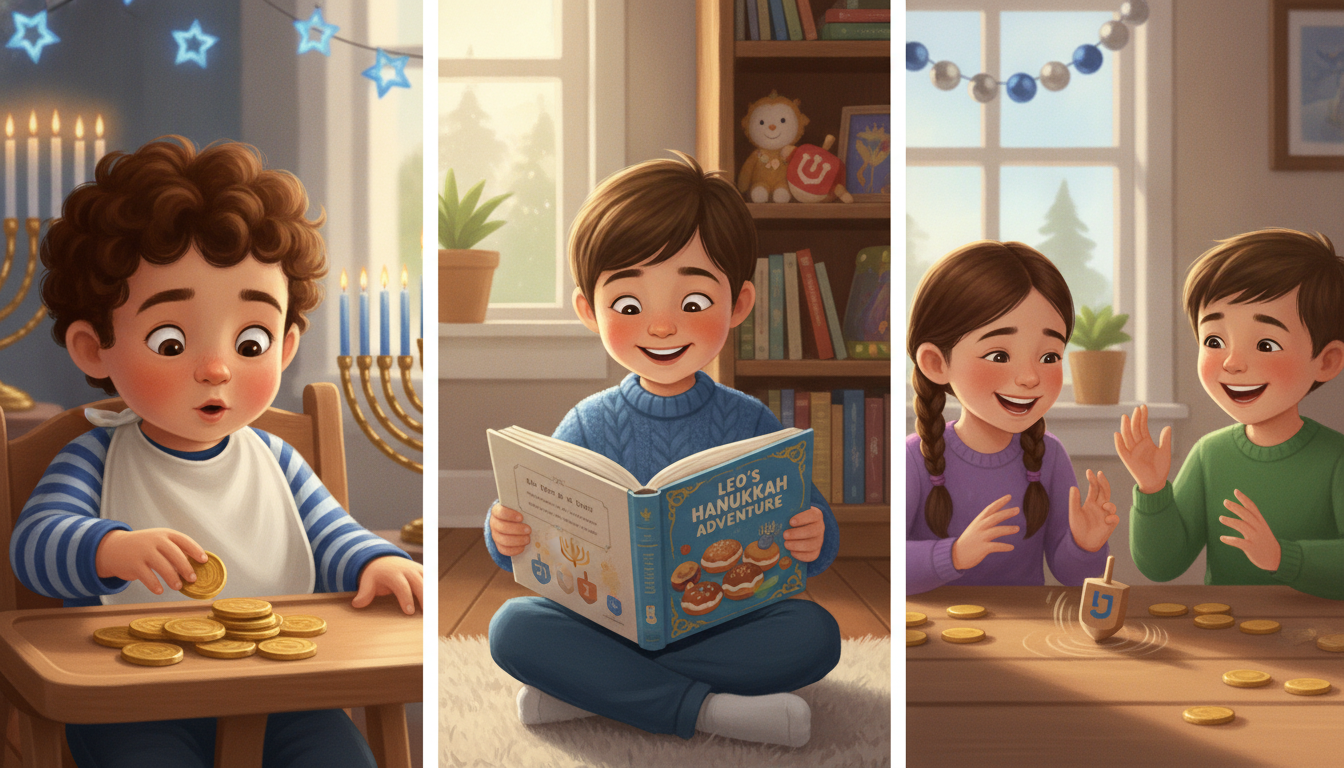
Keep it sensory and brief. Let toddlers touch the dreidel, shake it, and watch it spin across the floor. Give them chocolate gelt to unwrap — with supervision, of course — and revel in the joy on their faces. Read board books about Hanukkah with bright, bold illustrations; they don't need to absorb the whole story, just the warmth and the color. Involve them in latke-making by letting them stir a bowl or pat a piece of dough. The menorah lighting should be a calm, brief ritual with lots of narration: "Look at the pretty light! We light candles because of a very old miracle." That's enough. The feeling of the moment is what they'll carry forward.
Preschoolers (Ages 3–4): The Golden Age of Hanukkah Magic
This is the age when Hanukkah truly comes alive. Preschoolers can learn the basic dreidel rules and play a simple version of the game with great excitement. They can help place candles in the hanukkiah, recite simple blessings with prompting, and participate in every themed night with boundless enthusiasm. They are also at the perfect age for a personalized storybook from LoveToRead — because the line between story and reality is beautifully blurry at this age. When a preschooler sees their own name and a character who looks like them in a book, the magic is absolute. For more ideas on what makes a truly meaningful gift for this age group, see our roundup of personalized gift ideas for kids in 2026.
Kindergarteners (Ages 5–6): Ready to Learn and Lead
Children at this stage are ready to learn the Hebrew letters on the dreidel and what they stand for. They can memorize the Hanukkah blessings with a little practice and may enjoy helping to plan one of the themed nights — ask them: "What should we do on Game Night?" and watch them take ownership. Giving Night takes on real meaning as they begin to understand that other families have different needs, and choosing a charity becomes a genuine act of empathy rather than an abstract concept.
Early Readers (Ages 7–8): Taking Ownership of Tradition
Older children can read Hanukkah books independently, research the Maccabee story in age-appropriate books, and take real ownership of the holiday's traditions. They can lead the dreidel game for younger siblings, help cook latkes with more independence, and write a heartfelt Hanukkah card to a grandparent. The eight-nights structure gives them something to anticipate each day and teaches patience and delayed gratification — valuable life skills wrapped in celebration. If you have early readers in your family, our Hanukkah books for kids guide includes chapter book options and longer read-alouds perfect for this age.
The Most Important Tradition of All
Across all ages, the most powerful tradition is consistency. Children who grow up with the same songs, smells, foods, and rituals year after year build a deep, embodied sense of Jewish identity that stays with them long into adulthood. You don't have to do everything on this list — but the things you do, do them every year. That repetition is where the magic lives.
Five Frequently Asked Questions About Hanukkah Traditions
When exactly does Hanukkah 2026 start?
Hanukkah begins at sundown on Friday, December 4, 2026, and the eighth and final candle is lit on the evening of Friday, December 11, with the holiday ending at nightfall on Saturday, December 12. Because the Jewish calendar is lunar, Hanukkah falls on different dates each year in the Gregorian calendar, so it's always worth double-checking the year's dates. The fact that 2026's first night falls on a Friday evening is a wonderful bonus — families have a full weekend night to celebrate without the constraints of a school night.
How much gelt should we give?
There are no rules — gelt is meant to be a small, symbolic gift. Many families give a few real coins each night alongside chocolate gelt. The amount matters far less than the conversation around it: talking about saving, spending, and giving (tzedakah) turns a handful of coins into a meaningful lesson. Some families give a dollar coin each night; others give a quarter and a handful of chocolate coins. Follow your instincts and your budget.
Do we have to give a gift every night?
Absolutely not — nightly gifts are a modern, mostly American custom, and plenty of families skip them altogether. The themed-nights approach is a wonderful middle ground: some nights have a small, inexpensive gift, others are purely about an experience or activity. The goal is joy and togetherness, not a pile of presents. If you're looking for a framework that naturally limits gift-giving while keeping the magic alive, this is it. The four-gift rule that many families use for Christmas — want, need, wear, read — can be adapted beautifully for Hanukkah's eight nights as well.
How do we handle Hanukkah when our children are different ages?
Lean into the differences rather than fighting them. Toddlers can participate in sensory ways — touching, tasting, watching — while older children take on more responsibility. The eight-nights structure is naturally flexible: a toddler can enjoy Pajama Night just as much as a seven-year-old, even if they experience it completely differently. Older kids often love being "in charge" of explaining traditions to younger siblings, which deepens their own understanding at the same time.
What is the best way to make Hanukkah feel special without overspending?
Focus on ritual over stuff. The menorah lighting itself — the blessings, the songs, the glow of the candles — costs nothing and creates the most powerful memories. Homemade latkes, a library copy of a Hanukkah book (or one of our free stories), and a bag of chocolate gelt from the grocery store are all you truly need for a magical celebration. If you want one meaningful keepsake gift, a personalized storybook from LoveToRead is a beautiful investment that a child will treasure long after the candles have burned down — and it doubles as a Book Night gift that anchors the whole eight-night experience.
Conclusion: Building Hanukkah Traditions That Last
Hanukkah does not need to compete with Christmas. It is a celebration with its own distinct magic — the warmth of candlelight growing brighter each night, the smell of latkes frying, the satisfying clatter of a dreidel spinning across a wooden table, the sound of a child learning to say the blessings for the first time. These are the things that stay.
The traditions we've explored in this guide — from the classic hanukkiah lighting and gelt-giving to the modern eight-nights themed structure — are all tools in service of one goal: helping your children feel the joy and meaning of this holiday so deeply that they carry it with them for the rest of their lives. You don't need to do everything at once. Start with the candles. Add a themed night. Let it grow.
If you're building a broader December full of reading and tradition, you might also enjoy our guides to Christmas traditions for families, St. Nicholas Day traditions (December 6, two days after the first candle) and the beautiful Icelandic tradition of Jolabokaflod — giving books on Christmas Eve — which pairs wonderfully with Hanukkah's Book Night spirit.
Start Your Hanukkah Traditions This Year
Whether you're lighting your first menorah or looking for fresh ways to make eight nights feel special, the most important ingredient is intention. Choose the traditions that resonate with your family, adapt them to your children's ages, and let the warm glow of the hanukkiah do the rest. Hanukkah 2026 begins at sundown on Friday, December 4 — you have plenty of time to plan eight unforgettable nights. Start with Book Night and give your child a story that stars them.
Create a Personalized Hanukkah Storybook


One Comment
Comments are closed.