Jolabokaflod: What It Means, How to Say It, and Why Your Family Should Try It This Christmas Eve
If you just heard this word in a bookshop and had no idea how to pronounce it, you are in exactly the right place. Here is everything you need to know.
You are standing in a bookshop in November, half-listening to the person at the till, and you hear the word jolabokaflod. It sounds beautiful and slightly impossible, and you have no idea where to start with it. This guide will fix that in the next ten minutes.
By the time you reach the end, you will know what the word means, where the tradition came from, how to say it without embarrassing yourself, and — most usefully — exactly how to run it at home with children aged two to twelve this Christmas Eve.
What Does Jolabokaflod Mean and How Do You Actually Say It?
Jolabokaflod is an Icelandic compound word, and like most Icelandic compound words it is far more straightforward than it looks once you break it into pieces. It has three parts:
- Jola — meaning Christmas or Yule
- Boka — meaning books
- Flod — meaning flood
Put those together and you get the Christmas book flood, or the Yule book flood. That is the whole translation. It is not mysterious or poetic — it is simply a description of what happens: at Christmas, books flood into the house.
The letter J in Icelandic makes a Y sound — the same as the J in the name Björk. So there is no hard J at the front. Say it slowly in three chunks and you will be close enough. Your children will almost certainly want to attempt it too, which is a reasonable way to spend five minutes before the books come out.
The tradition itself is beautifully simple. On Christmas Eve, everyone in the household gives and receives at least one book as a gift. Then the evening is spent reading — in bed, on the sofa, or wherever is warmest — usually with something hot to drink. That is it. No special equipment, no elaborate setup, no performance. Just books and time.
A Short History: How Iceland's Book Flood Began
Iceland declared independence in 1944, and in the years surrounding that moment the country was living under real scarcity. Wartime supply chains had made many ordinary goods difficult or impossible to find. Fabric, toys, imported foods — all of these were in short supply or rationed outright.
Paper, however, was one material Iceland could still obtain in reasonable quantities. That meant books remained one of the few gifts an ordinary family could actually afford and find during the Christmas season. Giving a book was not a fallback — it was a genuine and practical expression of care.
Icelandic publishers began producing an annual autumn catalogue called the Bokatidindi — the Book Bulletin — which was sent to households across the country each year. Families could browse new titles, make their choices, and order well before the Christmas rush. The catalogue became a fixture of Icelandic autumn life, something people looked forward to rather than treated as junk mail.
The habit of gifting books at Christmas became so deeply embedded in Icelandic culture that it outlasted rationing entirely. Iceland is known for how much it publishes and reads relative to its size, and the jolabokaflod tradition is part of that picture.
This is worth saying plainly: jolabokaflod is not a commercial invention or a recent marketing idea. It grew organically from genuine circumstances and genuine love of reading. That is part of what makes it feel worth borrowing for your own family. You are not adopting a trend — you are borrowing a custom that has been working quietly for decades.
How to Set Up a Jolabokaflod Evening at Home
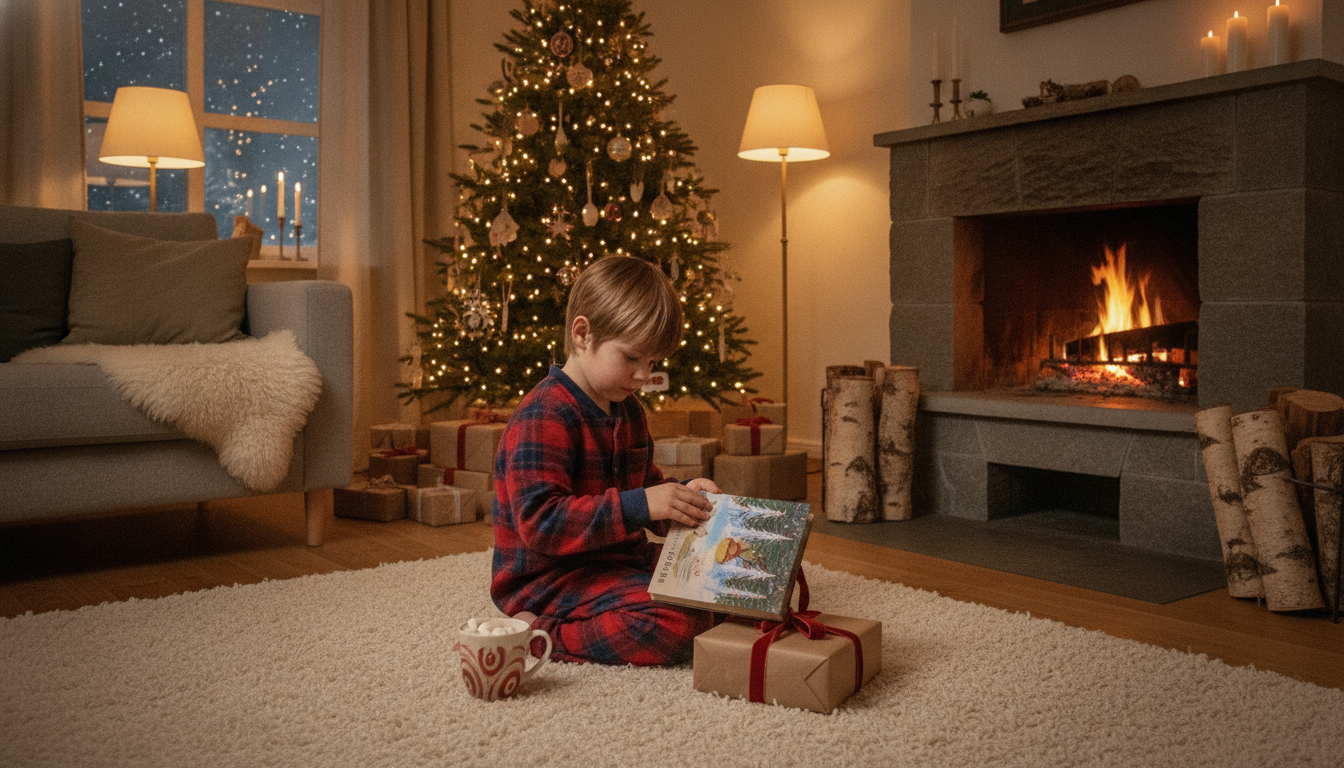
The most important thing to get right is the atmosphere. Jolabokaflod works best in one lit, warm, quiet room. A sitting room with a lamp and a fire if you have one — or simply the living room with the overhead light off and a few candles or fairy lights doing the work instead. The shift in lighting alone signals to children that something different is happening.

Keep the evening deliberately slow and screen-free. The whole point is that the book becomes the entertainment, so televisions and tablets should be put away before the books come out. This is not a punishment — frame it as part of the ritual, and most children will accept it without argument if the alternative is genuinely appealing.
A few things that make the evening feel like an occasion without requiring any real effort:
- Pajamas. The tradition is built around the idea that Christmas Eve reading is cozy and unhurried, not a performance. Pajamas or comfortable clothes make the whole thing feel different from a normal evening.
- Something warm to drink. Hot cocoa for the children, tea or something stronger for the adults. The drink gives everyone something to do with their hands while they settle in.
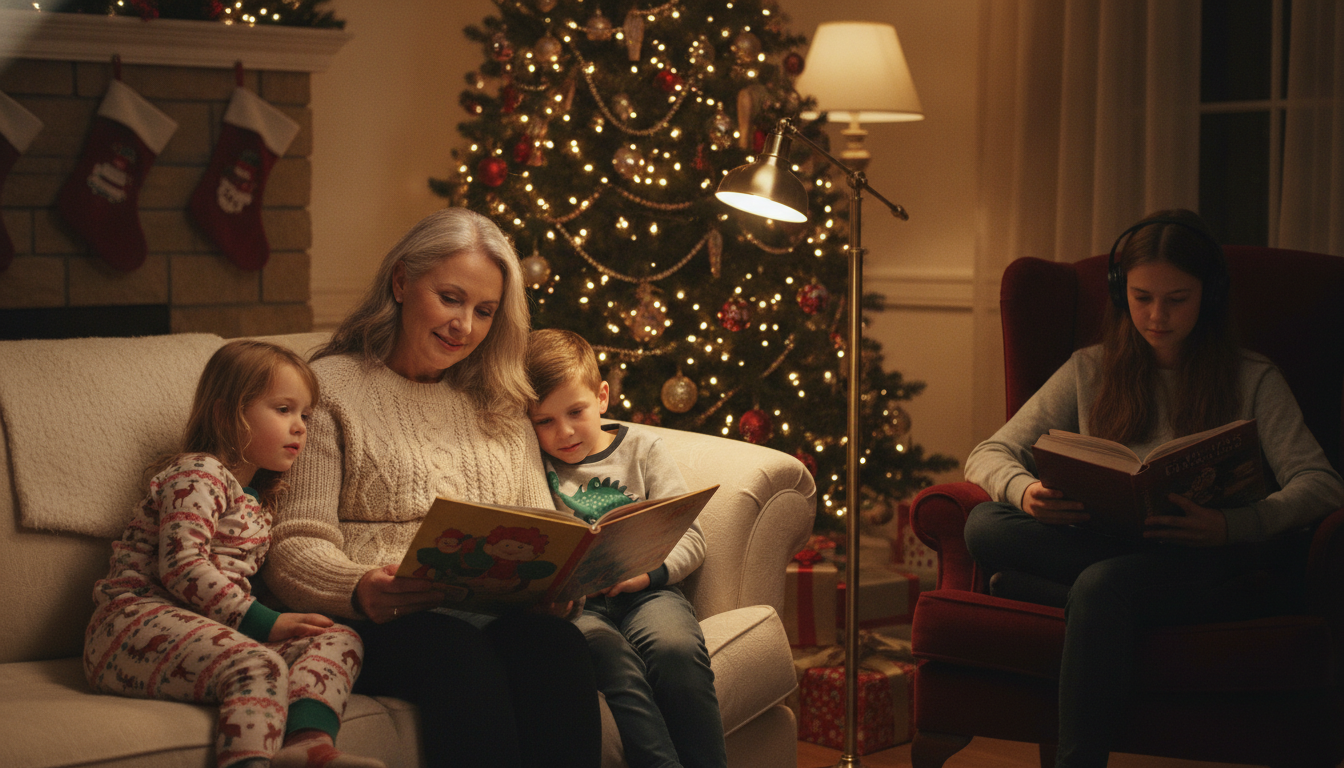
- One lit room. Resist the temptation to spread out. Keeping everyone in the same space, even if they are reading different books, makes it feel communal rather than solitary.
- Proper wrapping. Wrap each book with paper and ribbon so it reads as a real gift when it is handed over. The unwrapping is part of the ritual, and children take it far more seriously when the book looks like a present rather than something pulled off a shelf.
Key Takeaway
The atmosphere is doing half the work. A warm room, low lighting, comfortable clothes, and a hot drink create the conditions for a good jolabokaflod evening before a single page has been turned. Do not skip the setup.
Choosing the Right Book: Bookshop Picks and Personalized Storybooks
The best jolabokaflod gift is a book you have chosen with genuine care for that specific child — something that matches where they are right now, whether that is a picture book about dinosaurs for a three-year-old or a long adventure novel for a ten-year-old who stays up reading past bedtime.
Independent bookshops are an excellent starting point. Staff in good independent shops genuinely know their stock and can make recommendations based on age, interests, and what the child has already read. Visiting in November gives you plenty of time and avoids the December rush. Tell the person at the counter the child's age, one or two things they are currently obsessed with, and the last book they loved — and let them do the rest.
One option that works particularly well for younger children is a personalized storybook that puts the child's own name and sometimes their likeness into the story itself. These books tend to be read again and again because children find it genuinely magical to see themselves as the main character. If you are trying to build a positive relationship with books for a child who is not yet a confident reader, this is one of the most reliable ways to do it.
Personalized storybooks make especially good jolabokaflod gifts for children aged two to seven, for grandparents who want to give something memorable, or for families where the child already has a large collection of standard picture books. You can find a thorough breakdown of the options in this guide to the best personalized books for kids.
If you are shopping for grandparents who want to give a book but are not sure where to start, a personalized book chosen specifically for the grandparent-grandchild relationship is worth considering — it gives the reading session on Christmas Eve a particular warmth when the book itself acknowledges that bond.
Whatever you choose, think about length and complexity as well as subject matter. The goal is a book the child can actually engage with on Christmas Eve, ideally from start to finish. When in doubt, go slightly younger rather than slightly older. A book that is a little easy is one that gets read. A book that is too hard gets put down.
If you are considering a personalized Christmas storybook specifically — one that puts the child into a festive adventure — this guide to personalized Christmas storybooks is a useful place to start.
Reading by Age: A Practical Guide for Mixed-Age Households
One of the most common worries parents have about jolabokaflod is how to make it work when children in the same house are very different ages. A toddler and a nine-year-old have almost nothing in common when it comes to books, and that is completely fine. The tradition does not require everyone to be doing the same thing simultaneously — it just requires everyone to be in the same warm room, reading.
The practical solution is to treat each child's reading time as their own. A parent or grandparent sits with the youngest children and reads aloud to them, while older children read independently or take turns reading pages aloud to each other. For babies and toddlers, the tradition is really about the ritual of being read to in a warm room on Christmas Eve. They will not remember the specific book, but they will absorb the feeling of it — and that is enough.
Older children aged nine to twelve can be given a genuine reading hour with no interruptions, which many of them find unexpectedly enjoyable. It is rare to have permission to simply sit and read without being asked to do something else. Frame it as a treat rather than a task and most children will take it seriously.
If you want to build stronger reading habits beyond Christmas Eve, the techniques in this guide to building reading stamina in children are worth keeping in mind — jolabokaflod is a natural starting point for that longer project.
Jolabokaflod by Age Band: A Quick Reference
Use this table to plan the evening without having to improvise on the night itself. Every cell is kept short deliberately — this is a reference, not a reading list.
| Age Band | Books Per Child | Reading Time | Who Reads |
|---|---|---|---|
| Ages 2–3 | 1 book | 10–15 min | Parent aloud |
| Ages 4–5 | 1 book | 20 min | Parent aloud |
| Ages 6–8 | 1–2 books | 30–40 min | Child or parent |
| Ages 9–12 | 2 books | ~1 hour | Child independently |
A note on the four-to-five age band: children at this stage often love joining in with repeated phrases or pointing out things in the illustrations. Invite that participation rather than reading straight through — it makes the session feel interactive and keeps their attention for the full twenty minutes. The technique of talking with a child during a picture book, rather than just reading at them, is sometimes called dialogic reading, and it is worth knowing about if you have children in this age range.
Keeping Jolabokaflod Separate from Christmas Morning
The most common practical problem families run into is that jolabokaflod on Christmas Eve starts to feel like it is competing with the bigger present-opening on Christmas morning. When that happens, children can start to feel like the books are a consolation prize rather than a real gift — and the whole tradition loses its warmth.
The simplest fix is to frame the two events completely differently from the start. Christmas Eve is the quiet, cozy, reading evening. Christmas morning is the noisy, exciting, everything-else morning. They are not the same kind of event and do not need to be compared. Say this out loud to your children in the days before Christmas, more than once, and most of them will absorb it.
- Give jolabokaflod its own name and its own ritual from the very first year, so children grow up thinking of it as a separate tradition with its own identity.
- Some families keep Christmas Eve gifts exclusively to books and make that a firm rule — tonight is book night, tomorrow is everything else. The clarity helps.
- Lean into the atmosphere. The cocoa, the pajamas, the candles, the one lit room — the experience of the evening is the real gift, and most children respond to that more than parents expect.
- Avoid mentioning what is under the tree on Christmas morning until the morning actually arrives. Keep the two events in separate mental compartments.
How to Keep the Tradition Going Year After Year
Traditions stick when they have consistent elements that children can anticipate. Pick two or three details from your first jolabokaflod and keep them identical every year — the same mugs for cocoa, the same room, always opening books at the same time in the evening. The repetition is the point. Children find deep comfort in knowing exactly what is coming.
As children get older, bring them into the choosing. A seven-year-old who helped pick a book for a younger sibling has a completely different relationship to the tradition than one who just received a gift. That sense of participation builds genuine ownership of the custom, and it is one of the best ways to ensure the tradition survives adolescence.
If jolabokaflod lands well, the same one-book-per-evening idea scales to other winter holidays — our eight-night Hanukkah read-aloud plan uses exactly this structure across the eight candles, and our guide to Hanukkah traditions covers the rest of the holiday, from the blessings to the dreidel. Keep a simple record somewhere — even just a note in your phone — of what book each child received each year. By the time a child is twelve you will have a lovely list of their reading history, and they will almost certainly want to look back at it. It becomes a kind of accidental diary.
When children are old enough, around eight or nine, introduce the idea that everyone in the house gives a book as well as receives one. This shifts the tradition from something done for children to something the whole family does together — and that shift matters. Adults who participate fully make the tradition feel more real, not less.
The Most Important Thing
The tradition does not need to be perfect in its first year to become meaningful. It just needs to happen — and then happen again the following year, and the year after that. Imperfect traditions that recur are worth far more than perfect ones that happen once.
If you enjoy building reading into your family's calendar beyond Christmas Eve, a book advent calendar is a natural companion to jolabokaflod — twenty-four small books or reading moments leading up to the big evening on the twenty-fourth. Our guide to Christmas read alouds covers what to put in those twenty-four packages, matched to your child's age.
Frequently Asked Questions About Jolabokaflod
Do I need to give an expensive book?
No. Jolabokaflod is not about spending a lot of money. A paperback from a charity shop or a library sale is just as valid as a brand-new hardback, and the thought behind the choice matters far more than the price. The tradition started in a period of genuine scarcity — the spirit of it has never been about extravagance.
What if my child does not like reading yet?
That is exactly the right time to start this tradition. Being read to on a cozy evening with cocoa and no pressure is one of the most effective ways to help a reluctant reader build a positive association with books. Jolabokaflod removes any sense of obligation because it is framed as a treat, not a lesson. If you want more strategies for reluctant readers, the guide to personalized books for kids covers why books starring the child themselves can shift that resistance.
Can we do this if we celebrate on the 25th rather than the 24th?
Absolutely. The date is flexible. The spirit of the tradition is an evening of books and quiet togetherness, and that works on any evening you choose — including Christmas night after the main celebrations have wound down, or even Boxing Day if Christmas Day itself is too hectic.
What if a child wants to watch television instead of reading?
Give them the book first, read the first few pages together, and let the evening's atmosphere do the work. Most children who are reluctant at the start are absorbed within ten minutes, especially if the book has been chosen well. The key is not to negotiate — just begin reading, warmly and without drama, and let the story take over.
Is jolabokaflod only for children?
Not at all. Adults exchange books too in Iceland, and including a grown-up book in the gift exchange means that parents and grandparents get to participate fully rather than just facilitating the children's evening. A house where everyone is reading — toddler, teenager, and grandparent alike — is the real version of the tradition.
What if I want to compare personalized book options before buying?
There are several good services available. An honest side-by-side comparison of two of the most popular options is available in this Wonderbly vs LoveToRead.ai comparison, which covers the differences in approach, personalization depth, and what each service does best.
Ready to Start Your Own Book Flood This Christmas Eve?
The summary is this: jolabokaflod is a Christmas Eve tradition from Iceland in which everyone in the house gives and receives at least one book, then spends the evening reading it in a warm room with something hot to drink. It began during a period of wartime scarcity when books were one of the few gifts families could actually find and afford, and it has been a cherished part of Icelandic life ever since.
To bring it into your own home, you need three things: a book chosen with care for each child, a warm and quiet room with the screens put away, and an evening set aside with nowhere to be. The cocoa and the pajamas are optional but strongly recommended.
Start small if you are not sure. One book per child, one hour, one room. See how it feels. The families who do this once almost always do it again — not because they planned a perfect evening, but because something about it settled in and stayed.
Ready to Start Your Own Book Flood This Christmas Eve?
Pick up a book for each child in your house, wrap it properly, and set aside one quiet evening. That is all jolabokaflod takes — and it might just become the part of Christmas your family looks forward to most.
See Personalized Storybooks for Kids


3 Comments
Comments are closed.