Dialogic Reading: How to Turn Any Picture Book Into a Conversation With Your Child
How dialogic reading—reading with your child instead of to them—makes bedtime stories richer, warmer, and way more fun for both of you.
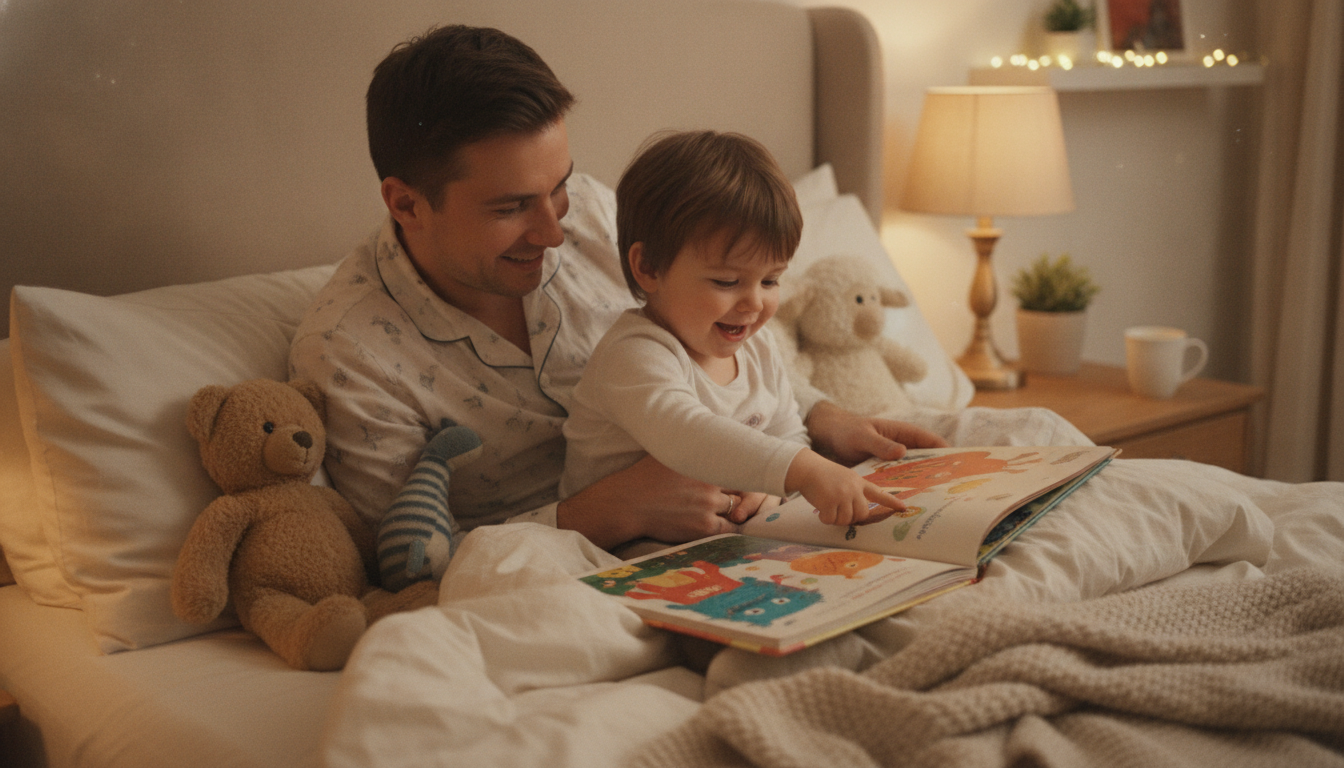
You Know That Feeling—Let's Start There
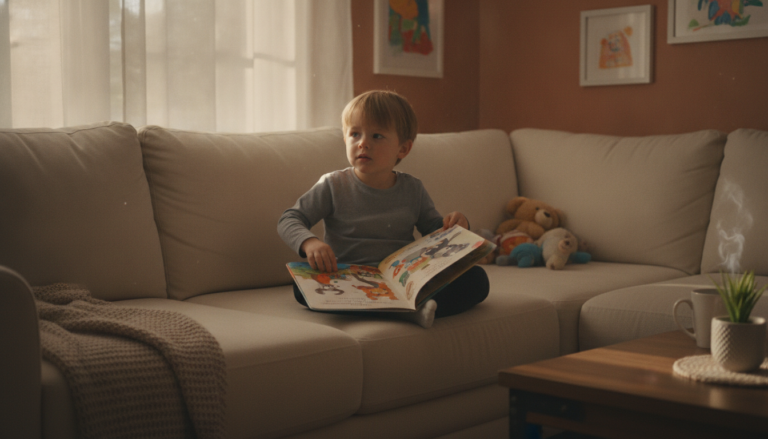
Picture the scene: it's the fifth night in a row with the same board book. Your child is wiggling. You are somewhere between tired and beyond tired, and somewhere in the back of your mind you are quietly racing for the last page so the lights can finally go out.
That feeling is completely normal, and it does not make you a bad parent. It makes you a tired one, which is the same thing.
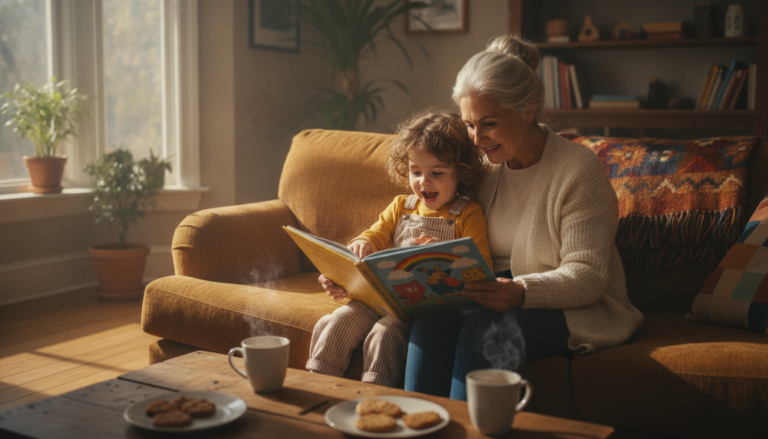
But here is the shift that changes everything: the book on your lap is not a script you have to get through. It is a conversation starter, and the conversation is the whole point. Once you stop trying to reach the last page and start treating each spread as something to talk about, storytime stops feeling like a chore—even when it is the same book for the fifth night running.
This guide is written for the person actually holding the book. Not a teacher, not a researcher—just a parent on the edge of the bed who wants bedtime to feel a little less like a performance and a little more like connection. Most of what you'll find online about this topic is aimed at educators. This is not that. This is for you.
What Dialogic Reading Actually Is (In One Plain Sentence)
Dialogic reading—dialog-ic, meaning "made of dialogue"—is simply the practice of pausing during a picture book to talk with your child instead of reading straight through to the end.
That's it. No special materials, no flashcards, no app. Just you, the book, and a genuine back-and-forth.
The core idea is that a child who talks during a story takes more from it than a child who listens in silence—not because silence is bad, but because saying something out loud, in their own words, helps a young child make the story their own. The same principle carries past the last page, when you close the book and ask them to tell the whole story back to you. When your child explains why the bear looks sad, or guesses what is behind the door, or tells you that the dog in the picture looks exactly like their friend's dog, they are doing real cognitive work: connecting the story to their own life, building vocabulary, and practicing how to put thoughts into words.
You are not teaching a lesson. You are having a chat. The book just gives you something to chat about. If you want to go deeper on making reading an active experience, this guide on making reading interactive for kids covers a range of approaches that work well alongside dialogic reading.
The Core Shift
Reading TO your child sounds like: "Let's read this one."
Reading WITH your child sounds like: "Look at the cover. What do you think happens?"
One is a performance. The other is a conversation. Both involve the same book.
Getting Past "What Color Is the Duck?"
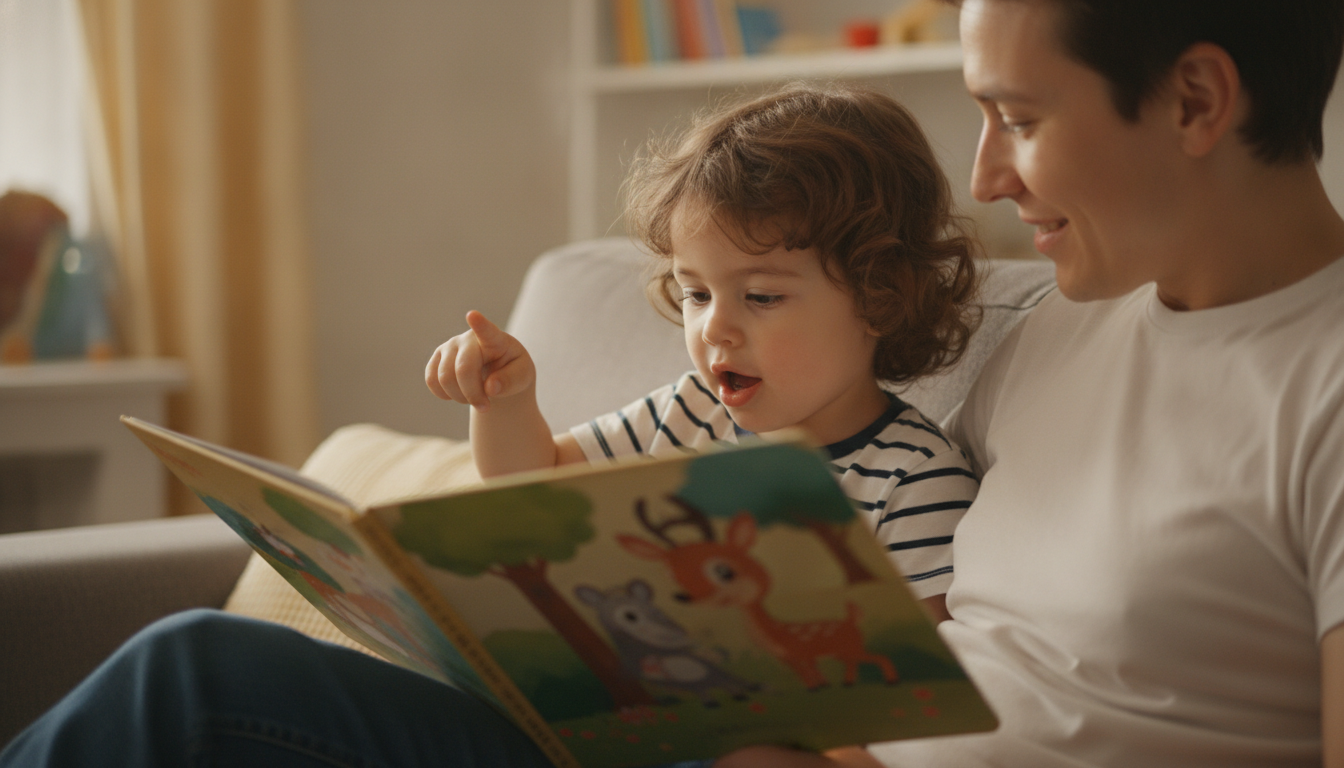
Most of us default to one kind of question when we read with kids: the naming question. What color is that? What animal is this? What does the cat say? These questions are not wrong, but they have a ceiling—there is only one right answer, and your child knows you already know it.
The questions that open a child up are the ones where you genuinely do not know the answer, because the answer lives inside your child's head, not on the page.
Try questions that start with "Why do you think…", "What would you do if…", "How does she feel?", or "What do you think happens next?" These are sometimes called open-ended prompts—which just means questions with more than one possible answer.
| Kind of question | What it sounds like | What you get back |
|---|---|---|
| Naming | "What color is the duck?" | The word you already knew they had. A fine warm-up, not a conversation. |
| Open-ended | "What's happening on this page?" | Their version of the story, in their own words. |
| Why / how | "Why do you think he ran away?" | Reasoning — your child links one thing to another out loud. |
| Recall | "What happened to the balloon before?" | Memory carried across pages, which is where comprehension starts. |
| Connection | "Has that ever happened to you?" | The story tied to their own life, which is what makes it stick. |
| Prediction | "What do you think she'll do next?" | A guess they will want to check, which keeps the pages turning. |
Reading TO them
- Read the sentence, turn the page
- "What color is the duck?"
- Close the book, lights out
Reading WITH them
- "He looks worried. Why do you think he's worried?"
- "What would you do if you were her?"
- "What was your favorite part? What would you have done?"
Before the book is even open, try: "Look at the cover—what do you think happens in this one?" Partway through a page, instead of reading the sentence and turning, pause: "She looks worried. Why do you think she's worried?" After the last page, instead of reaching for the lamp: "What was your favorite part? What would you have done?"
You do not have to hit every page with a question. Two or three good pauses per book is plenty. The goal is a conversation, not a quiz. None of this is a test. There are no right answers.
How to Follow Your Child's Answer Instead of Correcting It
This is the part that feels hardest at first: when your child gives an answer that is "wrong"—or just unexpected—the instinct is to gently correct and move on. Try to resist that instinct.
If you ask "Why is the rabbit hiding?" and your child says "Because he doesn't like his hat," that answer is not wrong. It is your child's answer, and it tells you something about how they are reading the picture and the story.
Follow it. Say: "Oh, he doesn't like his hat—what kind of hat would he like better?" Now you are in a real conversation, and your child has just done something impressive: they invented a motivation for a character. Expanding on what your child says—rather than replacing it with the "right" answer—keeps them talking and keeps them feeling like their ideas matter, because they do. The same move works when a character treats someone kindly or badly — ask what your child noticed rather than whether it was right, which is the heart of our guide to World Kindness Day at home.
A child who wanders off topic to tell you about something that happened at the park is still doing the thing—they are connecting the story to their world, which is exactly the point. Let them wander. Come back to the page when they're ready.
What to Do When the Answer Is "I Don't Know"
"I don't know" is not a dead end. It is an invitation to think out loud together.
When your child says "I don't know," try modeling your own guess: "I'm not sure either. I think maybe she's scared because it's dark. What do you think?" You are showing them that guessing is allowed, that wondering is allowed, and that you do not always have the answer either.
Sometimes "I don't know" means the question was a little too big or abstract. Try making it smaller and more concrete: instead of "How do you think he feels?" try "Does his face look happy or sad to you?" One question asks them to name an emotion; the other just asks them to choose between two.
And sometimes "I don't know" means your child is tired and just wants you to read the words. That is fine. Read the words. The conversation will be there tomorrow night. For more ideas on how bedtime stories can be read well, it helps to think about the whole ritual—not just the questions you ask.
The Same Book, Every Single Night
If your child has one book they want on repeat for weeks, you are not alone, and you have not failed at introducing variety. Young children find deep comfort and genuine pleasure in repetition—it is how they learn, and it is how they feel safe.
The good news is that dialogic reading makes repetition interesting again, because the conversation is never exactly the same even when the words are.
How to Keep the Same Book Fresh
Night 1: "What do you think will happen?"
Night 3: Since they now know what happens—"Why do you think it happened that way?"
Night 7: "You know this book so well. What would you change if you were the author?"
Night 12: Put the book in their lap. Let them tell you the story while you hold the pages.
A child who has heard the same book dozens of times and can narrate it back to you has done something real. That book is theirs now.
How This Looks Different at Two Versus Five
The technique scales with your child. You are always just one step ahead of where they are—asking questions that are slightly bigger than what they could answer alone, and then helping them get there.
Around Age 2
Point to the picture, name what you see, invite them to name it too. "Look—what's that?" "Dog!" "Yes! A big fluffy dog. Can you find another dog on this page?" That is enough, and it is plenty.
Ages 3–4
Simple "why" and "what if" questions work well. They will give you answers that are wild and wonderful and completely their own. Follow those answers wherever they go—even if they end up talking about the grocery store.
Ages 5–6
Ask about a character's feelings, what they would have done differently, what the story made them think about. A five-year-old can sustain a real back-and-forth, and those conversations can be genuinely surprising.
The questions change shape as your child grows, but the approach stays the same: pause, wonder out loud, and let them lead. This is also one of the most natural ways to spark a child's imagination—not with a special activity, but with a question asked over a picture book at bedtime.
Yes, This Works With Nonfiction Too
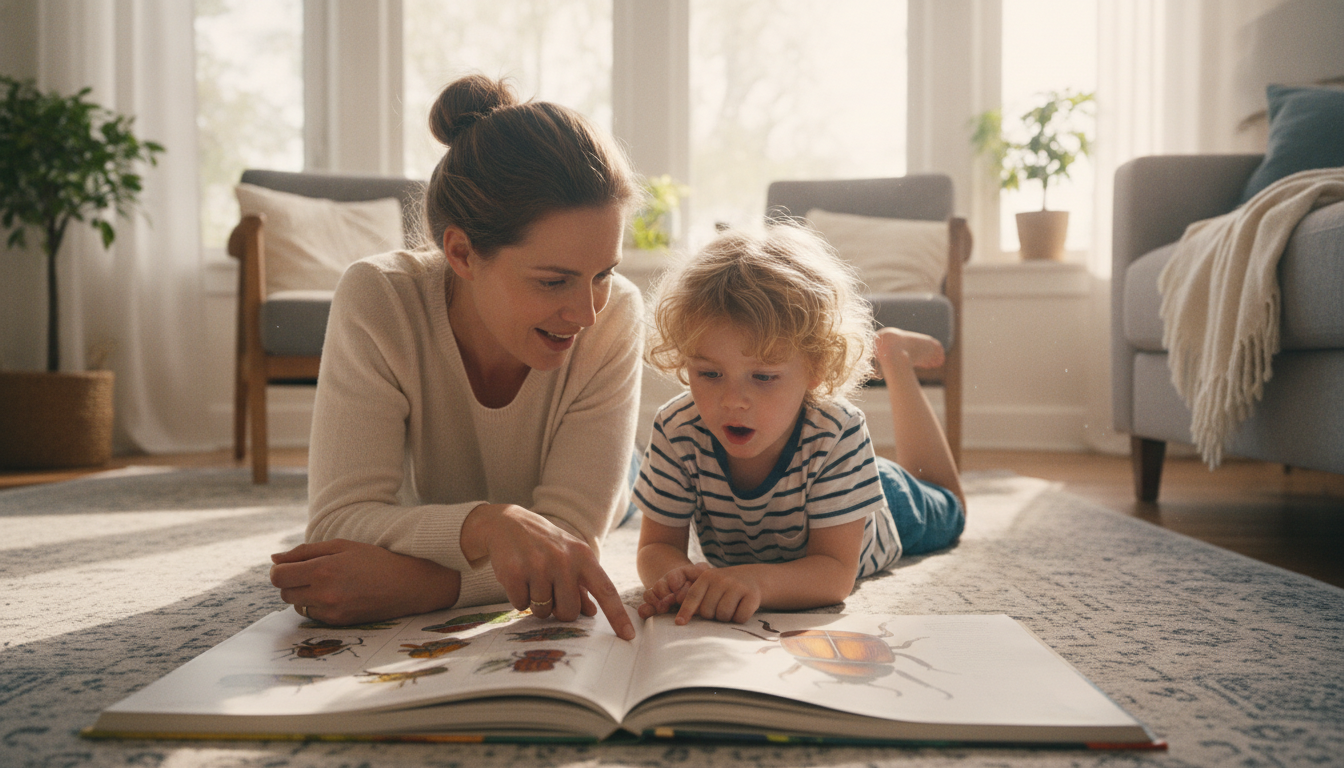
Picture books about trucks, bugs, weather, or space are perfect for this approach—maybe even better than fiction for some kids, because the questions feel real rather than made-up.
Before you open a nonfiction book, try: "What do you already know about frogs? What do you wonder about them?" Then, as you read, pause and ask: "Did you know that? Does that surprise you?"
After the last page: "What's one thing you want to remember from this book? What do you still want to know?" That last question—what do you still want to know?—is one of the most powerful things you can ask a young child, because it tells them that curiosity does not end when the book closes.
If your child is obsessed with a particular nonfiction topic, lean into it hard. A child who wants to talk about excavators for twenty minutes while you look at a book about construction vehicles is doing exactly what they should be doing. That enthusiasm is something worth nurturing into a lifelong love of reading—and it starts right there on the floor with the bug book.
You Are Allowed to Skip the Words
This one surprises a lot of parents: you do not have to read every word on the page. The text in a picture book is a guide, not a legal document.
If your child is fixated on a detail in the illustration that has nothing to do with the printed sentence, put the sentence down and talk about the detail. That is where your child's mind is, and that is where the conversation belongs. You can paraphrase, you can skip pages that are not landing tonight, you can go back to a page you already passed.
The book is a tool for connection, and you are in charge of how you use it. If you want to take the idea of a personalized story even further—one where your child is literally the main character—LoveToRead lets you create a custom story starring your child, which can make the whole experience feel even more immediate and personal.
But even a worn-out board book from the library bag works perfectly. The magic is in the conversation, not the book itself.
A Quick Note If You Have Worries
This guide is not here to make you anxious about your child's development—it is here to make storytime more enjoyable for both of you. If something about your child's language or communication genuinely concerns you, the right first step is a conversation with their teacher or pediatrician, who knows your child and can give you real guidance.
For everyone else: you are doing great. The fact that you are reading a guide about how to read better with your child means you are already the kind of parent who shows up. That matters more than any technique.
Putting It All Together
Dialogic reading is not a curriculum and it is not a program. It is a small shift in how you hold a book—from performer to conversation partner. You pause a little more. You ask questions you do not already know the answer to. You follow your child's ideas instead of steering them back to the text. You let the story be a starting point rather than a destination.
The practical moves are simple:
- Before the book opens: "What do you think this one is about?"
- Partway through a page: "He looks nervous. Why do you think that is?"
- After the last page: "What was your favorite part? What would you have done?"
- When they go off topic: Follow them. They are connecting the story to their world.
- When they say "I don't know": Model your own guess. Wonder out loud together.
- When it's the same book again: Change the question, not the book.
There are no right answers. There is no wrong way to talk about a picture book. A child who is talking—about the story, about the pictures, about something completely unrelated that the story reminded them of—is a child who is engaged, connected, and learning. And you, tired parent holding the book at the end of a long day, are the reason that is happening.
If you're looking for more ways to make reading feel alive and personal, the ideas in this guide on making reading fun pair naturally with everything covered here.
Ready to Make Storytime a Two-Way Street?
Start tonight. Pick up whatever book is on the nightstand, look at the cover together, and ask your child what they think happens. That's the whole first step. The rest will follow.
Create a Personalized Story Starring Your Child

4 Comments
Comments are closed.