Reading Level Chart Explained: A Plain-English Guide for Parents
Your child came home with a letter, a number, or a code. Now what? A calm, practical breakdown of every reading level chart a US parent is likely to encounter — and what to actually do with the information.

The Letter "M," the Number "24," the Code "620L" — Why Are There So Many?
You opened a report card, or maybe a conference note, and there it was: a letter, a number, or something that looks like a tax code. Nobody explained it. Nobody handed you a decoder ring. And now you are sitting at the kitchen table wondering whether to be worried.
Here is the first thing worth knowing: the confusion you feel is not your fault. Schools across the US use at least four different reading level systems, and most parents encounter more than one of them over the course of their child's elementary years — without anyone explaining that these systems measure slightly different things, were built for different purposes, and do not always line up neatly with each other.
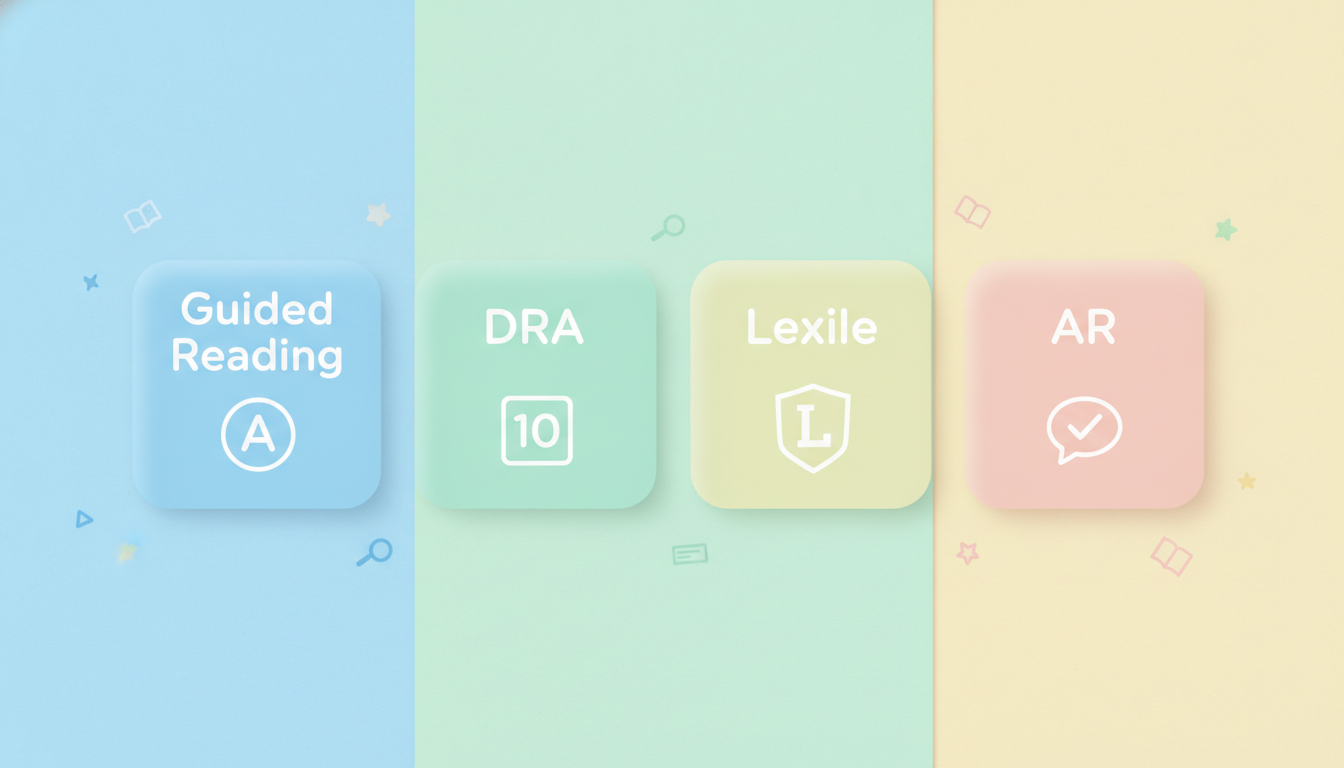
A letter like "M" comes from the Fountas and Pinnell guided reading system. A number like "24" likely comes from the Developmental Reading Assessment, known as the DRA. A code ending in "L" — like 620L — is a Lexile measure. And a number paired with a grade abbreviation like "4.2" is probably an Accelerated Reader level. Four systems, four formats, one bewildered parent.
The most important thing to know right now
Whatever number or letter your child received, it is a tool for choosing appropriately challenging books — not a permanent label, not a verdict on your child's intelligence, and not a prediction about their future. This guide will walk through each system in plain language so you can use that information calmly and practically.
What a Reading Level Actually Measures
Every reading level system is trying to answer one basic question: how complex is this text, and can this child read it with understanding? That sounds simple, but complexity turns out to be surprisingly hard to pin down with a single number.
Different systems measure complexity differently. Some look at sentence length and word frequency — how long are the sentences, and how common are the words? Others factor in the background knowledge a reader needs to bring to the text, the vocabulary load, or the kinds of thinking required to make sense of what is happening. A book about deep-sea creatures might use simple sentences but assume a lot of prior knowledge. A book about a child's first day of school might use complex sentences about a topic every child already understands. Those two books could score very differently depending on which system you use to measure them.
What a reading level does not measure is equally important to understand. It does not measure how smart your child is. It does not measure how hard they are trying. And it does not measure what their ceiling is. A reading level is a snapshot — a picture of where a child is right now, taken on a particular day, using a particular method.
Levels change, sometimes quickly. A child who scores at one level in the fall will very often be at a noticeably higher level by spring — especially if they are reading regularly and finding books they actually want to read.
Understanding this distinction — level as a snapshot, not a sentence — is the foundation for using any reading level chart calmly and effectively. Keep it in mind as we walk through each system.
System One: Fountas and Pinnell Guided Reading Levels
Fountas and Pinnell — often written as F&P — uses letters A through Z to describe text difficulty, and it is the system most commonly used during small-group reading instruction in US elementary classrooms. That is why you will often hear these called guided reading levels.
The letters were designed with a specific classroom purpose in mind: helping teachers pull together small groups of children who are ready for the same level of text challenge, so the teacher can work with them on specific reading skills. The letter is a grouping tool, not a ranking. A child at level M is not "better" than a child at level L — they are simply ready for a different set of books and a different set of teaching conversations.
As a rough guide to typical end-of-year goals — not a rule, and not a guarantee — the F&P letter bands generally look like this:
| Grade | Typical End-of-Year F&P Band |
|---|---|
| Kindergarten | A – D |
| Grade 1 | E – J |
| Grade 2 | K – M |
| Grade 3 | N – P |
| Grade 4 | Q – S |
| Grade 5 | T – V |
| Grade 6 | W – Y |
Your child's school may set slightly different benchmarks. Always check with the teacher for the targets used in your specific district.
One thing parents often miss: an F&P level describes the books a child should be reading with a teacher's support. It is not necessarily the level at which they should be reading independently at home. For home reading, a slightly easier book — one where your child feels confident and fluent — is often the right call. More on that in a moment.
Confident and fluent are not quite the same thing, and the difference is audible. Our guide to what reading fluency is and how to build it at home explains what to listen for when your child reads to you.
If your child is working on foundational skills like recognizing high-frequency words alongside their letter level, our guide to sight words for kindergarten explains how those two things connect and what you can practice at home without any special materials.
| System | What it looks like | What it measures | Who uses it |
|---|---|---|---|
| Fountas & Pinnell (Guided Reading) | A letter, A through Z | Text difficulty judged on several features, matched to a child by a teacher | Most US elementary classrooms |
| DRA | A number, roughly 1 to 80 | Accuracy, fluency and comprehension during a one-on-one read-aloud | Schools running periodic benchmark assessments |
| Lexile | A number followed by L, such as 620L | Sentence length and word frequency, calculated from the text itself | Publishers, library catalogs, some state tests |
| Accelerated Reader | A grade-and-month decimal, such as 3.4 | Text difficulty on a grade-equivalent scale, paired with a comprehension quiz | Schools that subscribe to the AR program |
Four systems, four formats. Your school will usually use one or two of these, not all four.
Systems Two, Three, and Four: DRA, Lexile, and Accelerated Reader
The Developmental Reading Assessment (DRA)
The DRA uses numbers — typically ranging from 1 to 80 and beyond — and is a one-on-one assessment a teacher conducts by listening to a child read aloud and then asking comprehension questions. It is designed to assess, not to label. Many parents see DRA numbers on report cards or conference notes without realizing what the assessment actually involves: a real conversation between a teacher and a child, with the teacher carefully noting what the child does when they hit a tricky word or a confusing passage.
The DRA is a diagnostic tool. Its purpose is to help the teacher understand how a child is processing text — not just whether they can decode words, but whether they understand what they are reading and what strategies they use when something does not make sense. That is useful information, even if the number on the page does not tell you any of that story.
The Lexile Framework
Lexile measures use numbers followed by the letter L — for example, 500L or 800L — and are calculated by analyzing two things: sentence length and word frequency. Longer sentences with less common words produce higher Lexile scores. It is a text-based measure, meaning the score describes the book or passage, not the child. When a child is given a Lexile score, it means they have been assessed and matched to a range of texts they are likely to be able to read with good comprehension.
Lexile is widely used by school libraries and book-finding tools, and this is where it becomes genuinely useful for parents at home. The official Lexile Hub at lexile.com lets you search for books within any Lexile range and filter by topic or interest — which means you can take that number from your child's report and use it to find books about dinosaurs, or soccer, or whatever your child actually wants to read about.
Accelerated Reader (AR)
Accelerated Reader is a reading practice program that many schools subscribe to. It assigns books a level based on grade-equivalent scoring — a level of 3.4 means the text is roughly at the difficulty of a third-grade reader in the fourth month of the school year. Children read books and then take short comprehension quizzes on a computer to earn points.
It is worth being clear about what AR is and is not. It is a practice and accountability tool, not a diagnostic assessment. The quiz scores tell you whether a child understood a particular book well enough to answer multiple-choice questions about it — they do not tell you the full picture of how a child is developing as a reader. AR can be motivating for some children and stressful for others, and the points and levels are best understood as a record of reading practice, not a comprehensive measure of reading ability.
The One Thing These Systems Have in Common (That Nobody Tells You)
Here is something publishers and school systems do not always say out loud: the correlation charts that try to line up these four systems with each other — and with grade levels — disagree with each other in meaningful ways. A book that falls at one point on an F&P chart may map to a different Lexile than a different conversion table suggests. This is not a flaw you need to fix; it is simply a reflection of the fact that these systems were built for different purposes and measure different things.
This disagreement is a key reason to use your own school's chart or the official Lexile Hub rather than a generic table you find on a random website. When in doubt, ask your child's teacher which system the school uses and whether they have a grade-level correlation chart they can share — most teachers are happy to explain this in a two-minute conversation, and it will save you a lot of confusion.
How to Find Out Your Child's Reading Level
The most reliable source is always your child's teacher. Levels are assessed formally two to four times a year in most schools, and teachers can tell you the current level, which system was used, and what it means in the context of your child's class. A quick email asking "which reading level system is this score from, and what does it mean for choosing books at home?" is completely appropriate and will almost always get you a helpful answer.
- Report cards and conference notes often include a level, though they do not always specify which system it comes from. If the source is unclear, ask.
- School library portals and AR logins (if your school uses Accelerated Reader) often show a child's current level and list books within their range — many schools give parents access to these portals.
- The Lexile Hub at lexile.com has a free book-search tool where you can enter a Lexile range and browse titles by topic or interest. This is genuinely useful for weekend library trips.
- Avoid generic "reading level by age" charts found on random websites. As noted above, these charts often disagree with each other and with what your child's school is actually using, which creates unnecessary confusion rather than clarity.
How to Use a Reading Level to Pick a Book (Without Making Reading Feel Like a Test)
This is where the rubber meets the road. You have a letter or a number. Now what do you actually do with it on a Saturday morning at the library?
The practical rule of thumb most teachers use for independent reading is sometimes called the "five-finger rule": if a child stumbles on more than about five words per page, the book is probably too hard for comfortable independent reading right now. That is not a failure — it just means that book might be better as a read-aloud together, where you can handle the tricky words and your child can focus on the story.
A book at or just below your child's assessed level is usually the right call for independent reading at home. Reading should feel mostly smooth and enjoyable, not like a workout. Fluency and confidence build fastest when a child is not constantly stopping to decode — and a child who finishes a book feeling good about themselves is more likely to pick up another one. Short classic tales are handy when you are between levels, because the same story works as a read-aloud one month and an independent read the next — our stories with morals for kids are all short enough to try both ways.
Interest matters more than level-matching. A child who is passionate about a particular topic will often push through a harder book because they want to know what happens. A child reading a book they love — even one that is technically "below level" — is still reading, still building fluency, still growing.
If your child is in kindergarten or early first grade and you are looking for free, accessible books to read together at home, our lists of free books online for kindergarten and free books online for first graders are good starting points — they are organized to help you find something at the right level without a lot of searching.
A note on personalized or custom stories — the kind where your child is the main character: these can be a genuinely motivating way to get a reluctant reader to sit down with a book, and that motivation is real and valuable. But it is worth being honest about what they are. A custom story is not leveled instruction and does not replace the structured reading practice the school is providing. Think of it as a spark, not a curriculum — a way to remind a child that reading can feel personal and exciting, not just like schoolwork. If you want to explore what that looks like in practice, our guide on how to make reading fun has more ideas along these lines.
What to Do If Your Child Is Above or Below the Expected Band

If Your Child Is Reading Above the Typical Band
The main thing to watch when a child is reading above the typical band for their grade is comprehension and emotional readiness — not just decoding ability. A book can be technically readable but full of themes or situations a child is not ready to process. A higher Lexile or F&P level does not automatically mean a book is appropriate for a younger child. It is worth reading the back cover, checking a review, or skimming a few pages yourself before handing it over.
Beyond content appropriateness, a child reading above grade level still benefits from talking about what they read — asking them what they thought, what surprised them, what they would have done differently. If you are hunting for material that keeps pace with them, our guide to free books for 4th and 5th graders lists free sources by reading stage. That kind of conversation does more for comprehension than any level-matched worksheet.
If Your Child Is Reading Below the Typical Band
If your child is reading below the typical band for their grade, the right first move is a conversation with the teacher — not a panic, and not a rush to buy a stack of workbooks. Teachers see a wide range of development and can tell you whether the gap is something to monitor, something to address with additional support at school, or something that warrants a more formal look.
If after talking with the teacher you have ongoing concerns, you have the right to ask the school to evaluate your child. This is a formal process with specific steps, and your child's teacher or school counselor can walk you through how it works in your district. You do not need to figure this out alone, and asking for more information is always the right call when you are uncertain.
For children who resist reading for any reason — whether they find it hard, boring, or frustrating — our guide to books for reluctant readers has practical suggestions that focus on finding the right match rather than pushing harder on books that are not working. Sometimes the issue is not the level at all — it is that the child has not yet found a book that feels worth the effort.
The core message, stated plainly
A reading level is a tool for choosing books. It is not a ceiling, not a diagnosis, and not a prediction. Children grow, levels change, and a child who loves reading — at whatever level — is already doing the most important thing.
Putting It All Together: A Quick Reference
If you want to keep this simple, here is what to take away from everything above:
- Find out which system your school uses. Ask the teacher if it is not clear from the report card. One email, two minutes.
- Use the F&P letter bands as a rough guide, not a rule. The table above gives typical end-of-year targets — your school may use slightly different benchmarks.
- Do not rely on generic conversion charts online. They disagree with each other. Use the Lexile Hub or your school's own chart for accurate ranges.
- For home reading, choose books at or just below the assessed level. Comfortable and enjoyable beats challenging and frustrating every time.
- Let interest drive book choice. A child reading a book they love — even one that is "below level" — is still building everything that matters: fluency, vocabulary, and a habit of reading.
- If you have concerns, talk to the teacher first. A reading level number is not enough information to act on alone — the teacher can give you the context you need.
Reading development is not a straight line, and no single number captures the full picture of a child who is learning to make sense of written language. The letter or number on that report is a starting point — a way to find the right books, have the right conversations, and support what the school is already doing. That is all it needs to be.
Reading Levels Are a Starting Point — Not the Whole Story
Now that you know what that letter or number means, use it as a loose guide and let your child's curiosity do the rest. Browse our free reading resources to find books your child will actually want to open.




2 Comments
Comments are closed.