
Reading Readiness: How to Tell If Your Child Is Ready to Read
You are on the floor with a picture book, and your child is doing that thing again — reciting the page before you turn it, word for word, without looking down. Are they reading? Are they close? Should they be further along by now?
That question sits behind the phrase reading readiness, and it is one of the most quietly stressful things a parent of a three- to six-year-old carries around. This guide is about what readiness actually means, what to look for, and — the part most articles skip — why waiting for it is the wrong instinct.
The honest starting point: readiness is not a waiting room
Here is the thing worth saying before anything else, because it changes what you do with the rest of this page.
The phrase “reading readiness” comes from an older way of thinking about early literacy, where readiness was treated as something that ripened on its own. The child would arrive at it, and only then would real teaching begin. That framing was used for a long time to justify waiting.
Current thinking has moved away from that. The skills below are not symptoms of a switch flipping somewhere inside your child. They are things children get better at by doing them with someone. A child who hears rhymes gets better at hearing rhymes. A child who is asked what happens next gets better at following a story. You are not standing by watching for a signal. You are part of how the signal arrives.
So read what follows as a description of what you are building, not a checklist you are waiting to pass.
The five pre-reading skills, and what each one looks like at your kitchen table
Early-literacy sources tend to converge on the same five building blocks. Here they are alongside what each one actually looks like in a normal evening at home, and one thing you can do about it without buying anything.
| Skill | What it looks like at home | One thing you can do |
|---|---|---|
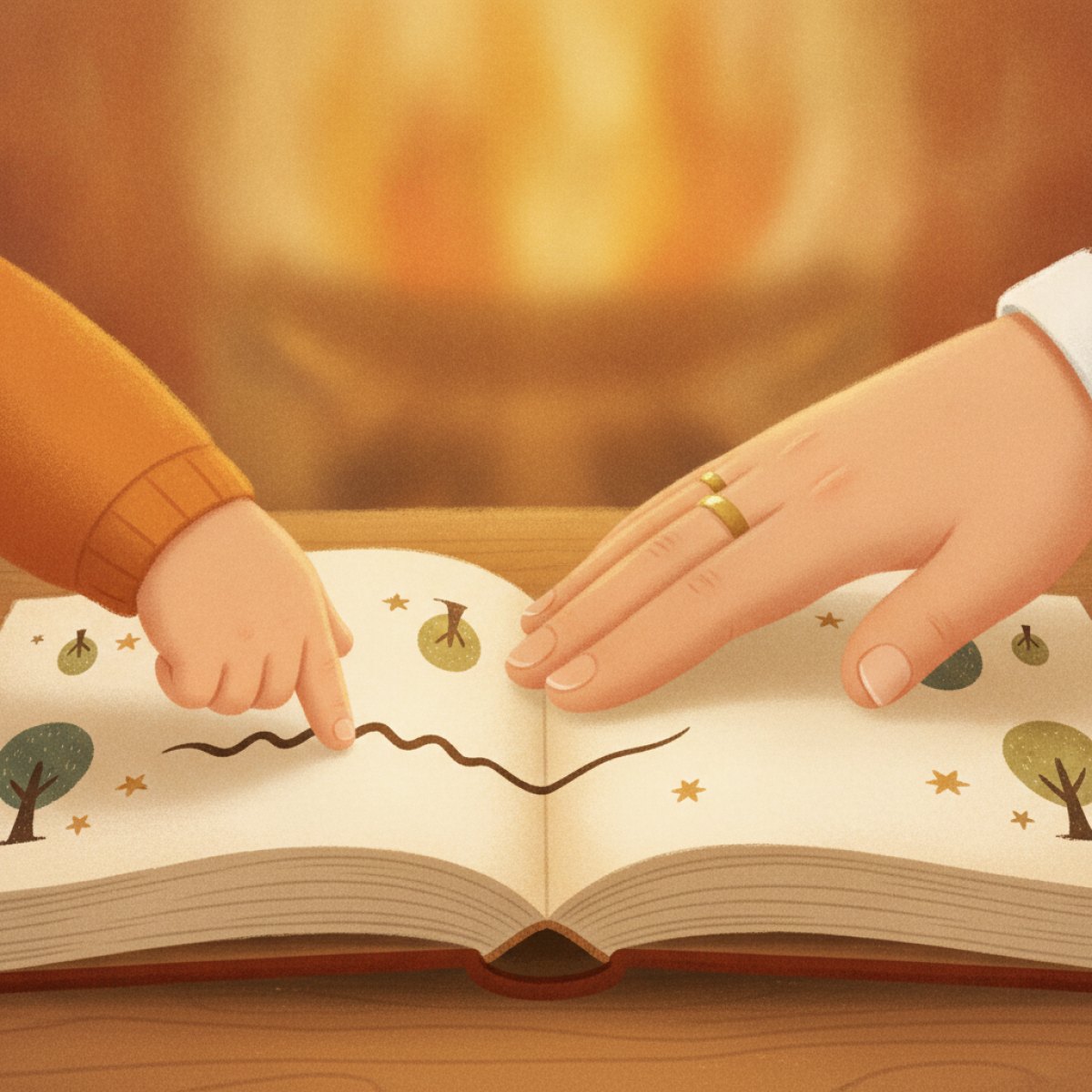
| Print awareness | Knows a book has a front and a back, knows the print runs left to right, points at the words rather than the pictures | Run your finger under the line as you read, so they see where the words are |
| Phonological awareness | Hears rhymes, claps out syllables, notices when two words start with the same sound | Play sound games in the car — what rhymes with cat, what else starts like sock |
| Letter knowledge | Names some letters, connects a few of them to their sounds, recognizes the letters in their own name | Start with the letters in their name — those are the ones they care about |
| Listening comprehension | Follows a read-aloud story, can answer what happened next, retells it roughly in order | Stop once mid-story and ask what they think happens now — then keep going |
| Motivation | Asks to be read to, picks up books alone, pretends to read a familiar book from memory | Let them choose the book, even when it is the same one for the ninth night |
Notice that only one of those five is about letters. That surprises most parents. The alphabet is the visible part, so it is the part we measure, but a child who knows every letter and cannot hear that “cat” and “hat” belong together is not further ahead than a child who is the other way around.
Print awareness: the book itself is the lesson
Before a child can read words, they have to understand what words physically are — that the black marks are the thing being said, that they go in a direction, that the story lives in them rather than in the picture. This is the easiest skill to build because it happens automatically during any read-aloud where the child can see the page.
Signs it is coming along: they turn the pages themselves and in the right direction. They hand you the book the right way up. They notice when you skip a page. They point at a word and ask what it says.
Phonological awareness: hearing the pieces inside a word
This is the one that predicts the most and gets the least attention, largely because it is invisible. It has nothing to do with print at all — you could build it in a completely dark room. It is the ability to hear that spoken words are made of parts: that “butterfly” has three beats, that “sun” and “fun” end the same way, that “mommy” and “moon” start the same way.
Children who find this hard are not being careless. Some ears take longer to pull a word apart, and it is a skill that responds well to being played with — nursery rhymes, silly songs, name games at dinner, anything where the sounds themselves are the joke.
Letter knowledge: names first, then sounds
Most children learn to name letters before they learn what those letters do. Both matter, and the second one is what reading actually runs on. A child who can sing the alphabet has memorized a song; a child who knows that the letter M makes the sound at the start of “mom” has something they can use.
Start where they are already invested. The letters in their own name carry more weight than any other letters in the alphabet, and most children learn those first without being taught.
Listening comprehension: the skill people forget is a reading skill
Reading is not just decoding. A child who can sound out every word on a page but has lost the thread of what is happening is not reading in any way that matters. Comprehension gets built long before decoding does, entirely through being read to and talked with.
If you want one thing to do here, it is to stop reading occasionally and talk. Why do you think she did that? What would you have done? This is worth more than a longer book. That habit has a name — dialogic reading — and it is the single easiest thing on this page to start tonight.
Motivation: quietly the most important one
A child who wants to read will get there. A child who has decided that books are where they get corrected will make it much harder for themselves, and that association forms early and sticks.
This is the skill most easily damaged by well-meant pressure. If reading time has started to feel like testing time, back off the quizzing and go back to enjoying the story for a while. If your child has already reached the stage of actively avoiding books, our guide to books for reluctant readers deals with that specific problem in more depth.
What readiness is not
Three things get confused with readiness constantly, and untangling them takes a lot of pressure off.
It is not an age. The range across perfectly typical children is enormous — wide enough that two children in the same class, born in the same month, can be a year apart in these skills and both be entirely fine. Any age you see attached to reading is a rough middle, not a deadline. A child can arrive at all of this earlier or later than the child next to them and there is nothing to read into it.
It is not a race against the class. Comparing your child to the loudest data point you have — the friend’s kid who reads chapter books at five — tells you nothing useful about your own child’s trajectory.
It is not a diagnosis, and this page cannot give you one. Nothing here is an assessment. If something genuinely worries you, the useful move is a conversation with your child’s teacher or your pediatrician, who can actually see and hear your child. That is a much better use of your worry than another article.
Where the age question really lands
Parents usually arrive at this topic with a specific version of the question: is my child behind? Here is a fairer way to frame what you are looking at.
| What you are seeing | What it usually means | What it does not mean |
|---|---|---|
| Loves being read to, no interest in letters yet | Comprehension and motivation are ahead of print skills — a good position to be in | That they are behind |
| Knows every letter, cannot hear rhymes | The sound side needs more play than the letter side | That letter drilling is the fix |
| “Reads” a familiar book perfectly, cannot read the same words elsewhere | Memorization, which is a normal and useful stage on the way | That they were faking or have gone backward |
| Interested for two minutes, then gone | Age-typical attention — short and frequent beats long and forced | A lack of ability |
| Actively avoids books, gets upset | Worth mentioning to the teacher or pediatrician, especially if it is new | Something to push through harder |
One question deliberately left off that table: whether to delay starting school. That decision belongs to your family together with your child’s school, who know the child and the classroom. No article — this one included — has enough information to answer it.
What to actually do this week
None of this requires a program, a subscription, or a workbook.
- Read aloud, and let them see the page. The single highest-value thing on this list, and it is the one you are probably already doing.
- Run your finger under the words. Costs nothing, builds print awareness silently.
- Play with sounds away from books. In the car, in the bath, waiting in line. Rhyming, clapping syllables, spotting first sounds.
- Talk about the story, not just through it. One question per book is plenty.
- Let them re-read the same book. Repetition is how the memorization stage does its work.
- Keep it short and stop while it is still fun. Ending on a good note protects motivation, which is the thing you least want to lose.
If you want more material to read together without spending anything, there are plenty of free options — our roundup of free books online for kindergarten collects sites that let you read on a screen for nothing, which is useful when you have run out of books at home on a Tuesday night.
What comes after readiness
Once a child does start reading, the vocabulary changes and a new round of parent confusion begins. Two things tend to come up first.
The first is sight words — the lists that come home in a folder with an instruction to practice them. If that has already started for you, sight words for kindergarten covers what those lists actually are and what to do with them.
The second is levels. At some point someone will tell you your child is a level something, and it will not be obvious what that means or whether it is good. Our reading level chart guide explains the main systems in plain English, including why the charts disagree with each other.
If you are still in the choosing-books stage rather than the levels stage, books for 4 year olds is a more useful starting point.
Where a personalized story fits — and where it does not
Two of the five skills above respond well to a child seeing themselves on the page. A story where your child is the main character tends to buy you attention you would not otherwise get, which helps with motivation, and a book they want to hold and turn and point at is doing print-awareness work while it does it. That is the honest case for a tool like LoveToRead.
The dishonest version would be to call it a reading program. It is not one. It does not teach letter sounds, it does not sequence instruction, and it does not replace what the school is doing. It is one more good reason to sit down together with a book, which is genuinely worth something — but the teaching still happens elsewhere.
Common questions
My child is not interested in letters at all. Should I be worried?
On its own, no. Interest in letters arrives on a wide schedule and often shows up suddenly. Keep reading together and playing with sounds; the letters usually follow. If the lack of interest comes with real distress around books, mention it to the teacher.
Is it too early to start?
You have already started. Being read to, talked with, and sung to is the foundation, and none of it requires the child to be ready for anything. There is no gate you can open too soon by enjoying a book together.
Should I be teaching phonics at home?
You can support it, and the sound games described above do exactly that. Formal, sequenced instruction is the school’s job, and trying to run a parallel curriculum at home usually costs more in goodwill than it gains in skill. Ask the teacher what they are working on and reinforce that.
My child memorizes books instead of reading them. Is that a problem?
No — it is a stage, and a useful one. Memorizing a book teaches print awareness, story structure, and the physical habit of reading. Decoding comes later and builds on top of it. If you want the whole arc laid out, our guide to the stages of reading development shows where memorizing sits and what comes after it.
What is the one thing that matters most?
Reading aloud together, often, in a way that stays enjoyable. If you do nothing else on this page, that one covers a surprising amount of ground.
The short version
Reading readiness is not a date on a calendar and not a test your child passes. It is five ordinary skills that get built by ordinary time spent with books and sounds and conversation — and the old advice to sit back and wait for it was wrong. Read together, play with sounds, keep it short, keep it fun, and take any real worry to the people who can see your child in person.



2 Comments
Comments are closed.