How to Make a Book Advent Calendar Kids Actually Look Forward To
December is loud. School concerts, cookie swaps, shopping lists, the relentless countdown energy that makes children vibrate at a frequency only dogs can hear. But there is one small ritual that cuts through all of it: a book advent calendar. One wrapped book. One child. One quiet half-hour before bed. If you have never tried it, this guide will walk you through everything — from where to find the books to what to put on Day 24.
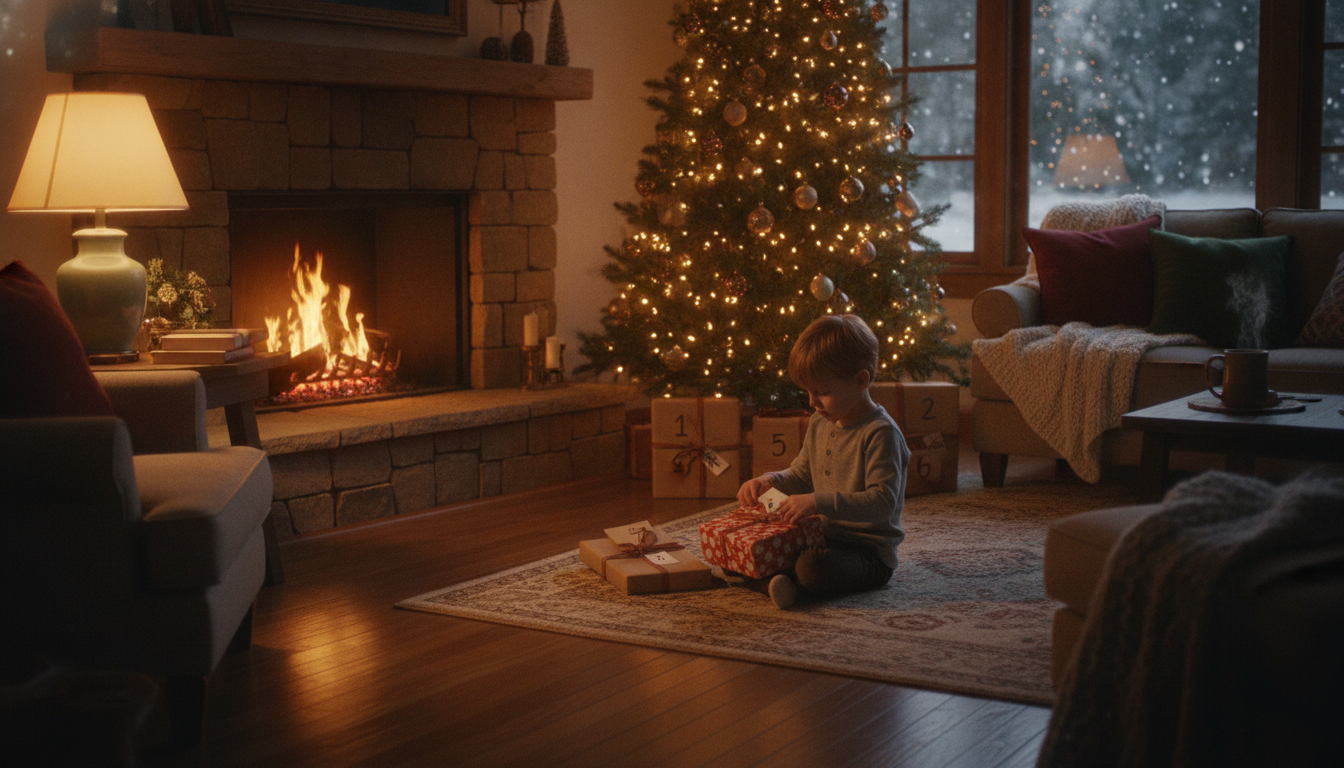
What a Book Advent Calendar Actually Is (And Why It Beats a Chocolate One)
A children's book advent calendar is exactly what it sounds like: 24 children's books wrapped individually, numbered 1 through 24, with one unwrapped and read aloud each night from December 1 to December 24. The concept is almost disarmingly simple, which is part of why it works so well. There is nothing to assemble, nothing to charge, and no app required.
The case against a chocolate calendar is not that chocolate is bad — it is that a chocolate calendar is over in four seconds. The foil is off, the chocolate is gone, and whatever small pleasure it delivered has already evaporated before you have sat down. A book does the opposite: someone has to sit down, open it together, and spend real time with it. That enforced slowness is the whole point. It is a built-in pause in a month that otherwise refuses to slow down.
The books also become keepsakes in a way that a foil square simply cannot. Three years into this tradition, you will find your child asking to re-read the one we opened on the seventh. The numbering and the nightly ritual give each book a memory attached to it — a specific night, a specific mood, a specific moment of sitting together. That is not something you can buy in a chocolate calendar.
Why it works for ages 2–10
For toddlers: board books that survive enthusiastic handling. For ages 3–6: picture books read aloud in one sitting. For older children: illustrated chapter sections, poetry collections, or short story anthologies. The range of suitable books is enormous, which means you can tailor every single night to exactly where your child is right now — not where a generic boxed set assumes they are.
There is no sugar crash, no arguments about who gets which door, and no moment at 7 a.m. where a child has already eaten tomorrow's chocolate. The pacing is built into the tradition itself, and children — even very young ones — understand and respect it in a way that surprises most parents the first time they try it.
Pre-Made Boxed Set vs. Building Your Own: A Fair Look at Both
Pre-made book advent calendar sets are genuinely worth considering if you are short on time. Publishers and specialist retailers put real thought into the curation, the books are age-banded, and everything arrives wrapped or ready to wrap. In a busy November, that is a meaningful time-saver — and the time you save is real time you would otherwise spend sourcing, sorting, and wrapping 24 individual books across several weeks.
The curation advantage is also real. A well-chosen boxed set from a reputable publisher often introduces titles you would never have stumbled across yourself. For a parent who does not spend hours browsing bookshops, that editorial work has genuine value. Someone with expertise has already done the thinking about what works together, what covers the right range of length and tone, and what holds up to repeated reads.
A pre-made set done well beats a DIY build done badly, and a thoughtful DIY build beats a generic boxed set. Know your own capacity in November and choose accordingly.
The trade-off with pre-made sets is personalization. The books are chosen for a general age range, not for your specific child who is obsessed with dinosaurs, or who has already read half the classics in the box, or who is going through something emotionally that makes one particular theme land better than any other right now. A boxed set cannot account for any of that.
Building your own gives you total control over theme, reading level, and the mix of new versus familiar. You can include a beloved re-read on a hard week, or slot in a book that connects to something your child is going through right now. If you want inspiration for personalized titles to include in a DIY build, the guide to the 5 best personalized books for kids is a useful starting point — those make particularly strong mid-calendar or Day 24 choices because they put your child's name and face at the center of the story in a way no off-the-shelf title can.
If you are weighing up specific platforms for personalized books to include, the comparison of Wonderbly vs LoveToRead.ai gives a clear side-by-side look at what each service offers, which is helpful when you are trying to decide what to order for one or two special slots in the calendar.
The honest answer is that neither option is wrong. Your decision should come down to one question: how much time do you genuinely have in October and November? If the answer is very little, a good pre-made set is a perfectly respectable choice. If you have an evening or two and access to a decent second-hand bookshop, build your own.
How to Build Your Own: A Step-by-Step Walkthrough
Step 1: Decide how many books you actually need
The calendar runs December 1 to December 24, so 24 books is the standard. If your family also marks St. Nicholas Day on December 6, that night is a natural slot for the slightly bigger book in the stack. But if your child is very young or you are doing this for the first time, there is no rule against mixing in a few activity cards, a small puzzle, or a simple toy on a handful of nights to stretch a smaller book collection. The tradition is yours to shape — the number 24 is a guide, not a constraint.
| Age band | Board books | Picture books | Longer or chapter reads | Seasonal or activity | What to watch for |
|---|---|---|---|---|---|
| Toddler, 2–3 | 10 | 12 | 0 | 2 | Short and sturdy. Expect the same three favorites to be requested again on later nights. |
| Preschool, 4–5 | 4 | 16 | 1 | 3 | Peak picture-book age. A couple of lift-the-flap titles buy you extra minutes. |
| Early reader, 6–8 | 0 | 14 | 6 | 4 | Mix read-to-me with read-it-yourself so it never feels like homework. |
| Confident reader, 8–10 | 0 | 6 | 14 | 4 | One longer book can cover three or four nights — wrap it as a single parcel. |
Step 2: Source cheaply and cleverly
Sourcing cheaply is the key to making this sustainable year after year. Library book sales are one of the best-kept secrets for building a calendar — many libraries hold sales in October and November where picture books sell for very little, and the quality is often excellent. Thrift shops and charity shops are equally reliable, especially in the weeks after school summer fairs when families donate outgrown books in bulk. Go early, go often, and bring a list of what you still need.
Do not overlook what you already own. Walk through your child's bookshelf before you spend anything. Pull out books they loved at age three that have been forgotten, or titles you bought with good intentions and never got around to reading. Re-wrapping a book your child has not seen in two years is not cheating — it is good curation, and for very young children it is completely invisible.
For families who want to supplement with digital reading on lighter nights, a resource like free books online for kindergarten can fill gaps without any cost. You can print a simple illustrated card to wrap in place of a physical book on those evenings, and frame it as a special screen-reading night — children often find this a welcome change of format mid-calendar.
| Source | Rough cost for 24 books | Effort | Best for |
|---|---|---|---|
| Books you already own, re-wrapped | Free | Low | First-timers, and toddlers who will not remember last year |
| Library book sales | Lowest paid option | Medium — they are seasonal, often October and November | Building the bulk of the stack in one trip |
| Thrift and charity shops | Low | Medium to high — needs repeat visits | Picture books, hunted over several weeks |
| Secondhand online sellers | Low to mid | Low — delivered to you | Filling specific gaps once you know what is missing |
| Discount and remainder retailers | Mid | Low | New-condition books without full retail pricing |
| New from a bookshop | Highest | Low | A handful of standout titles — not all 24 |
| Pre-made boxed set | Highest per book, but a single purchase | Very low | Short on time and happy to have the curation done for you |
| Free digital stories, printed as a card | Free | Low | Lighter mid-calendar nights |
Step 3: Wrap and number everything
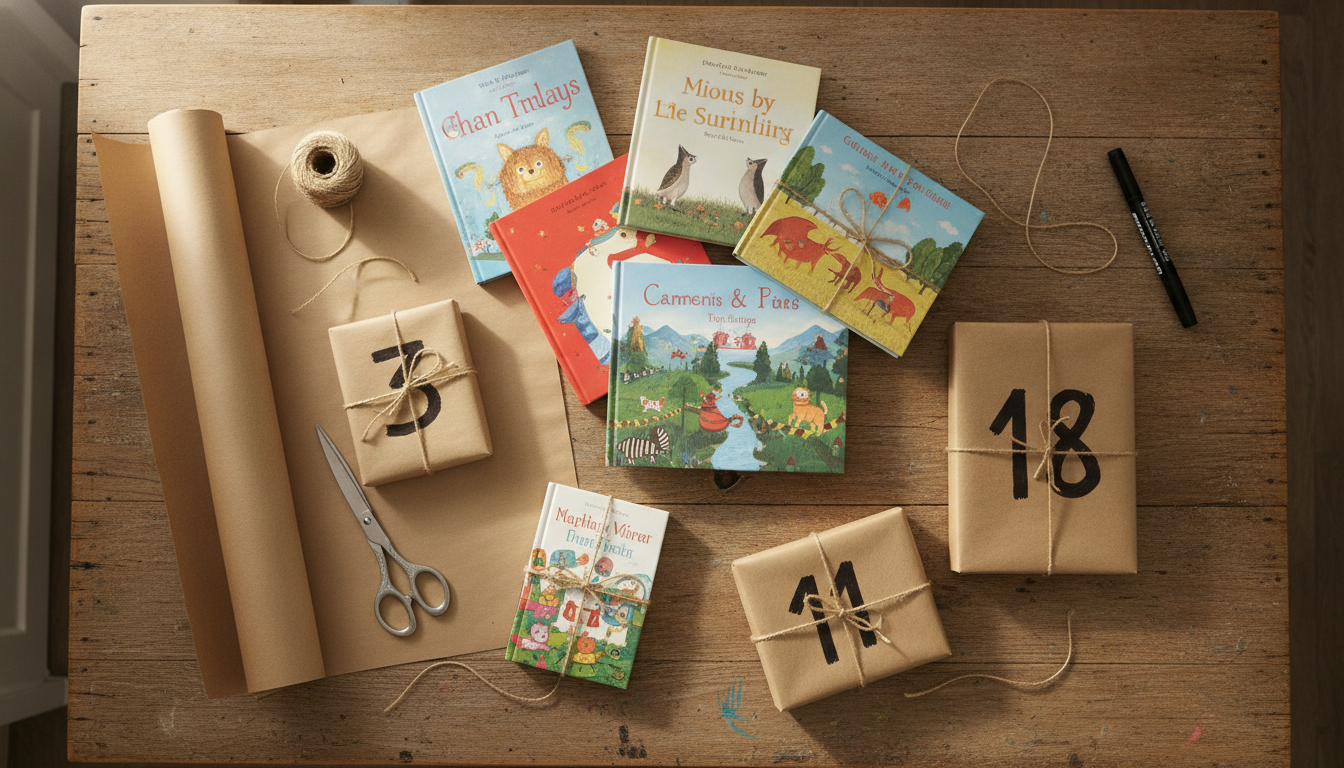
Wrapping does not need to be elaborate. Kraft paper and a marker for the number is the most popular approach because it looks cohesive, takes minutes per book, and the handwritten numbers add a homemade warmth that children respond to. Number the spines as well as the front so you can read the stack without unwrapping anything — this small detail saves a lot of rummaging on busy evenings.
If you want a bit more visual interest without much extra effort, a loop of twine tied around each parcel and a small sprig of dried rosemary or a cinnamon stick tucked under it takes about thirty seconds per book and makes the whole stack look intentional. Washi tape in a single pattern across all the parcels also works well for cohesion.
Step 4: Decide where to put it
Where you put the calendar matters more than you might expect. A dedicated shelf, a wooden crate, a basket by the fireplace, or a length of ribbon strung along a wall with books hanging from numbered pegs all work well. The display itself builds anticipation, so make it visible from the main living space rather than tucking it away in a corner. The stack of wrapped books should be the first thing a child sees when they come downstairs in December — that visibility is doing real work every single day.
What Goes on Day 24: Making Christmas Eve the Finale
Christmas Eve 2026 falls on Thursday, December 24, and for most families running a book advent calendar, this is the night that carries the most weight. The book you choose for Day 24 should feel different from everything that came before it — a clear signal that this is the finale, not just another evening in the run. If Day 24 is already a production in your house, the book pairs naturally with a Christmas Eve box, and our guide to Christmas read alouds has age-by-age picks for the title itself.
Many families reserve Day 24 for one of three things: a longstanding family favorite that is read only at Christmas and never at any other time of year; a brand-new hardback that feels genuinely special and has been kept hidden since it arrived; or a personalized storybook that puts the child at the center of a Christmas story. The personalization option works particularly well for Day 24 because it is impossible to find at a thrift shop, so it carries an obvious sense of intention — the child understands immediately that this one was made specifically for them.
Families running an Elf on the Shelf alongside the calendar often let the elf be the one who delivers each morning's book, which saves you inventing a new elf scene every night. Our guide to easy Elf on the Shelf ideas covers that pairing in detail.
A personalized Christmas storybook is one of the most effective Day 24 choices for children aged 2 to 7. Seeing their own name and likeness in a Christmas Eve story creates a moment that is genuinely hard to replicate with any off-the-shelf title, and the book itself becomes something they ask for again the following year. It also photographs beautifully, if that matters to you.
If you want to explore personalized options for the finale or for other gifts in the season, the personalized Christmas gifts for kids page is worth browsing well before December. Personalized books typically need ordering several weeks in advance — November 30 is too late for most providers, and some fill their order slots by mid-November during busy years.
Some families pair the Day 24 book with a new pair of pajamas, a hot chocolate, and a tradition of reading by the light of the Christmas tree only, with everything else switched off. That evening has a name and a country of origin — it is the Icelandic tradition of jolabokaflod, the Christmas Eve book flood, and it pairs naturally with a calendar that has been building toward Day 24 all month. The ritual around the book matters as much as the book itself. Layering a few consistent elements each year — the same mug, the same spot on the sofa, the same lamp — turns a single reading into a memory that sticks in a way that a standalone book simply cannot.
Day 24 checklist
Order your personalized book by early November at the latest. Decide on the ritual elements — pajamas, hot chocolate, tree lights only — and keep them consistent year to year. Save this book for after dinner, not before, so the unwrapping feels like a genuine event rather than just another item in the bedtime routine. If you want to build the habit before December arrives, October gives you a natural run-up — see our 31-day National Book Month plan.
Common Mistakes (And How to Avoid Every One of Them)

- Buying 24 brand-new books. This is the most common first-year mistake. It is expensive, it is unnecessary, and it often means you are buying to fill a number rather than because the book is right for your child. A calendar built from thrift finds, re-wrapped favorites, and three or four genuinely special new titles will outperform an all-new haul every time.
- Picking books above your child's reading level because they look impressive. The goal is a book that can be read aloud in one sitting before bed. For most ages, that means picture books or short illustrated chapter sections — not novels that will take a week to finish. A book that feels like homework on a Tuesday evening in December is a book that will make the whole tradition feel like a chore.
- Making it a chore. If you are tired and distracted and clearly just going through the motions, children feel it. The ritual only works if the adult is genuinely present for it. On hard nights, it is fine to read a shorter book, sit closer, and keep it simple rather than performing enthusiasm you do not have. Presence matters more than performance.
- Not checking what you already own before you buy anything. Most families with children aged 2 to 10 have more books than they realize. A book your child loved at age three and has not seen since is genuinely exciting to rediscover in December — and it costs you nothing. Walk the shelves first, always.
- Starting the wrapping job on November 30. This is a specific kind of chaos that experienced calendar-makers will recognize immediately. You run out of paper, the numbers look rushed, you cannot find the tape, and you end up wrapping in a panic while your child is technically asleep. Aim to have everything wrapped by the third week of November.
- Missing the natural deadline. The first Sunday of Advent in 2026 falls on November 29. Use that as your hard deadline for having your books fully sourced. If your pile is complete by November 29, you have a full week to wrap calmly before December 1 arrives — and calm wrapping produces a much better-looking calendar than panicked wrapping.
FAQ: Real Questions Parents Ask About Book Advent Calendars
Q: What if my child unwraps all the books at once on December 1?
This happens, especially with children under four. The solution most parents land on is keeping the wrapped books somewhere the child can see them but not easily reach without help — a high shelf, a closed crate, or a basket that requires an adult to lift down. Framing the nightly unwrapping as something you do together, rather than something they do alone, also helps. The ritual of choosing together is part of what makes it work, and children who feel that shared quality tend to wait more willingly.
Q: Can I do this for two children of different ages at the same time?
Yes, and there are two main approaches. The first is to build one shared calendar with books that suit the older child and read them together — this often works better than you expect, because younger children absorb more from read-alouds than their age suggests, and the shared experience has its own value. The second is to build two separate smaller calendars, which takes more sourcing but means each child gets books pitched exactly at them. Either approach works; the right one depends on how far apart your children's ages and reading levels are.
Q: What do I do if we miss a night?
Nothing. Skip it, double up the next night if you want to, or just carry on from where you left off. The calendar is a tradition, not a contract, and treating a missed night as a failure is the fastest way to make the whole thing feel like an obligation. December is unpredictable. The tradition survives a gap — it does not survive becoming a source of stress.
Q: Is there a good personalized book option for Day 24 that children actually love?
Personalized Christmas storybooks where the child is the main character are consistently well-received by children aged 2 to 7. The personalized Christmas storybook guide covers several strong options and explains what to look for in terms of illustration quality and lead times — both of which matter considerably if you are ordering in November. If you are also considering personalized books as gifts for other children in the family, the 5 best personalized birthday books for kids is a useful companion read for understanding what makes a personalized book genuinely good rather than just novelty.
Q: How do I stop the calendar feeling repetitive by week three?
Mix the format deliberately. Alternate longer picture books with very short ones. Include a poetry book or a book of Christmas riddles. Add a re-wrapped favorite from two years ago. Consider saving one genuinely surprising or different format — a lift-the-flap, a pop-up, a book with an audio component — for somewhere in the third week, when the novelty of unwrapping has settled into comfortable routine. That one unexpected format tends to re-energise the whole calendar for the final stretch. For ideas on books that do something different with format and imagination, the best kids' books for creativity in 2026 is a good place to browse.
Ready to Start Building Your Calendar?
The best time to source your 24 books is October and early November, before library sales sell out and thrift shop shelves get picked over. Walk your own bookshelves first, make a list of what you still need, and then hit the charity shops with that list in hand. The wrapping can wait until the third week of November — but the sourcing cannot. If your family marks Hanukkah rather than (or as well as) Advent, the same sourcing logic applies on a shorter runway — see our eight-night Hanukkah read-aloud plan. Families new to the holiday can start with our Hanukkah traditions guide.
If you want one genuinely special book to anchor Day 24 on Christmas Eve, a personalized storybook is worth ordering early. Lead times fill up fast in November, and the difference between a Day 24 book that feels like it was made for your child and one that was grabbed in a panic is the difference between a memory and a missed opportunity.
Find the Perfect Day 24 Book
Browse personalized Christmas gift options to find something that will make the finale night feel exactly as special as it should — and order early, before November slots fill up.
Browse Personalized Christmas Gifts




One Comment
Comments are closed.