Books for 4 Year Olds: What Actually Works at This Age
Four is a genuinely fascinating age for reading. Here's how to find books that will land — whether you're the parent doing bedtime or a grandparent shopping from across the country.
What Changes at Four (And Why It Matters for Books)
If you've been buying books for a two- or three-year-old, four feels like a different country. The child who used to squirm through a single spread can now sit through a longer picture book without losing the thread — and on a good night, they'll ask for another one. That shift in attention span alone opens up a whole new range of titles. If you are still in that earlier stretch, our guide to potty training books covers the titles that carry a two- or three-year-old through it.
But attention span is only part of the story. Four is peak silly. Kids this age are obsessed with jokes, absurdity, rule-breaking, and anything that makes a grown-up look ridiculous. Books that lean into that energy tend to become instant obsessions — the kind a child carries to the dinner table and insists on recapping to anyone who will listen.
Big feelings are also front and center at this age. Anger, jealousy, fear of the dark, anxiety about starting preschool or pre-K — four-year-olds are living through all of it, and they're just beginning to develop the vocabulary to name what they feel. That's what makes books such a powerful tool at this age: a story can hand a child the words for something they've been feeling but couldn't say.
The "why" questions are relentless at four. Books that follow a character solving a problem, or that explain how the world works in a concrete way, feed that curiosity in a way that feels satisfying rather than overwhelming. And many four-year-olds are starting to notice letters, recognize that print moves left to right, and pick out familiar words on a page. They're not reading independently yet — that's completely normal — but they're paying attention to the page in a new way, which is worth encouraging.
What Four-Year-Olds Bring to a Book
- A noticeably longer attention span than at two or three
- A deep love of jokes, absurdity, and grown-ups looking ridiculous
- Big feelings — and a growing need to name them
- Relentless curiosity about how things work and why
- Early awareness of letters and print — not reading yet, but watching closely
| Age | What they can sit through | What to look for in a book | Formats that work |
|---|---|---|---|
| Three | A short book, often abandoned mid-page | Rhythm, repetition, one clear idea per spread | Board books, short picture books |
| Four | A whole picture book, and usually a second one | A problem and a fix, jokes, characters with big feelings | Picture books, longer read-alouds |
| Five | A picture book plus a chapter or two | Longer arcs and characters they can follow across books | Picture books, early readers, first chapter books |
Ages here are a rough guide, not a rule. Plenty of four-year-olds are still happiest with a board book, and plenty are already asking for chapters.
Read-Aloud Picture Books That Really Land at Four
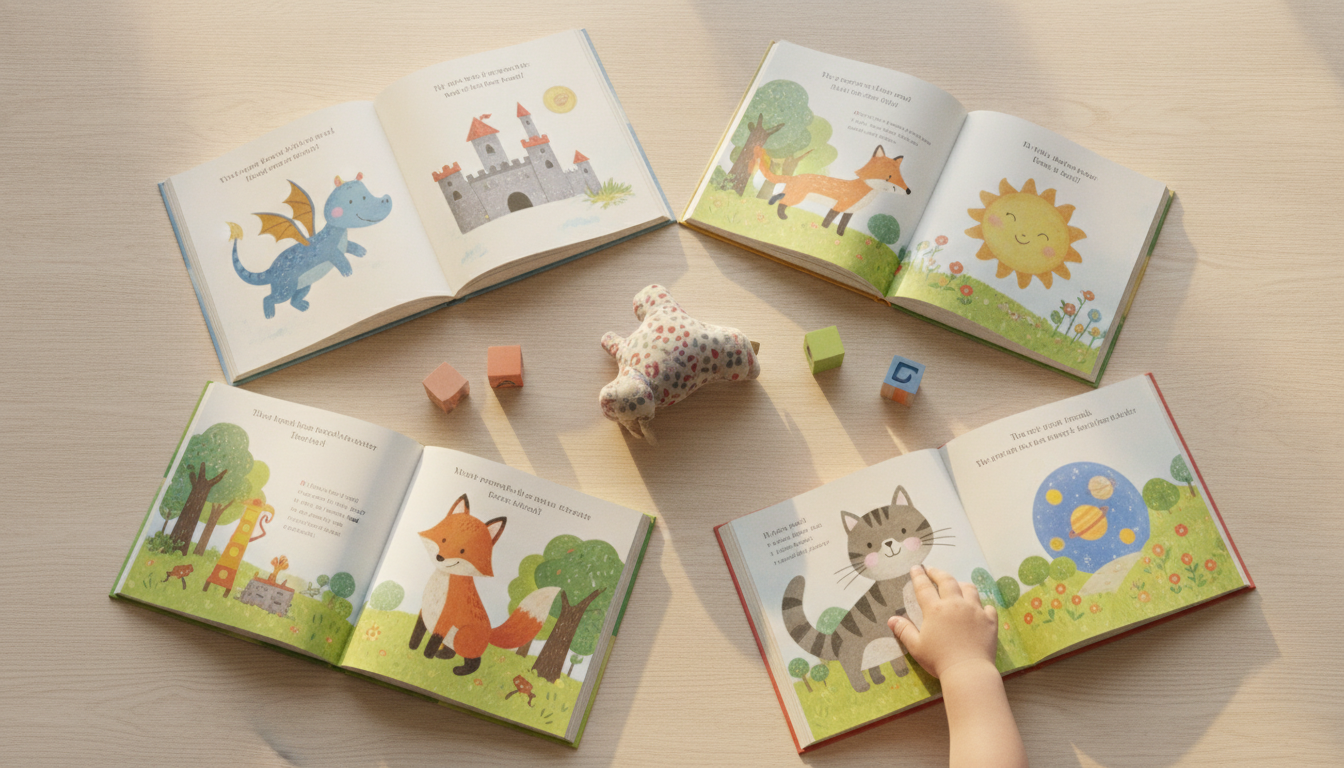
These are the books that earn their place on the shelf — the ones kids ask for repeatedly and that hold up across dozens of reads. They're organized here roughly by mood, not by any ranking, because the right book depends entirely on the child and the moment.
For the Drama Lover
The Day the Crayons Quit by Drew Daywalt is practically made for this age. It's told through a series of complaint letters from crayons — each one aggrieved about something different — which satisfies a four-year-old's love of drama and grievance while sneaking in early concepts about perspective and feelings. The format is unusual enough to feel fresh even after many reads.
For the Kid Who Loves to Memorize
The Gruffalo by Julia Donaldson has a rhyming text that four-year-olds memorize fast. Within a few reads, many kids will start "reading along," which feels like a huge accomplishment and builds real confidence. The story itself — a small mouse outwitting a series of predators — is satisfying in a deeply structural way that kids this age respond to without being able to explain why.
For the Child Who Feels Things Deeply
Corduroy by Don Freeman is a quieter book about a stuffed bear looking for a missing button and a little girl who loves him anyway. It handles longing and belonging with a lightness that doesn't minimize the feeling — and it's one of the best books available for a child who is navigating friendships, separation, or the fear of not being enough.
Where the Wild Things Are by Maurice Sendak remains one of the best books ever written about anger and imagination. Four-year-olds who have big feelings often find it genuinely comforting to see a child who acts wild and still gets to come home to supper. The arc of rupture and repair is deeply reassuring, even if a child can't articulate that.
For the Child Who Asks Questions About the World
The Snowy Day by Ezra Jack Keats follows a small boy's solo adventure in the snow. The illustrations are beautiful and the story is gentle, but there's a real sense of a child's inner world being taken seriously — which four-year-olds respond to strongly, because they are often not taken seriously enough.
Last Stop on Market Street by Matt de la Peña is a gorgeous book about a boy and his grandmother riding the bus through their city. It opens up conversations about gratitude, community, and noticing beauty in everyday places — the kind of book that sparks a long discussion after the last page, which is exactly what you want from a read-aloud.
For Story Time That Feels Like an Event
Strega Nona by Tomie dePaola is a folktale-style story about a magic pasta pot and the chaos that follows when someone uses it without permission. It's funny, a little scary, and satisfying in the way that classic stories tend to be — there's a clear cause, a clear consequence, and a resolution that feels fair. Four-year-olds who are working out the rules of the world find that structure genuinely comforting.
That register — a little scary, but safely resolved — is worth being able to find on purpose, because it comes around every October. Our list of Halloween stories for preschoolers is built on the same test: enough atmosphere to feel like an event, without the part that keeps a four-year-old awake afterward.
Funny Books: Four Is Peak Silly
If you want to guarantee a read-aloud that a four-year-old will ask for again, lean into funny. This is the age when humor becomes a genuine shared language between kids and the adults who read to them.
Don't Let the Pigeon Drive the Bus! by Mo Willems is one of the funniest books for this age group because it invites the child to be the authority. The pigeon begs, wheedles, and throws a tantrum, and the child gets to say no — which is enormously satisfying for someone who is told no constantly. The power reversal is the entire joke, and four-year-olds get it completely.
Dragons Love Tacos by Adam Rubin is pure absurdist joy: dragons, tacos, and a plot twist involving spicy salsa. It's the kind of book that four-year-olds ask for again and again, and that adults can read without losing their minds — which is not a small thing when you're on your fifteenth bedtime read of the week.
"The entire joke of The Book with No Pictures is that the adult reading it is forced to say increasingly ridiculous things out loud. Four-year-olds find this absolutely hilarious — and it turns the read-aloud into a performance."
The Book with No Pictures by B.J. Novak has no illustrations at all, which sounds risky. But it works because the adult reading it is forced to say increasingly ridiculous things out loud. Four-year-olds find this absolutely hilarious, and it turns the read-aloud into a performance — the child gets to watch a grown-up be silly on command, which is basically their dream scenario.
The Very Hungry Caterpillar by Eric Carle skews slightly young — it's a classic for ages two and three as well — but the counting, the days of the week, and the transformation at the end still hold genuine interest for four-year-olds who are starting to notice patterns and sequences. If a child already loves it, there's no reason to retire it.
If you have a child who is ready to explore slightly longer formats, these free stories are a low-pressure way to try something beyond a picture book before committing to a chapter book.
Books for Big Feelings and Starting Preschool
Four is often the year kids start preschool or pre-K, and the anxiety around separation, new friends, and unfamiliar routines is real. Books that normalize those feelings without being preachy are genuinely useful — not as a substitute for conversation, but as a way to open one.
Where the Wild Things Are works double duty here. It's funny and wild, but it's also about a child who acts out, gets sent away (metaphorically), has a grand adventure, and chooses to come home. That arc of rupture and repair is deeply reassuring for a child who is worried that being bad might mean being unloved.
Corduroy handles the fear of not being chosen — or not being enough — with a lightness that doesn't minimize the feeling. It's a good book to read before a playdate, a first day of school, or any moment when a child needs to feel that they are already lovable, exactly as they are.
Last Stop on Market Street is useful for a different kind of big feeling — the one where a child notices that not everyone has the same things and starts asking hard questions. It models gratitude and purpose without being saccharine, and it gives parents a natural opening to talk about community and helping.
For kids who are on the edge of kindergarten readiness, it's worth exploring what's available for slightly older readers. This guide to free books online for kindergarten is a helpful next step when your four-year-old starts acting like a five-year-old — which, as any parent knows, happens earlier than you expect.
First Chapter Books and Early Readers Worth Knowing
Not every four-year-old is ready for a chapter book — and that's completely fine. But some kids this age are hungry for something longer, and there are a handful of titles that bridge the gap beautifully when read aloud by an adult.
Frog and Toad Are Friends by Arnold Lobel is the gold standard first chapter book for this age band. The chapters are short, the friendship between Frog and Toad is warm and funny, and the vocabulary is accessible without being dumbed down. Many four-year-olds who are ready for something longer will love it read aloud — and the subsequent books in the series give you a natural next step.
Mercy Watson to the Rescue by Kate DiCamillo is a slightly longer early chapter book about a pig who loves buttered toast and the gentle chaos she causes. It's funny, the chapters are short enough to read one at a time, and it works beautifully as a bedtime serial — the kind where a child asks "just one more chapter" and you actually want to say yes.
A Note on Read-Aloud vs. Independent Reading
Neither Frog and Toad nor Mercy Watson requires a child to read independently. They are written to be read aloud to a child who is ready for a slightly longer story arc — which is a different skill from decoding words on a page. Don't rush the distinction. Being read to is doing exactly what it needs to do.
If your four-year-old is showing strong interest in letters and early reading, the jump from picture books to early readers is gradual. This resource on free books online for first graders gives a useful preview of what comes next, even if you're not quite there yet — it's helpful to know what the horizon looks like. That horizon includes a phase plenty of families hit a few years later, when a child who loved books simply stops choosing them — our guide to books for reluctant readers covers what actually helps when that happens.
A good series also has a real practical advantage for gift-buyers: once you know a child loves the first book, every subsequent volume is a safe, welcome gift. That's worth remembering when you're shopping.
How to Buy Books for Someone Else's Four-Year-Old
If you're a grandparent, aunt, uncle, or family friend choosing books for a child you don't see every day, the single most useful thing you can do is text the parents one question before you order: "Which books does she already own or know by heart?" This prevents duplicates and shows you care about getting it right.
Duplicates are more common than you'd think with the most popular titles on this list. The Very Hungry Caterpillar and Where the Wild Things Are are so well-loved that many families own multiple copies — sometimes three or four, from different gift-givers over the years. If you're going for a classic, it's worth checking first.
| What you know about the child | A safe pick | Why it works |
|---|---|---|
| Loves drama and big reactions | The Day the Crayons Quit | Every page is a small performance, and it gives the reader something to do with their voice |
| Quotes lines back at you all day | Don't Let the Pigeon Drive the Bus! | Built for talking back to, so it survives the fortieth reading |
| Starting preschool, or working through big feelings | Corduroy | A gentle story about wanting to belong, told without ever saying so directly |
| Asks why about everything | Last Stop on Market Street | Answers a child's questions about the world with a conversation rather than a lecture |
| Already sitting still for longer stories | Mercy Watson to the Rescue or Frog and Toad Are Friends | Chapters that are short enough to finish in one sitting, with pictures still doing real work |
| You genuinely do not know, and cannot ask | A personalized storybook | The one book on this list you can be certain is not already on their shelf |
Hardcover vs. Paperback
This is a real decision. Hardcovers hold up better to repeated reading and feel like a gift. But paperbacks are lighter, cheaper to replace, and easier for small hands to hold and carry. For a book you expect a child to love to pieces — literally — paperback is often the better call. For a book you want to last on a shelf for years, hardcover makes more sense.
Series vs. Standalone
Standalone books are lower risk for gift-buyers who aren't sure of a child's tastes — you're not betting on a child loving the first volume enough to want the next one. Series books (Frog and Toad, Mercy Watson) are higher reward if you know the child already loves the first volume, because you've just unlocked a whole shelf of future gifts. Keep that distinction in mind when you're shopping.
When You Want Something They Definitely Won't Already Own
A personalized storybook — one that casts the child as the main character — is one good option when you want a gift they definitely won't already own. LoveToRead creates this kind of book, and it can feel genuinely special for a child who is just starting to see themselves as a reader. It's not a replacement for the classics above — it's a different kind of gift entirely, one that works well alongside a shelf of well-loved picture books.
For ongoing gifting — think birthdays, holidays, or "just because" packages sent from across the country — a children's book subscription service takes the guesswork out entirely. This roundup of the best children's book subscription services is a helpful starting point if that sounds appealing.
FAQ: Quick Answers for Parents and Gift-Buyers
How many books should a 4-year-old have?
There's no magic number, and quantity matters far less than variety and access. A small collection of books that a child can reach, choose from, and return to independently is worth more than a large library that lives on a high shelf. A mix of funny books, quieter books, and one or two slightly longer stories covers most moods and most nights.
Should a 4-year-old be reading yet?
Most four-year-olds are not reading independently, and that is completely normal. Reading readiness varies widely, and the research is clear that being read to is what builds the foundation for reading later. If a child is recognizing letters or sounding out a few words, that's a bonus — not a requirement, and not something to stress about if it isn't happening yet.
What if they only want the same book every night?
This is one of the most common things parents worry about, and it's actually a sign of healthy development. Repetition helps children build memory, predict story structure, and feel safe. If you're the one reading it for the fortieth time, you have full permission to feel tired of it. The child is getting something real from it — and they'll move on when they're ready.
Ready to Build a Book Collection They'll Actually Love?
Whether you're stocking a shelf at home or shopping for a child you adore from a distance, the right book at the right age is a gift that lasts. Start with one title from this list, ask the parents what they already have, and trust your instincts — you know this child.
One Comment
Comments are closed.