Diwali Stories for Kids: A Warm Guide for American Parents
Everything you need to read, retell, and celebrate the Festival of Lights with your child — from toddlers to tweens.
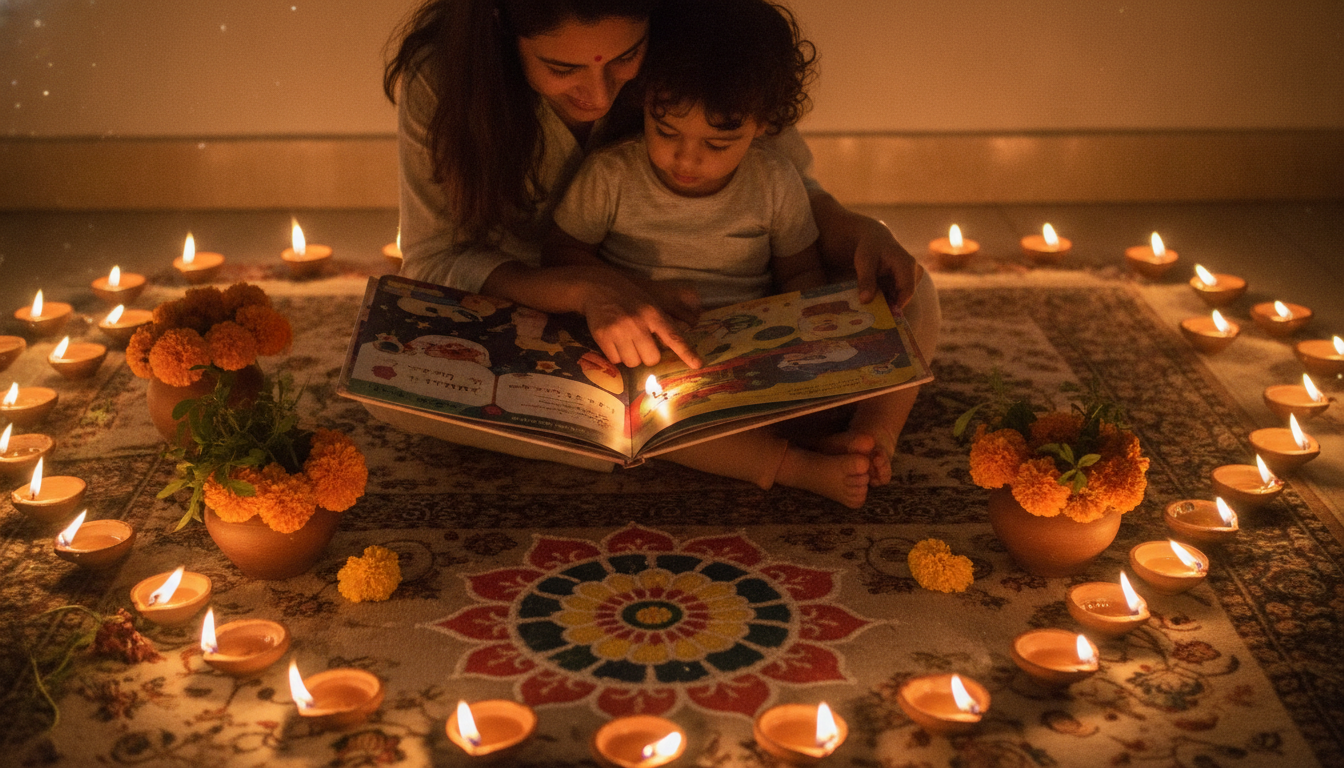
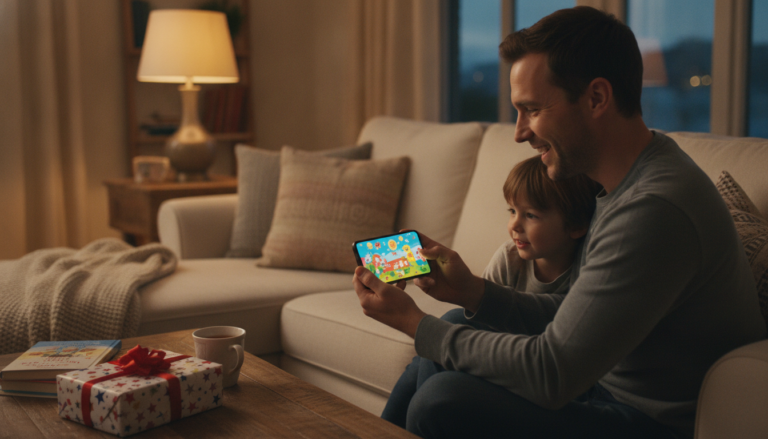
There is something quietly magical about sitting with your child in the glow of a candle and saying, "Once upon a time, a kind prince named Rama…" You do not need to celebrate Diwali yourself to share these stories. You just need a warm blanket, a few minutes, and a willingness to let a very old and very beautiful tradition into your living room for the evening.
This guide is for American parents who want to introduce their children to Diwali stories — whether your family has South Asian roots, your child came home from school buzzing about the Festival of Lights, or you simply believe that great stories from around the world make children bigger, kinder people. You will find simple retellings you can read aloud tonight, an age-by-age guide, book recommendations, and answers to the questions parents ask most.
What Is Diwali and Why Do We Celebrate It?
Diwali, often called the Festival of Lights, is one of the most widely celebrated holidays in Hindu, Jain, Sikh, and some Buddhist traditions. It typically falls in October or November each year, following the Hindu lunar calendar. In 2026, Diwali falls on Sunday, November 8th, with the five days of the festival running from November 6 through November 10 — which makes mid-October a good time to begin reading these stories together.
The word "Diwali" comes from the Sanskrit Deepavali, meaning "row of lights." It refers to the thousands of small clay oil lamps called diyas that families light to welcome goodness and push away darkness. Walk through any neighborhood in Mumbai, Delhi, or Leicester on Diwali night and you will see windowsills, doorsteps, and rooftops shimmering with tiny flames — a sight that stops the breath.
✨ The Heart of Diwali
At its core, Diwali celebrates light over darkness, knowledge over ignorance, and good over evil. These are themes that resonate with children of every background — and they are exactly what makes Diwali stories so powerful at bedtime.
The festival lasts five days and includes lighting diyas, making colorful rangoli art on the floor, sharing sweets with neighbors, wearing new clothes, and gathering with family to tell ancient stories. For American families exploring Diwali with their children, those stories offer the most beautiful entry point of all — they are vivid, dramatic, and full of heroes, loyalty, and hope.
If you are already in the habit of reading seasonal stories with your family, you might enjoy pairing Diwali story nights with your broader National Book Month reading plan — October is National Book Month, which makes it a natural runway into a November Diwali.
The Main Diwali Stories Your Child Will Love
Diwali is not tied to a single story — different communities celebrate different tales, all of which carry the same luminous thread of light, courage, and goodness winning the day. Here are the four stories your child is most likely to encounter.
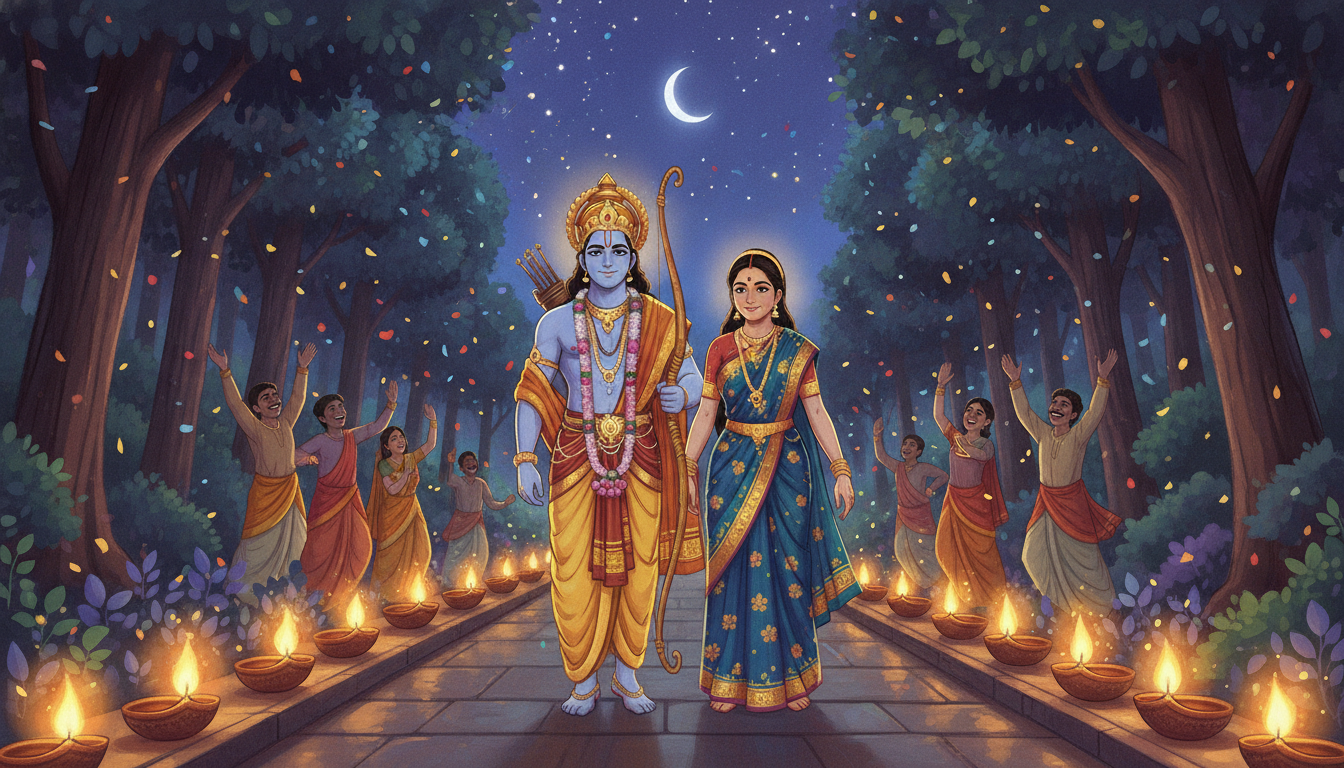
1. The Return of Rama (The Ramayana)
The most widely told Diwali story follows Lord Rama, a kind and noble prince, who is sent into exile for 14 years through no fault of his own. During that time, the demon king Ravana kidnaps his beloved wife Sita. With the help of his loyal brother Lakshmana and the brave monkey general Hanuman, Rama fights Ravana and rescues Sita. When they finally return home to the kingdom of Ayodhya, the people light thousands of lamps to guide them through the dark — and that, the story tells us, is why we light diyas on Diwali. It is a perfect story for young children: a clear hero, a clear villain, and a homecoming that fills the heart.
2. The Goddess Lakshmi
Lakshmi, the goddess of wealth and prosperity, is said to visit clean, bright, and welcoming homes on Diwali night. Families light lamps, decorate their doorways with rangoli, and prepare sweets to welcome her. This story is less about battle and more about gratitude, generosity, and the idea that a home filled with love and care is the richest home of all — a message that lands beautifully with the youngest children.
3. Bandi Chhor Divas (The Sikh Tradition)
In the Sikh tradition, Diwali coincides with Bandi Chhor Divas, the day Guru Hargobind Sahib was freed from imprisonment along with 52 other princes. The Guru refused to leave unless all the other prisoners were freed too — and the king agreed. Lamps were lit in celebration. It is a powerful story of justice, solidarity, and the idea that freedom is only real when it belongs to everyone. Older children find this story particularly moving.
4. Lord Krishna and Narakasura
Celebrated especially in South India, this story tells of the demon Narakasura, who terrorized the world until Lord Krishna — brave, clever, and unstoppable — defeated him. People celebrated with fireworks and lamps. For children who love action and adventure, this is the Diwali story that will have them cheering.
Each of these stories carries a timeless moral that transcends any single culture, making them wonderful conversation starters for families of all backgrounds. They are the kind of tales that, once told, stay with a child for life.
Simple Retellings to Read Aloud at Bedtime
You do not need a script or a special book to tell these stories tonight. Here are four read-aloud retellings written in language a young child can follow. Read them slowly, pause often, and let your child ask questions.
The Rama and Sita Story
"Once upon a time, a kind prince named Rama lived in a beautiful kingdom. He loved his wife Sita and his loyal brother Lakshmana more than anything. But one day, a wicked demon king named Ravana stole Sita away. Rama was heartbroken — but he never gave up. With the help of a brave monkey general named Hanuman and a great army, Rama fought Ravana and rescued Sita. When they finally came home, the whole kingdom lit tiny lamps to welcome them back — and that is why we light diyas on Diwali."
Read-aloud tip: Pause after "Rama was heartbroken" and ask your child: "What do you think Rama was feeling right now? What would you do if someone you loved needed help?"
The Lakshmi Story
"Lakshmi is a beautiful goddess who brings happiness and good things to families. On Diwali night, she travels from home to home looking for places that are bright, clean, and full of love. Families light lamps and decorate their doorways so Lakshmi knows she is welcome. When she visits, she brings blessings for the whole year ahead."
Read-aloud tip: Use a soft, hushed voice — as if Lakshmi might be listening right now. Let your child help you "light" a battery-powered diya as you finish the story.
The Bandi Chhor Divas Story
"Long ago, a wise and kind leader named Guru Hargobind was put in prison even though he had done nothing wrong. When he was finally set free, he refused to leave unless 52 other men who were also locked up could go free too. The king agreed, and everyone lit lamps and celebrated — because when one person is free, it matters that everyone is free."
Read-aloud tip: After the story, ask: "Why do you think the Guru waited for everyone else? What does it mean to be a good friend or a good leader?"
The Narakasura Story
"There was once a powerful demon named Narakasura who caused trouble for everyone. Lord Krishna was very brave and very clever, and he found a way to stop Narakasura and bring peace back to the world. People celebrated by lighting fireworks and lamps — and some families still do this today!"
Read-aloud tip: Let your child roar like Narakasura, then cheer like the people celebrating — a little drama makes a story unforgettable.
💡 The Golden Rule of Read-Alouds
Pause after each main event and invite your child in. "What do you think happens next?" or "How would you feel if you were Hanuman?" — these small stops turn a story into a shared experience. For more on this technique, see our guide to dialogic reading with picture books.
Story-to-Age Guide: Which Tale Is Right for Your Child?
Not every Diwali story works equally well at every age. Here is a quick reference to help you choose — and a read-aloud tip for each stage.
| Age Band | Best Story | Why It Works | Read-Aloud Tip |
|---|---|---|---|
| Ages 2–4 Toddlers |
The Lakshmi Story | Short, gentle, full of sensory details — lights, flowers, sweets. No scary villains. | Use a soft, hushed voice as if Lakshmi might be listening. Let your child help "light" a battery-powered diya. |
| Ages 4–6 Preschool & Kindergarten |
Rama and Sita (simplified) | Children this age love heroes, villains, and happy endings. Hanuman is a natural favorite. | Act out Hanuman leaping across the ocean with a dramatic jump. Let your child roar like Ravana for extra giggles. |
| Ages 6–8 Early Elementary |
Rama and Sita (fuller version) | Children can handle more detail and will love Hanuman's loyalty and Sita's courage. | Stop after Hanuman's part and ask: "What makes someone a true friend?" to spark a meaningful conversation. |
| Ages 8–10 Middle Elementary |
Narakasura & Bandi Chhor Divas | Children this age can appreciate themes of justice, freedom, and standing up for others. | After the story, find India on a map together and talk about how the same holiday can mean different things to different communities. |
| Ages 10–12 Tweens |
All four stories — compare them | Older children can explore common themes across traditions and think critically about storytelling itself. | Invite your tween to retell one story in their own words, or write a short journal entry from Sita's point of view. |
If your tween takes to retelling stories, that impulse is worth nurturing — our guide to getting your child to retell stories has practical techniques that work beautifully alongside cultural storytelling like this.
How to Read and Talk About Diwali Stories Together at Home
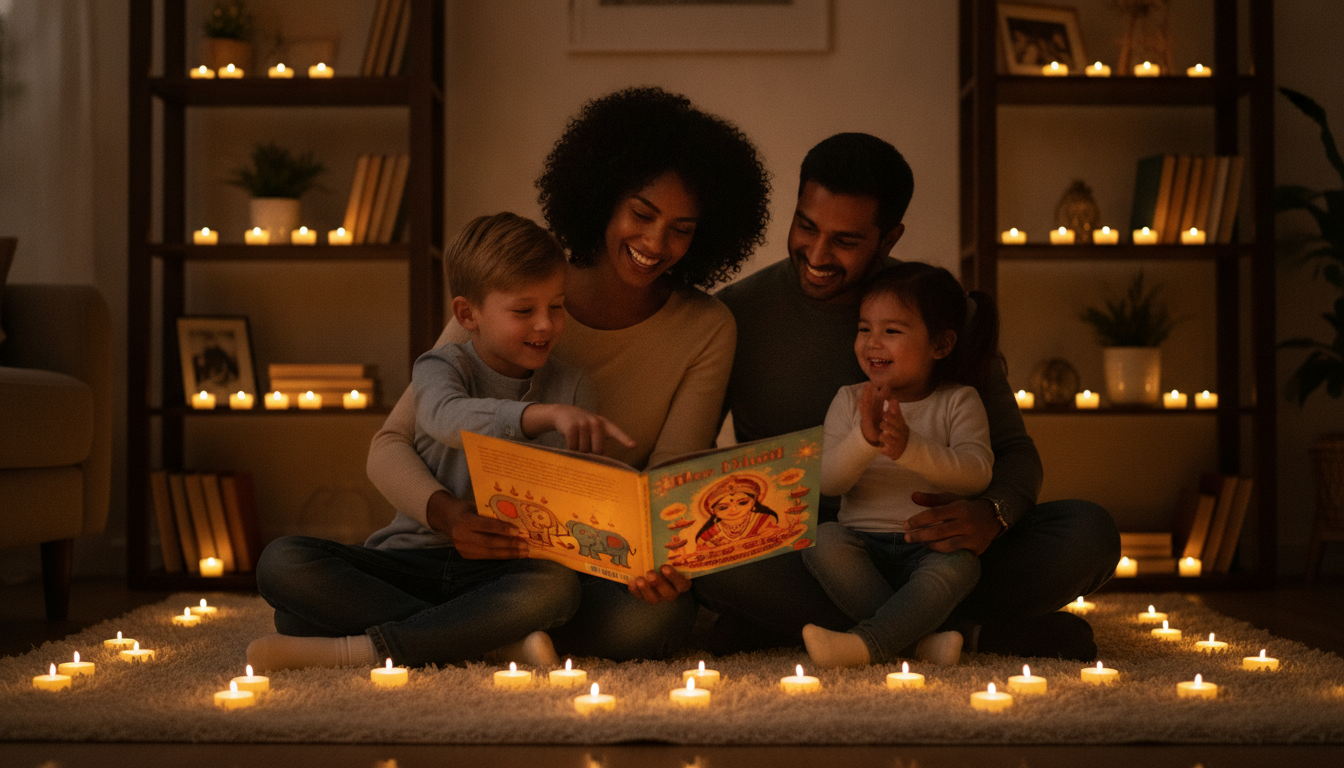
The atmosphere you create matters almost as much as the words on the page. Here is how to make Diwali story time feel genuinely special — no budget required.
Create a Simple Diwali Reading Corner
Gather a few battery-powered tea lights, a cozy blanket, and any Diwali picture books you have. If you have marigolds or orange flowers nearby, set them out. The physical warmth of light and color helps children feel the spirit of the stories before you even begin — they arrive at the first sentence already a little enchanted.
Make Storytelling Interactive
Assign roles: one child can be Rama, another can be Hanuman, and a parent narrates. Even a five-minute dramatic retelling at the dinner table becomes a memory that lasts for years. Do not worry about getting every detail right. The joy is in the telling, not the accuracy.
Follow Up With a Creative Response
After reading, invite your child to draw their favorite moment from the story — whether it is Sita's rescue, the rows of glowing lamps welcoming Rama home, or Lakshmi stepping through a decorated doorway. This creative response helps cement the story in memory and gives your child a sense of ownership over it. You might be surprised by what they choose to capture.
Connect the Stories to Your Family's Values
Use the stories as a springboard for conversations about what your own family believes in. Ask: "Our family believes in being kind — which character in the story showed kindness today?" or "Hanuman never gave up on his friend. When have you felt like that?" Ancient stories become living things when they connect to everyday life.
These conversations are also a natural extension of the kind of empathy-building that happens on World Kindness Day — reading stories about goodness is one of the most direct ways to grow it.
Be Honest If Your Family Does Not Celebrate Diwali
If Diwali is not part of your own tradition, be clear and warm about that with your child: "This is a story that many families in India and around the world love. We are reading it to learn about their traditions and because these stories teach us something good." Respectful curiosity is one of the finest gifts you can give a child. You might light a diya, make some kheer (rice pudding), or watch a Diwali parade video together — small gestures that say this matters, and so do the people who celebrate it.
Recommended Diwali Books for Every Age
Once you have told the stories in your own words, a beautiful picture book can deepen the experience. Here are five worth finding at your library or local bookstore.
Binny's Diwali by Thrity Umrigar
A warm, simple picture book perfect for ages 3–6 that follows a young girl explaining Diwali to her classmates. Ideal for children who want to share what they have learned — and for parents who want a gentle, school-friendly introduction to the festival.
The Story of Diwali by Jatinder Verma
A richly illustrated retelling of the Rama story suitable for ages 5–9. The language is poetic enough to read aloud beautifully but clear enough for children to follow every twist. One of the best read-aloud Diwali books available.
Amma Tell Me About Diwali! by Bhakti Mathur
Part of a beloved series that uses a grandmother-grandchild conversation to retell the Rama story. The intimate, intergenerational frame makes it feel exactly right for bedtime reading — as if you are the grandmother, telling the story to your own child.
Festival of Colors by Surishtha Sehgal
While primarily about Holi, this book introduces young children to the joy of Indian festivals and pairs beautifully with a Diwali conversation about celebration and community. Great for ages 3–6 who respond to bright, joyful imagery.
Ramayana: Divine Loophole by Sanjay Patel
For readers aged 9 and up, this visually stunning illustrated retelling by a Pixar animator brings the full Ramayana epic to life in a format that tweens and teens will genuinely want to pick up on their own. A brilliant bridge between the bedtime story and independent reading.
If your child is in the habit of reading independently and you want to build on that momentum, our list of best kids' books for creativity has more titles that pair well with cultural storytelling.
Frequently Asked Questions About Diwali for Kids
Do I need to be Hindu to read Diwali stories with my child?
Absolutely not. Diwali stories are shared across Hindu, Sikh, Jain, and Buddhist communities, and people of all backgrounds can enjoy and learn from them respectfully — just as families read Greek myths or Norse legends without practicing those religions. The stories belong to the world, and reading them is an act of appreciation, not appropriation.
My child asked why we don't celebrate Diwali ourselves. What should I say?
A wonderful answer is: "We celebrate it by learning about it and appreciating it. Some families celebrate it with lights and sweets — maybe we can do that too!" You might light a diya, make some simple Indian sweets from an international grocery store, or watch a Diwali parade video together. The gesture does not need to be elaborate to be meaningful.
Are there any parts of the Diwali stories that might scare young children?
The demon characters like Ravana and Narakasura can sound frightening in their full versions — but in the stories they are always defeated. Frame them exactly the way you would a fairy-tale villain: scary enough to make the hero's courage matter, but never without resolution. Reassure your child that the good characters always find a way through. For toddlers, simply skip the demon stories and stick with the Lakshmi story, which has no frightening elements at all.
When exactly is Diwali celebrated?
Diwali falls on the new moon night between mid-October and mid-November each year, following the Hindu lunar calendar. In 2026, Diwali falls on Sunday, November 8th, and the five days of the festival run from November 6 through November 10. Beginning your Diwali story nights in mid-October gives you three or four weeks of cozy reading before the festival itself — a lovely slow build.
How can I make Diwali story time feel special without a big budget?
Light a few candles or battery tea lights, make a simple sweet snack like rice pudding or pick up a small box of Indian sweets from an international grocery store, put on soft instrumental music, and read together. The magic is entirely in the togetherness. Diwali, at its heart, is about the light you create in the dark — and that costs nothing at all.
My child wants to tell their own Diwali story. How do I encourage that?
That impulse is wonderful and worth every encouragement. Ask them to start with: "Once upon a time, there was a lamp that never went out…" and see where they go. If they love the idea of creating their own illustrated stories, our guide to encouraging storytelling in kids has practical next steps for every age.
Bringing It All Together
Diwali stories are not just beautiful — they are useful. They give children language for bravery, loyalty, homecoming, justice, and hope. They introduce the idea that different families around the world carry different stories, and that those stories are worth knowing. And they do all of this in the most natural way possible: through a tale told in the dark, by lamplight, with someone you love beside you.
You do not need to get every detail right. You do not need a perfect accent or a shelf full of books. You need the Lakshmi story, a battery-powered tea light, and five minutes before your child falls asleep. Start there. The rest will follow.
Diwali also opens a run of festival reading that carries right through the fall and winter — Thanksgiving activities for preschoolers comes next on the calendar, and then the eight nights of Hanukkah in early December. If you want to keep the reading momentum going beyond Diwali, our guide to inspiring kids to read is full of practical ideas that work year-round — and the habits you build this fall will carry your family through the whole year ahead.
And if all that lamp-light leaves your child wanting to be the hero of a story themselves, you can make one with them over at LoveToRead.
Start Your Diwali Story Night This Week
Pick one story, gather a few tea lights, and snuggle in. The Festival of Lights is waiting — and your child will remember this bedtime for a long time.
Read Free Stories at LoveToRead


4 Comments
Comments are closed.