Phonological Awareness: A Plain-English Guide for Parents Who Just Heard That Phrase
A plain-English guide for parents who want to understand phonological awareness — and actually do something about it tonight.
The Moment That Sent You Here
Picture it: you're sitting across from your child's teacher, nodding along, and the phrase phonological awareness lands on the table like a word in a foreign language. You smile, you nod, you write it down maybe — but you leave the meeting not entirely sure what just happened or what you're supposed to do next.
That experience is common, and it says nothing about you as a parent. It says everything about how rarely this term gets explained in plain language to the people who matter most to a child's learning: the adults at home.
This guide exists to fix that. By the end, you'll know exactly what phonological awareness is, why it matters for your child's reading, and how you can build it together in the car, in the grocery line, or while doing the dishes — no worksheets, no flashcards, no special equipment required.
The single most important thing to know upfront
This skill lives entirely in the ear. It has nothing to do with letters, books, or screens. A child can practice it with their eyes closed — which is what makes it so easy for parents to work on at home, and so often overlooked.
So What Actually Is Phonological Awareness?
Think of phonological awareness as a big umbrella. Under that umbrella is your child's ability to hear, notice, and play with the sound structure of spoken language — completely apart from any written letters.
Under that umbrella you'll find a whole range of sound skills: hearing individual words inside a sentence, clapping out syllables in a name, recognizing that "cat" and "hat" rhyme, noticing that "bird" and "ball" start with the same sound, and eventually pulling a word apart into its tiniest individual sounds.
Phonemic awareness — a term you may also have heard — is not a different thing. It's the narrowest, most precise corner of that same umbrella. It refers specifically to working with individual sounds, called phonemes, inside a word. So "cat" has three phonemes: /k/, /a/, /t/. Phonemic awareness is the hardest part of the umbrella to master, and it comes after the broader skills are already in place.
The umbrella-and-subset relationship matters because it tells you where to start. A child who can't yet hear that "sunshine" has two chunks isn't ready to pull apart the individual sounds in "sun." The skills build on each other, and the bigger, easier ones come first.
Oral language — all the talking, listening, singing, and storytelling your child does every day — is the soil this whole umbrella grows in. Rich conversation at home isn't separate from phonological awareness; it's the foundation of it.
Phonological Awareness vs. Phonics: They Are Not the Same Thing
This is the confusion that trips up almost every parent, and it's completely understandable because the words sound like they belong together.
Phonological awareness is a listening-and-speaking skill. It operates entirely in sound. There are no letters involved — not a single one. When a child hears that "dog" and "log" rhyme, or taps out the three beats in "ba-na-na," they are using phonological awareness.
Phonics is what happens when sounds get connected to written letters and letter combinations. When a child looks at the letter "b" and knows it makes the /b/ sound, or sees "sh" and knows how to pronounce it, that's phonics at work.
A useful way to think about it: phonological awareness is the ear skill, and phonics is the bridge between the ear and the eye. Children generally need a solid foundation in phonological awareness before phonics instruction really clicks, because they need to hear the sounds clearly before they can match those sounds to symbols on a page.
Alphabet knowledge — knowing the names and shapes of letters — is also separate from phonological awareness, though the two eventually work together. You can have strong sound awareness without yet knowing a single letter name, and that's perfectly normal in the early stages. If you're curious about the bigger picture of how early reading skills connect to each other, the guide on reading readiness lays it out clearly from a parent's point of view.
| Skill | What it works with | Can you do it in the dark? | What it sounds like at home |
|---|---|---|---|
| Phonological awareness | Spoken sound in bigger pieces — whole words, syllables, rhymes, first sounds | Yes | "Do cat and hat rhyme?" |
| Phonemic awareness | Spoken sound at its smallest — the individual sounds inside a word | Yes | "What sounds do you hear in ship?" |
| Phonics | Sound joined to written letters on a page | No — the letters have to be visible | "What sound does sh make?" |
How These Skills Usually Unfold
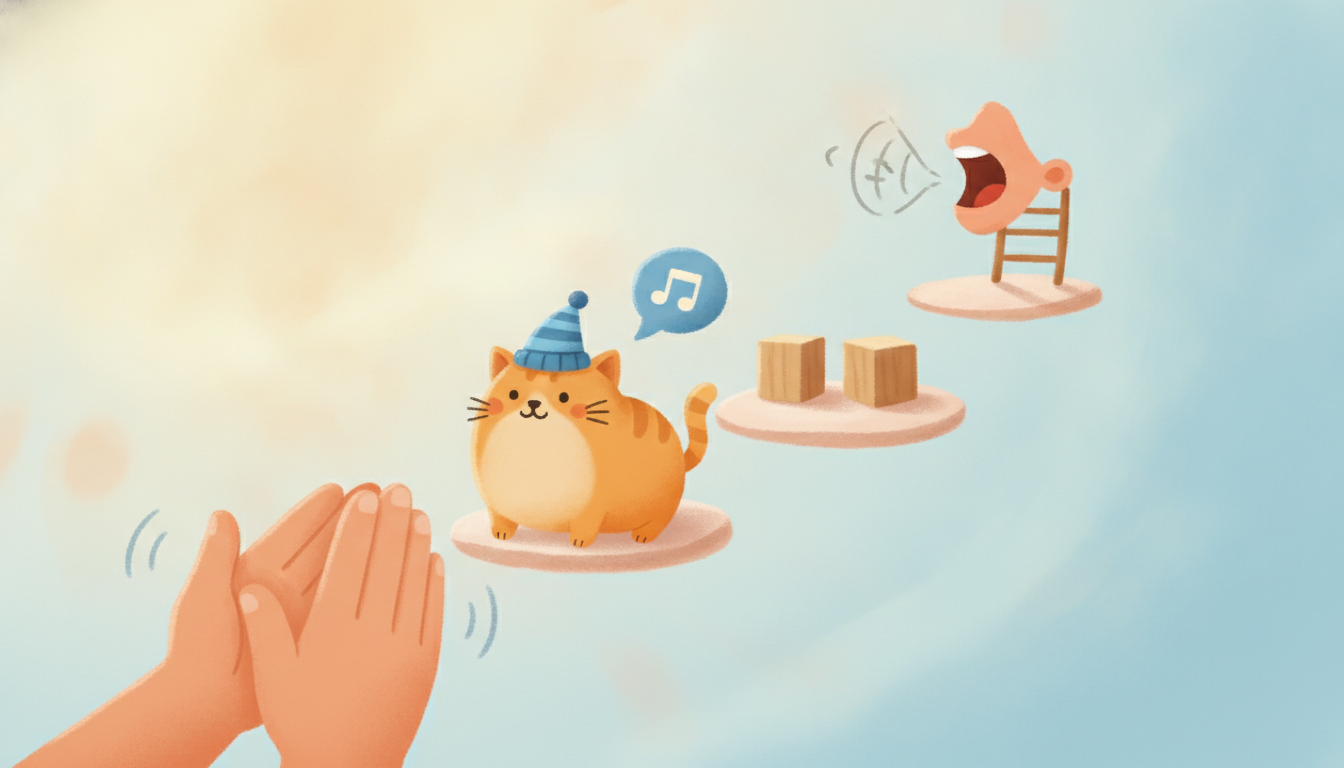
Sound awareness doesn't arrive all at once. It develops in a fairly predictable sequence, moving from big, easy-to-hear chunks down to the smallest, trickiest units of sound. What follows is a typical order — a map of the territory, not a checklist with deadlines.
Hearing words inside a sentence
It usually starts with words. A child begins to hear that a sentence is made of separate words — that "I want milk" is three distinct things, not one long sound. This seems obvious to adults but is genuinely a skill children develop.
Syllables
Next come syllables — the beats or chunks inside a word. Children can often clap along to a name or a song before they can do anything else with sounds. "Rain-bow" is two claps; "el-e-phant" is three.
Rhyme
Rhyme comes in around the same time or shortly after. A child starts to notice and enjoy the fact that "cat," "hat," and "sat" all share an ending sound — and they delight in making up silly rhymes, even nonsense ones, which is exactly the kind of play that builds this skill. This is one reason rhyme-rich bedtime stories are so valuable at this stage.
First sounds
Then comes attention to the first sound of a word — hearing that "fish" and "phone" start the same way, or that "dog" starts differently from "cat." This is sometimes called initial sound awareness.
Blending
After that, blending: a child can take sounds that are stretched out — /m/... /oo/... /n/ — and snap them together into a real word: "moon." This is a huge step toward reading.
Segmenting
Then comes segmenting — pulling a word apart into its individual sounds. "Ship" becomes /sh/... /i/... /p/. This is the heart of phonemic awareness and is harder than blending for most children.
Manipulating sounds
Finally, the most advanced skill: manipulating sounds — swapping one sound out for another. "What do you get if you change the /k/ in 'cat' to /b/?" This level of flexibility with sound is a strong predictor of reading ease down the road. You can read more about how this connects to the broader stages of reading development when you're ready to zoom out.
What It Looks Like When This Skill Is Still Coming Together
Children whose sound awareness is still developing often show it in ways that are easy to miss — or to chalk up to just being young or silly.
- You might notice your child mishears words in songs or fills in a lyric with something that sounds close but isn't quite right, because they're processing the sound stream in larger chunks than the actual words.
- Rhyming games might feel confusing — they might offer a word that starts the same as the target word rather than one that ends the same, because distinguishing between "starts like" and "ends like" is a real cognitive task.
- They might struggle to clap or tap along to the syllables in a name, especially a longer one, even if they can say the name perfectly well. Saying and hearing are different skills.
- They might have a hard time playing I-Spy by sound. If you say "I spy something that starts with /s/," they might look for something that starts with the letter S rather than something that starts with that sound — or they might not be sure what you mean at all.
None of these things are causes for alarm on their own. They're simply signs that the ear is still tuning itself. The best response is more playful practice, not pressure. If you have ongoing concerns after a few months of regular sound play at home, a conversation with your child's teacher is always a reasonable next step.
Why This Skill Matters So Much for Reading
Here's the moment that makes phonological awareness worth understanding: your child is reading a book, and they hit a word they've never seen before. What happens next depends enormously on whether they can hear the sounds inside words.
A child with strong sound awareness can break that unfamiliar word into parts in their head — they hear the chunks, they blend the sounds, they test the result against words they already know from spoken language. The word clicks into place.
A child whose sound awareness is still shaky has a much harder time doing that. The letters on the page might as well be a locked door, because they don't yet have the key that phonics instruction is trying to hand them. This is exactly the challenge described in the guide on decoding words — and it starts well before a child ever picks up a book.
Strong phonological awareness also supports spelling, because spelling is essentially the reverse of reading. Instead of turning print into sound, a child turns sound into print. Both directions require the same underlying skill: the ability to hear a word as a sequence of distinct sounds. And once words stop costing so much effort to get off the page, attention is freed up for meaning, which is where reading comprehension takes over.
The good news
This skill is genuinely buildable through play, conversation, and the kind of low-stakes sound games that feel nothing like schoolwork. You don't need a curriculum. You need a few minutes and a willingness to be a little silly. The picture book on the nightstand is a good place to start: dialogic reading turns the story itself into the conversation.
Six Sound Games You Can Play Anywhere
These work in the car, at the dinner table, in a grocery line, or while you're doing the dishes. Each one takes about two minutes and requires nothing but your voice.

Game 1
What you do: Clap once for every chunk you hear in a family member's name. Try your own name, then your child's, then grandma's.
Sound skill it builds: Syllables
Game 2
What you do: Say two words and ask whether they end the same, then let your child throw a silly non-word back at you. The sillier, the better — nonsense rhymes count.
Sound skill it builds: Rhyme
Game 3
What you do: Play I-Spy using the first sound of the object instead of its first letter or color. "I spy something that starts with /t/."
Sound skill it builds: First sounds
Game 4
What you do: Say a word stretched into slow motion — "/mmm/... /oo/... /n/" — and let your child snap it back together into a real word.
Sound skill it builds: Blending
Game 5
What you do: Say a short word and ask your child to say it back one sound at a time, tapping a finger for each sound they hear.
Sound skill it builds: Separating sounds
Game 6
What you do: Say a word, then ask what it becomes with one sound swapped for another. "What do you get if you change the /k/ in 'cat' to /b/?"
Sound skill it builds: Swapping sounds
One More Thing Worth Knowing
The best fuel for phonological awareness is a child who loves the sound of language — who wants to hear stories again and again, who asks for the same song on repeat, who laughs at a good rhyme.
Motivation matters. A child who is genuinely interested in a story will listen more carefully, engage more deeply with the sounds of the words, and ask more questions — all of which quietly build sound awareness without either of you realizing it. This is one reason story books have such an outsized effect on early language development.
If you want to use that natural enthusiasm, LoveToRead lets you turn your child's own interests into a personalized story they'll want to hear over and over. A story your child is already invested in is one they'll listen to closely — and close listening is exactly what phonological awareness needs to grow.
Beyond that, the most powerful thing you can do is keep talking, keep singing, keep playing with words in the car and at the dinner table. You're already doing more than you think.
Quick Answers to Questions Parents Often Have
Do I need to buy anything to help with this?
No. Every game in this guide requires only your voice and a few minutes. Sound awareness is built through conversation and play, not products.
Should I be correcting my child when they get a sound game wrong?
Not in a way that feels like a test. Keep it light — if they miss a rhyme, just say the rhyming pair again with a little exaggeration and move on. The goal is exposure and enjoyment, not accuracy under pressure.
My child already knows some letters. Does that mean phonological awareness is handled?
Not necessarily. Letter knowledge and sound awareness develop alongside each other but are separate skills. A child can know every letter name and still need more practice hearing the sounds inside words. The two will eventually work together — but one doesn't automatically cover for the other.
How often should we do these games?
A few minutes several times a week is far more useful than one long session. Short, regular, playful practice — during a car ride, while setting the table, waiting in a line — is exactly the right approach. Consistency matters more than duration.
What if I'm still worried after trying these things at home?
Talk to your child's teacher. They can tell you whether what they're seeing at school matches what you're seeing at home, and they can suggest next steps that are specific to your child. You can also look at the broader picture of reading fluency to understand where sound awareness fits into the longer arc of learning to read.
You Know More Than You Did an Hour Ago
Phonological awareness is just sound — and sound is something you and your child are already swimming in every day. The games are simple, the moments are everywhere, and you don't need anything but your voice to get started. Keep talking, keep playing, keep listening together.