The Book Closes. You Ask. They Say "I Dunno."
Here's what's actually happening — and the small shift that turns a dead end into a real story retelling.
What's Really Going On When Your Child Says "I Dunno"
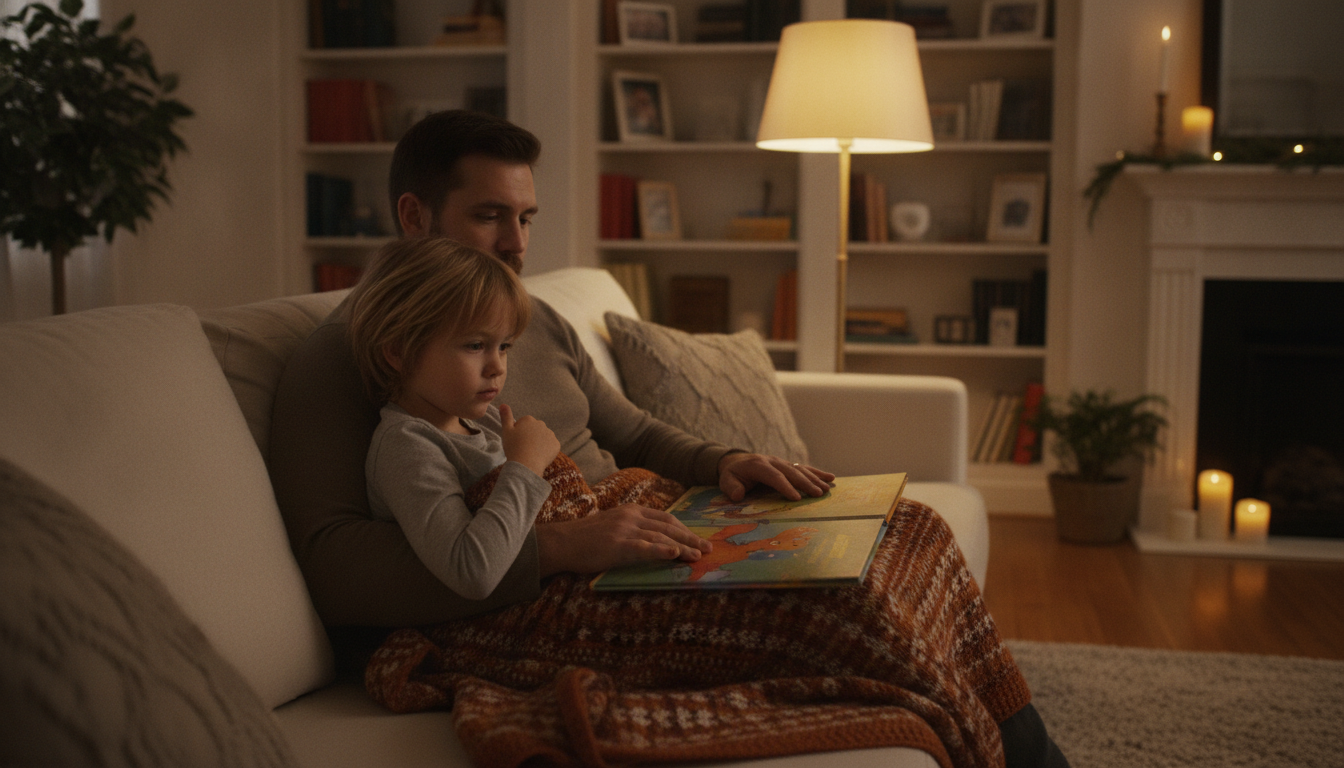
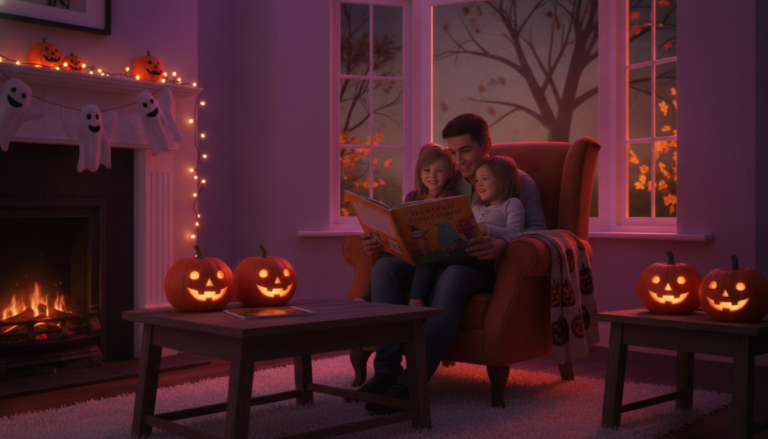
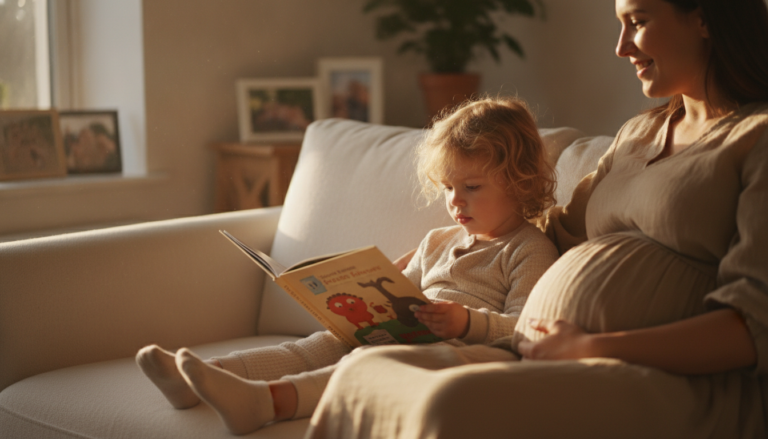
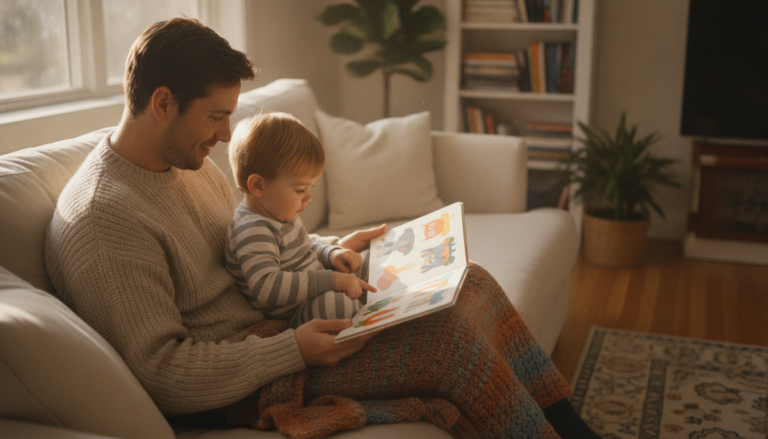
Picture it: the two of you are on the couch, the book is warm in your hands, the last page just turned. You close the cover and you ask, naturally, the thing most parents ask: "What was that about?" And your child — who was leaning into you thirty seconds ago, who gasped at the right moment, who pointed at the pictures — shrugs and says, "I dunno."
It feels like they weren't paying attention. It feels like the whole read-aloud went in one ear and out the other. But here is the thing: they were listening. They heard every word. They felt every feeling. They were right there in that story with you, all the way to the end.
The problem isn't their listening. The problem is the question.
"What was that about?" is a closed question. It has one correct answer, it sounds like a quiz, and a child who isn't sure they know the exact right answer will opt out rather than risk being wrong. That's not laziness or inattention — that's a completely reasonable response to a question that feels like a test.
A closed question puts your child in the audience seat. An open question hands them the storyteller's chair — and that is a completely different invitation, one that almost no child refuses.
Story retelling isn't a test of whether your child listened. It's a conversation you're starting, and like any good conversation, it depends entirely on how you open it. Once you see the difference between a question that closes down and a question that opens up, you'll never go back to "What was it about?" — because you'll have something so much better.
Why Telling It Back Actually Matters
Before we get to the questions themselves, it's worth understanding why story retelling is worth your time at all — not in a school-report way, but in a real, couch-level way.
When your child retells a story in their own words, they're not just repeating what happened. They're rebuilding the whole thing inside their head, which is how comprehension actually works. Reading the words aloud is the first pass; retelling is where meaning gets made. The story stops being a sequence of events and becomes something they actually understood and can hold onto.
Retelling also helps children hold onto new vocabulary in a way that passive listening doesn't. A word they heard in the book becomes a word they use when they describe what happened — and that's the moment it starts to belong to them. This is one of the quieter, more powerful reasons that reading comprehension and vocabulary grow together so naturally when children talk about books.
Then there's story sequence — the sense that things happen in a particular order for particular reasons. The more a child talks through what happened next and why, the stronger that sense of narrative logic becomes. It's the same logic they'll eventually use when they learn to write their own stories.
And beyond all of that, it's just good conversation — the kind where your child gets to be the expert, the one who knows things you need to know. That feeling of being the person with the knowledge is worth a great deal on its own. If you're already building a storytelling ritual before bedtime, adding a simple retelling question is the most natural next step.
Why Retelling Matters — in Plain Terms
It deepens comprehension by making your child rebuild the story in their own mind.
It moves new vocabulary from "heard it" to "actually mine."
It builds story sequence — the sense that events happen in order for reasons.
It lays the groundwork for writing, long before a pencil is ever picked up.
It gives your child the storyteller's chair, which is a genuinely good place to sit.
What Most Parents Ask vs. What Actually Gets a Retelling
The comparison below isn't about tricking your child or using a script. It's about noticing that some questions hand the answer back to the child while others demand the child hand the answer to you — and those two things feel completely different when you're five.
The questions most parents reach for automatically are often the ones that were asked of us when we were kids. They're familiar, they feel logical, and they almost always produce a one-word answer or a shrug. The questions in the right column do something different: they assume your child has something interesting to say and simply need a way in.
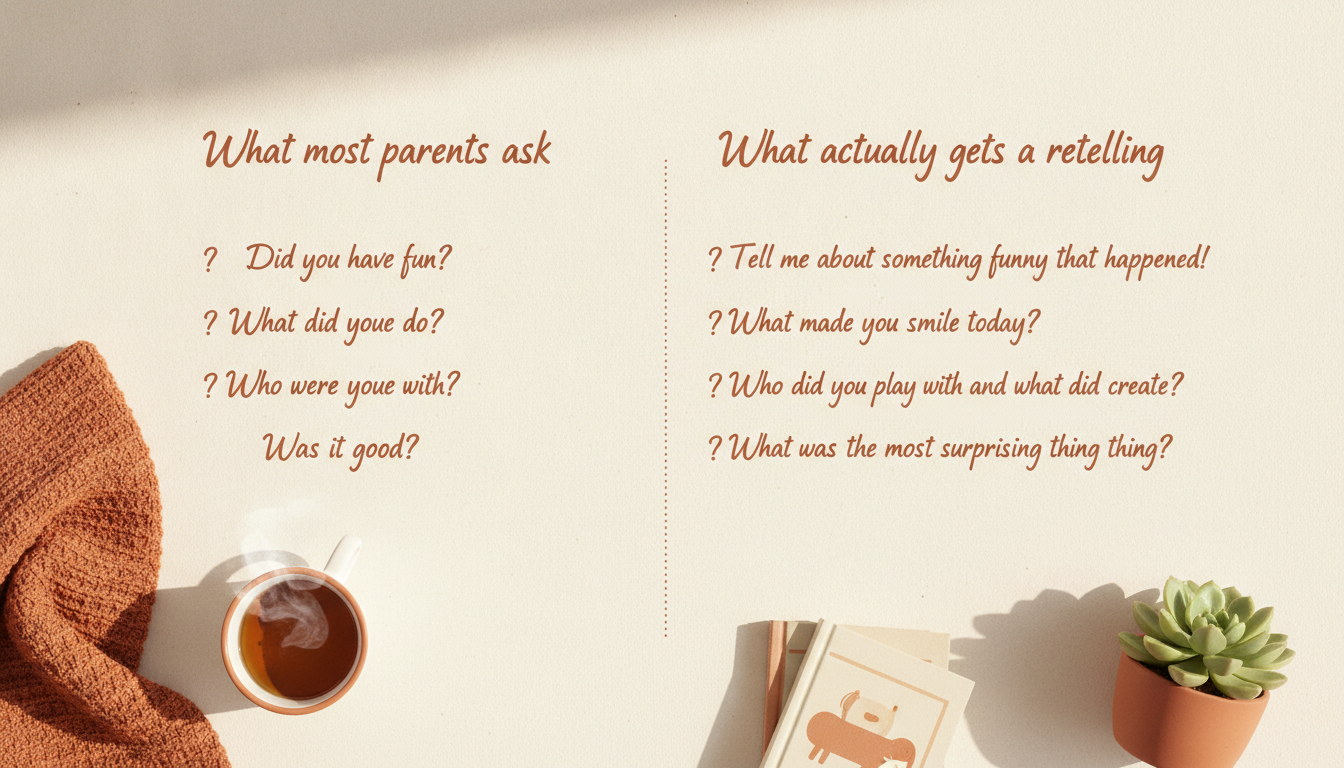
Six Questions, Side by Side
| What most parents ask | What actually gets a retelling |
|---|---|
| What happened in the story? | Who was in trouble, and how did that start? |
| Did you like it? | Which part would you change if you could? |
| What was it about? | Tell it to me like I have never read it before. |
| Who was the main character? | Who wanted something, and did they get it? |
| What happened at the end? | How did they fix it? |
| Can you tell me the story? | Start with the part you remember best. |
Notice that "Start with the part you remember best" is almost impossible to get wrong, which is exactly why it works so well. There is no wrong answer. Every child remembers something, and whatever they remember is the perfect starting point for a retelling.
"Tell it to me like I have never read it before" is equally powerful because it gives your child a real reason to tell the story — you need the information. They are doing you a favour. That shift in purpose, from performing for you to informing you, changes the whole dynamic.
You don't need to use all six. Pick one or two that feel natural to you, try them after your next read-aloud, and pay attention to how differently the conversation goes. The goal is to position your child as the storyteller — the one with the knowledge — rather than the student being checked. That shift in role is everything.
When the Retelling Stalls: What to Do Next
Every retelling stalls at some point. Your child is rolling along — they've got the main character, they're describing what happened next, they're doing brilliantly — and then they stop. They look at the ceiling. They go quiet. This is completely normal and it doesn't mean they've run out. It usually means they're searching, and searching takes a moment.
The best prompt to restart a stalled retelling is a gentle, specific nudge that points back into the story without giving the answer away. Something like "And then what did they do about that?" or "Do you remember what happened right after that part?" gives them a handhold without taking over. It says: I'm still here, I'm still listening, keep going.
Finishing their sentence for them feels helpful in the moment but almost always ends the retelling. When you supply the word or the event they were reaching for, you've stepped back into the storyteller's chair — and they quietly step out of it, often for good, for that session. The retelling was theirs. The moment you complete it, it becomes yours.
Silence is your friend here, even when it doesn't feel like it. Most adults jump in after about three seconds of quiet. Try letting it run to eight or ten. That extra space is often exactly what a child needs to find the next piece of the story on their own.
If the retelling truly stops and doesn't restart, that's fine too. You can say "I loved that part too" or "That was my favorite bit" and let it be a conversation rather than a performance. Tomorrow is another book and another chance. The point was never to extract a perfect retelling — the point was to talk about a story together, and that already happened.
Out-of-Order Retellings: Leave Them Alone
Your child starts the retelling in the middle, jumps to the end, circles back to something from the beginning, and then tells you a detail you're pretty sure they made up. This is not a problem. This is exactly what a developing retelling looks like.
Story sequence — the ability to tell a story in order from beginning to end — is one of the last pieces of retelling to arrive, not the first. Expecting a young child to tell it back in perfect chronological order is like expecting them to run before they've gotten comfortable walking. The sequence comes with time, and it comes through practice — through many more retellings, many more books, many more couch conversations exactly like this one.
When you stop a retelling to correct the order — "No, wait, that happened before the other part" — you are almost always ending the retelling entirely. The child's focus shifts from the story to their performance, and the storytelling impulse quietly shuts down. What felt like a helpful correction felt, from their side, like a wrong answer.
An out-of-order retelling that covers the main events, the feeling of the story, and what happened to the main character is a genuinely good retelling. The order is a detail. The content is the win. This is worth repeating to yourself the next time you feel the urge to rearrange what they're telling you.
A Useful Move for After the Retelling
If order matters to you in a particular moment, reflect it back gently after they've finished: "So first this happened, and then that, and at the end they did this — did I get it right?" That way the sequence is there, but it comes after the retelling, not during it. The storytelling stays theirs.
Retelling Without the Book: Dinner, the Car, Bath Time
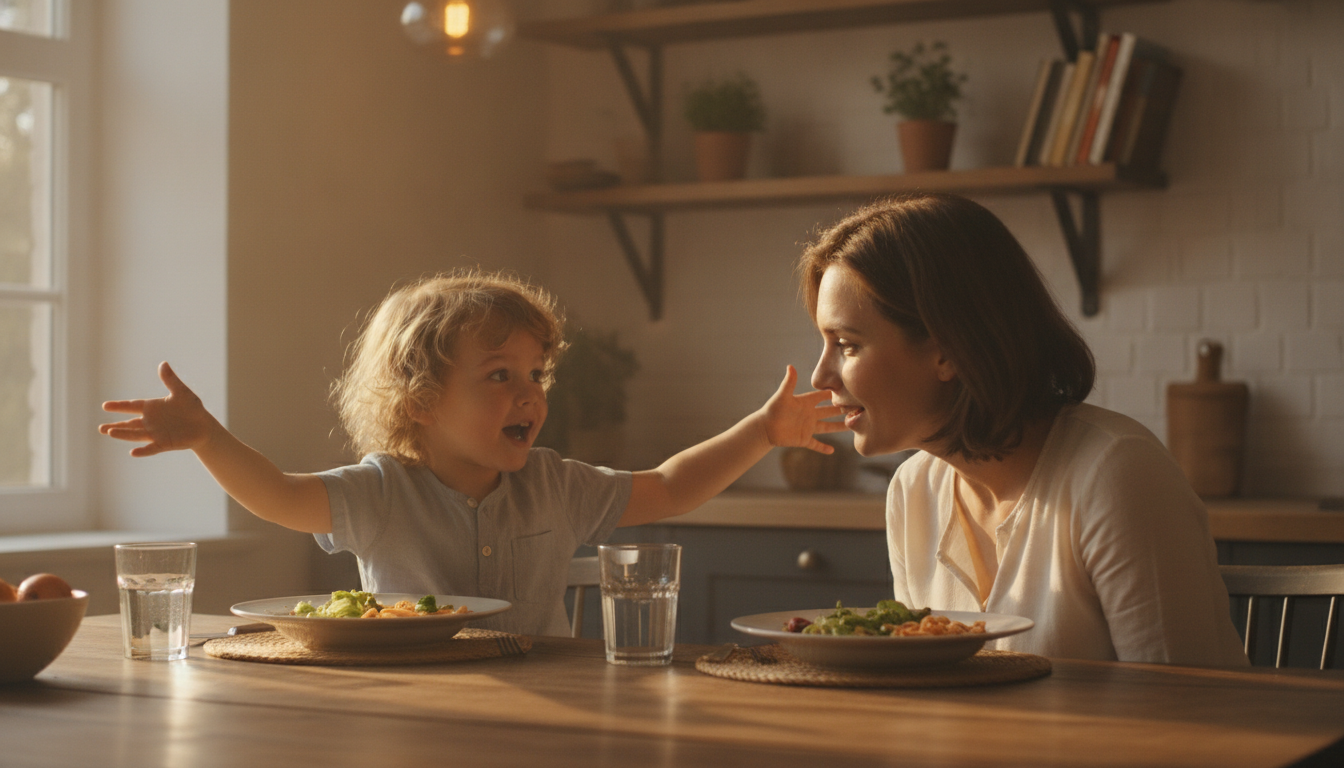
Some of the best story retelling happens hours after the book is closed, when your child has had time to let the story settle. Bringing it up at dinner — "Hey, tell Dad what that story was about that we read earlier" — gives them a real audience and a real reason to tell it. A new listener who genuinely doesn't know the story is the best possible prompt. If you want stories built for this, short tales with a clear beginning, middle, and lesson are the easiest to tell back — our set of short moral stories for kids gives your child a shape to hang the retelling on.
The car is a particularly good place for retelling because there's no eye contact, which takes the pressure off. A child who clams up on the couch will often talk freely when you're both looking at the road. "Tell me that story again, I want to remember it" is all you need. The movement, the forward motion, the absence of a face to perform for — it all adds up to a more relaxed retelling.
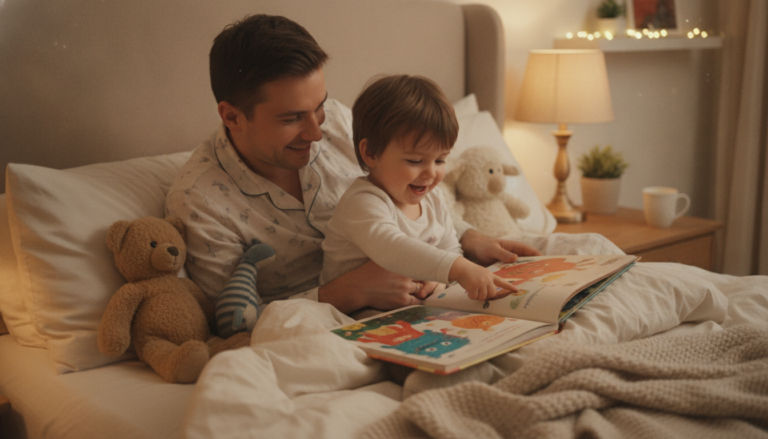
Bath time works because it's relaxed and there's nothing to do but talk. You can ask "What do you think happened to them after the story ended?" and get a retelling that turns into its own new story — which is even better than a straight retelling, because your child is now using the story as a launching pad for their own imagination. That's exactly how images and stories build creative thinking over time.
Returning to the same story more than once is not repetition for its own sake. Each time your child retells a story, the retelling gets a little more complete, a little more ordered, a little more their own. Familiar stories are good stories for retelling practice — the comfort of knowing the story frees up the cognitive space to tell it well. If you're looking for stories worth returning to again and again, short bedtime stories are ideal for exactly this kind of repeated, relaxed retelling.
You don't need to announce that you're doing retelling practice. You're just talking about a story you both loved, and that's enough. The learning is in the conversation, and the conversation is just the two of you.
A Note on Dialogic Reading
Story retelling after the book closes is one half of a larger conversation about books. The other half happens during the read-aloud itself — pausing to ask questions, pointing at pictures, wondering aloud about what might happen next. This approach, sometimes called dialogic reading, turns a read-aloud into a back-and-forth conversation, and it makes the retelling that follows feel much more natural. When a child has been talking during the book, talking after it is simply the next thing — not a test, just more of the same good conversation.
Frequently Asked Questions
What if my child says "I don't know" to every open question too?
Try making it even more specific and low-stakes: "What was the funniest part?" or "Was there a scary moment?" Single-feeling questions are easier to answer than plot questions, and they often get the retelling started from a side door. Once your child answers a feeling question, the story usually follows naturally behind it.
Does it count as retelling if they mostly act it out instead of saying the words?
Absolutely. Acting out a story is retelling in its fullest form — your child is sequencing events, embodying characters, and recreating the emotional arc of the story with their whole body. Narrate along with them if you like: "Oh, so now what's happening?" You're still getting the retelling; it's just in motion rather than words.
What if they retell it completely wrong — like they've mixed it up with a different story?
Go with it. Ask questions that gently bring them back: "Hmm, was that in this story or the other one we read?" But if they're happily blending two stories together, that's creative and that's fine. Comprehension isn't just recall — it's the ability to make meaning, and meaning-making sometimes looks like mixing things together in interesting ways.
How long should a retelling be?
As long as it lasts. A two-sentence retelling from a child who was reluctant to start is a success. A ten-minute retelling with voices and made-up extra scenes is a success. The goal is the conversation, not the length or the completeness. Any retelling is better than no retelling, and any retelling is better than a quiz.
Should I read the same book more than once to help with retelling?
Yes, and enthusiastically. A second or third reading gives your child more material to work with, more confidence in the details, and more ownership of the story. Familiarity is not the enemy of retelling — it's the foundation of it. If you're looking for books worth revisiting, books for four-year-olds and stories for elementary readers both have strong picks for repeated read-alouds.
What if my child is a reluctant talker in general?
Start with the car or bath time rather than the couch — the lower-pressure setting makes a real difference. Use the feeling questions first. And remember that reluctant readers and reluctant talkers often open up when the story itself is the right fit. A story they genuinely loved is always the easiest one to retell.
Putting It Together
Story retelling doesn't require a special setup, a particular time of day, or any materials at all. It requires one open question and a willingness to let your child be the one who knows things. That's it.
The next time the book closes and you feel the urge to ask "What was that about?", swap it for "Start with the part you remember best" or "Tell it to me like I've never read it before." Then wait. Let the silence run a little longer than feels comfortable. You'll be surprised — often delighted — by what comes next.
An out-of-order retelling is still a retelling. A two-sentence retelling is still a retelling. A retelling that turns into a completely made-up story is still a retelling. Whatever your child gives you, it's more than "I dunno" — and it's the beginning of a reading life where books don't just get read, they get talked about, turned over, lived in.
That's the real point of all of this. Not the comprehension, not the vocabulary, not the story sequence — though all of those things are happening quietly in the background. The point is that you and your child are talking about a story together, and that is one of the best things the two of you can do.
Tonight, Try Just One Question
When the book closes tonight, pick one question from the open column and hand your child the storyteller's chair. You might be surprised how much they were listening all along. And if you want a story that is unusually easy to tell back, try one your child is actually in — a personalized book from LoveToRead hands them a story they were already inside of.
3 Comments
Comments are closed.